EFFECTS OF METHANOL MODIFICATION ON THE PHYSICOCHEMICAL PROPERTIES OF COCONUT SHELL BIOCHAR
DOI:
https://doi.org/10.11113/jurnalteknologi.v89.23077Keywords:
coconut shell biomass, biochar, self-sustained carbonization, methanol modification, BET surface areaAbstract
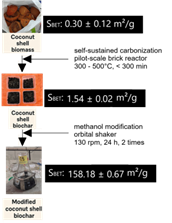
Production of biochar for nano-adsorbents requires advanced technology and substantial energy input for large-scale production. This study evaluated the impact of surface modification using methanol on the properties of coconut shell biochar after low energy self-sustained carbonization. Methanol serves as a mild modifier that may alter surface polarity, improve pore accessibility, and enhance the availability of active sites for adsorption without complex processing. Self-sustained carbonization was carried at 300–500 °C for less than 300 minutes at low retention times. Subsequently, the produced biochar was modified by mixing it with methanol at 130 rpm for 24 hours. The modified biochar showed significant improvements, where BET surface area increased from 1.54 ± 0.02 to 158.18 ± 0.67 m²/g and total pore volume from 0.0005 ± 0.004 to 0.09 ± 0.06 cm³/g. This was supported by SEM images which indicate pore network development with increased porosity and surface roughness, suggesting the modified biochar’s potential as an adsorbent. These results underscore the feasibility of developing effective adsorbents through appropriate technology for the coconut industry and environmental protection.
References
[1] J. O. Ighalo et al., “Biochar from coconut residues: An overview of production, properties, and applications,” Ind. Crop. Prod., vol. 204, no. PA, p. 117300, 2023, doi: 10.1016/j.indcrop.2023.117300.
[2] E. Taer, R. Taslim, A. W. Putri, A. Apriwandi, and A. Agustino, “Activated carbon electrode made from coconut husk waste for supercapacitor application,” Int. J. Electrochem. Sci., vol. 13, no. 12, pp. 12072–12084, 2018, doi: 10.20964/2018.12.19.
[3] MOPC, “National Biomass Action Plan 2023-2030.” Ministry of Plantation and Commodities, Putrajaya, Malaysia, pp. 1–22, 2023.
[4] C. H. Goh, “Green energy source going to waste,” The Star, Petaling Jaya, Sep. 24, 2018.
[5] N. Ferronato and V. Torretta, “Waste mismanagement in developing countries: a review of global issues,” Int. J. Environ. Res. Public Health, vol. 16, no. 1060, pp. 1–28, 2019, doi: 10.3390/ijerph16061060.
[6] J. Lehmann, “Black carbon decomposition under varying water regimes,” Org. Geochemical, vol. 40, p. 846, 2009.
[7] A. Ajien, J. Idris, N. Md Sofwan, R. Husen, and H. Seli, “Coconut shell and husk biochar: A review of production and activation technology, economic, financial aspect and application,” Waste Manag. Res. J. a Sustain. Circ. Econ., vol. 41, no. 1, pp. 37–51, Jan. 2023, doi: 10.1177/0734242X221127167.
[8] J. Idris et al., “Improved yield and higher heating value of biochar from oil palm biomass at low retention time under self-sustained carbonization,” J. Clean. Prod., vol. 104, pp. 475–479, Oct. 2015. doi: 10.1016/j.jclepro.2015.05.023.
[9] M. H. Samsudin et al., “A one-step self-sustained low temperature carbonization of coconut shell biomass produced a high specific surface area biochar-derived nano-adsorbent,” Waste Manag. Res. J. a Sustain. Circ. Econ., vol. 37, no. 5, pp. 551–555, May 2019, doi: 10.1177/0734242X18823953.
[10] J. Idris et al., “Improved yield and higher heating value of biochar from oil palm biomass at low retention time under self-sustained carbonization,” J. Clean. Prod., vol. 104, pp. 475–479, Oct. 2015, [Online]. Available: https://linkinghub.elsevier.com/retrieve/pii/S0959652615005697.
[11] M. H. Samsudin et al., “Production of nanopore structure bio-adsorbent from wood waste through a self-sustained carbonization process for landfill leachate treatment,” Biochem. Eng. J., vol. 189, no. September, p. 108740, 2022, doi: 10.1016/j.bej.2022.108740.
[12] J. Idris et al., “Self-sustained carbonization of oil palm biomass produced an acceptable heating value charcoal with low gaseous emission,” J. Clean. Prod., vol. 89, pp. 257–261, Feb. 2015, doi: 10.1016/j.jclepro.2014.11.016.
[13] N. Hasana, R. Wahi, and Y. Yusof, “Ethanol, methanol, and magnesium-treated palm kernel shell biochar for methylene blue removal: adsorption isotherms,” Int. J. Curr. Res. Rev., vol. 13, no. 4, pp. 02–11, 2021, doi: 10.31782/IJCRR.2021.SP130.
[14] W. C. Oh, “Surface transition by solvent washing effects and biological properties of metal treated activated carbons,” Bull. Korean Chem. Soc., vol. 25, no. 5, pp. 639–646, 2004, doi: 10.5012/bkcs.2004.25.5.639.
[15] X. R. Jing, Y. Y. Wang, W. J. Liu, Y. K. Wang, and H. Jiang, “Enhanced adsorption performance of tetracycline in aqueous solutions by methanol-modified biochar,” Chem. Eng. J., vol. 248, pp. 168–174, 2014, doi: 10.1016/j.cej.2014.03.006.
[16] T. Ai, X. Jiang, Z. Zhong, D. Li, and S. Dai, “Methanol-modified ultra-fine magnetic orange peel powder biochar as an effective adsorbent for removal of ibuprofen and sulfamethoxazole from water,” Adsorpt. Sci. Technol., vol. 38, no. 7–8, pp. 304–321, 2020, doi: 10.1177/0263617420944659.
[17] G. Murtaza et al., “Recent trends and economic significance of modified/functionalized biochars for remediation of environmental pollutants,” Sci. Rep., vol. 14, no. 1, p. 217, Jan. 2024, doi: 10.1038/s41598-023-50623-1.
[18] P. . Rangari and P. Chavan, “Preparation of activated carbon from coconut shell,” Int. J. Innov. Res. Sci. Eng. Technol., vol. 6, no. 7, pp. 220–225, 2017.
[19] S. J. Gregg and K. S. . Sing, Adsorption, Surface Area, and Porosity, 2nd Ed. New York, United States of America: Academic Press Incorporation, 1982.
[20] H. Kaur, B. Rana, D. Tomar, S. Kaur, and K. C. Jena, Fundamentals of ATR-FTIR Spectroscopy and Its Role for Probing In-Situ Molecular-Level Interactions, vol. 13, no. April. Springer Singapore, 2021.
[21] J. Coates, “Interpretation of Infrared Spectra, A Practical Approach,” Encycl. Anal. Chem., pp. 1–23, 2006, doi: 10.1002/9780470027318.a5606.
[22] K. Yadav and S. Jagadevan, “Influence of Process Parameters on Synthesis of Biochar by Pyrolysis of Biomass: An Alternative Source of Energy,” in Recent Advances in Pyrolysis, IntechOpen, 2020, pp. 1–14.
[23] F. Amalina, A. S. A. Razak, S. Krishnan, A. W. Zularisam, and M. Nasrullah, “A comprehensive assessment of the method for producing biochar, its characterization, stability, and potential applications in regenerative economic sustainability – A review,” Clean. Mater., vol. 3, no. September 2021, p. 100045, 2022, doi: 10.1016/j.clema.2022.100045.
[24] M. Amer and A. Elwardany, Biomass Carbonization. 2020.
[25] R. K. Ahmad, S. A. Sulaiman, S. Yusup, S. S. Dol, M. Inayat, and H. A. Umar, “Exploring the potential of coconut shell biomass for charcoal production,” Ain Shams Eng. J., vol. 13, no. 1, p. 101499, Jan. 2022, doi: 10.1016/j.asej.2021.05.013.
[26] M. Inayat, S. A. Sulaiman, and M. Y. Naz, “Thermochemical characterization of oil palm fronds, coconut shells, and wood as a fuel for heat and power generation,” MATEC Web Conf., vol. 225, 2018, doi: 10.1051/matecconf/201822501008.
[27] V. Dhyani and T. Bhaskar, “Pyrolysis of Biomass,” in Biofuels: Alternative Feedstocks and Conversion Processes for the Production of Liquid and Gaseous Biofuels, 2nd ed., A. Pandey, C. Larroche, E. Gnansounou, S. K. Khanal, C.-G. Dussap, and S. Ricke, Eds. Amsterdam, Netherlands: Elsevier: Amsterdam, Netherlands, 2019, pp. 217–244.
[28] C. F. Núnez, J. Jochum, and F. Sierra Vargas, “Characterization and feasibility of biomass fuel pellets made of Colombian timber, coconut and oil palm residues regarding European standards,” Environ. Biotechnol., vol. 8, no. 2, pp. 67–76, 2012.
[29] A. Tomczyk, Z. Sokołowska, and P. Boguta, “Biochar physicochemical properties: pyrolysis temperature and feedstock kind effects,” Rev. Environ. Sci. Biotechnol., vol. 19, no. 1, pp. 191–215, Mar. 2020, doi: 10.1007/s11157-020-09523-3.
[30] A. G. Adeniyi, K. O. Iwuozor, E. C. Emenike, O. J. Ajala, S. Ogunniyi, and K. B. Muritala, “Thermochemical co-conversion of biomass-plastic waste to biochar: a review,” Green Chem. Eng., vol. 5, no. 1, pp. 31–49, Mar. 2024, doi: 10.1016/j.gce.2023.03.002.
[31] N. Schapiro and E. J. Moreau, “Deashing Process of Coal,” 19, 1986.
[32] Á. D. G. Llamas, N. Guo, T. Li, R. Gebart, and K. Umeki, “Rapid change of particle velocity due to volatile gas release during biomass devolatilization,” Combust. Flame, vol. 238, p. 111898, Apr. 2022, doi: 10.1016/j.combustflame.2021.111898.
[33] J. G. O’Neill, “The Volatile Matter of Coal,” J. Am. Soc. Nav. Eng., vol. 28, no. 1, pp. 11–19, Feb. 1916, doi: 10.1111/j.1559-3584.1916.tb00597.x.
[34] Y. Y. Gan et al., “Torrefaction of microalgal biochar as potential coal fuel and application as bio-adsorbent,” Energy Convers. Manag., vol. 165, no. March, pp. 152–162, 2018, doi: 10.1016/j.enconman.2018.03.046.
[35] J. Lehmann and S. Joseph, Biochar for environmental management : science and technology. Earthscan, 2009.
[36] Q. Liu, F. Takemura, and A. Yabe, “Solubility of hydrogen in liquid methanol and methyl formate at 20 °C to 140 °C,” J. Chem. Eng. Data, vol. 41, no. 5, pp. 1141–1143, 1996, doi: 10.1021/je9601321.
[37] T. Sato, Y. Hamada, M. Sumikawa, S. Araki, and H. Yamamoto, “Solubility of oxygen in organic solvents and calculation of the Hansen solubility parameters of oxygen,” Ind. Eng. Chem. Res., vol. 53, no. 49, pp. 19331–19337, 2014, doi: 10.1021/ie502386t.
[38] S. Xu et al., “Effect of biomass type and pyrolysis temperature on nitrogen in biochar, and the comparison with hydrochar,” Fuel, vol. 291, no. October 2020, p. 120128, 2021, doi: 10.1016/j.fuel.2021.120128.
[39] T. Katayama and T. Nitta, “Solubilities of Hydrogen and Nitrogen in Alcohols and n-Hexane,” J. Chem. Eng. Data, vol. 21, no. 2, pp. 194–196, 1976, doi: 10.1021/je60069a018.
[40] J. O. Ighalo et al., “Biochar from coconut residues: An overview of production, properties, and applications,” Ind. Crops Prod., vol. 204, no. PA, p. 117300, 2023, doi: 10.1016/j.indcrop.2023.117300.
[41] J. H. Windeatt, A. B. Ross, P. T. Williams, P. M. Forster, M. A. Nahil, and S. Singh, “Characteristics of biochars from crop residues: Potential for carbon sequestration and soil amendment,” J. Environ. Manage., vol. 146, pp. 189–197, Dec. 2014, doi: 10.1016/j.jenvman.2014.08.003.
[42] N. Khuenkaeo and N. Tippayawong, “Production and characterization of bio-oil and biochar from ablative pyrolysis of lignocellulosic biomass residues,” Chem. Eng. Commun., vol. 207, no. 2, pp. 153–160, Feb. 2020, doi: 10.1080/00986445.2019.1574769.
[43] L. M. R. Millán, F. E. S. Vargas, and A. Nzihou, “Characterization of Steam Gasification Biochars from Lignocellulosic Agrowaste Towards Soil Applications,” Waste and Biomass Valorization, vol. 12, no. 7, pp. 4141–4155, Jul. 2021, doi: 10.1007/s12649-020-01241-9.
[44] D. Nuryana et al., “Methylene blue removal using coconut shell biochar synthesized through microwave-assisted pyrolysis,” J. Teknol., vol. 82, no. 5, pp. 31–41, 2020.
[45] T. Rout, D. Pradhan, R. K. Singh, and N. Kumari, “Exhaustive study of products obtained from coconut shell pyrolysis,” J. Environ. Chem. Eng., vol. 4, no. 3, pp. 3696–3705, 2016, doi: 10.1016/j.jece.2016.02.024.
[46] J. Adorna, M. Borines, V. D. Dang, and R. Doong, “Coconut shell derived activated biochar – manganese dioxide nanocomposites for high performance capacitive deionization,” Desalination, vol. 492, p. 114602, 2020, doi: 10.1016/j.desal.2020.114602.
[47] N. A. Baharum, H. M. Nasir, M. Y. Ishak, N. M. Isa, M. A. Hassan, and A. Z. Aris, “Highly efficient removal of diazinon pesticide from aqueous solutions by using coconut shell-modified biochar,” Arab. J. Chem., vol. 13, no. 7, pp. 6106–6121, 2020, doi: 10.1016/j.arabjc.2020.05.011.
[48] B. Behera, M. S. Selvam, B. Dey, and P. Balasubramanian, “Algal biodiesel production with engineered biochar as a heterogeneous solid acid catalyst,” Bioresour. Technol., vol. 310, p. 123392, 2020, doi: 10.1016/j.biortech.2020.123392.
[49] P. Pituya, T. Sriburi, and S. Wijitkosum, “Properties of biochar prepared from acacia wood and coconut shell for soil amendment,” Eng. J., vol. 21, no. 3, pp. 63–76, 2016, doi: 10.4186/ej.2017.21.3.63.
[50] R. M. Sari, S. Gea, B. Wirjosentono, S. Hendrana, and Y. A. Hutapea, “Improving quality and yield production of coconut shell charcoal through a modified pyrolysis reactor with tar scrubber to reduce smoke pollution,” J. Environ. Study, vol. 29, no. 2, pp. 1815–1824, 2020, doi: 10.15244/pjoes/110582.
[51] A. H. Atienza, J. Orcullo, C. Salamat, and C. Wassmer, “Coconut shell feedstock based top lit updraft gasifier for biochar and heat cogeneration,” J. Phys. Conf. Ser., vol. 1519, p. 012014, 2020, doi: 10.1088/1742-6596/1519/1/012014.
[52] N. R. A. Manap, R. Shamsudin, M. N. Maghpor, M. A. Abdul Hamid, and A. Jalar, “Adsorption isotherm and kinetic study of gas-solid system of formaldehyde on oil palm mesocarp bio-char: pyrolysis effect,” J. Environ. Chem. Eng., vol. 6, no. 1, pp. 970–983, 2018, doi: 10.1016/j.jece.2017.12.067.
[53] B. Sajjadi, W. Chen, and N. O. Egiebor, “A comprehensive review on physical activation of biochar for energy and environmental applications,” Rev. Chem. Eng., vol. 35, no. 6, pp. 735–776, Jul. 2018, doi: 10.1515/revce-2017-0113.
[54] P. R. Yaashikaa, P. S. Kumar, S. Varjani, and A. Saravanan, “A critical review on the biochar production techniques, characterization, stability and applications for circular bioeconomy,” Biotechnol. Reports, vol. 28, p. e00570, 2020, doi: 10.1016/j.btre.2020.e00570.
[55] B. Sajjadi, T. Zubatiuk, D. Leszczynska, J. Leszczynski, and W. Y. Chen, “Chemical activation of biochar for energy and environmental applications: a comprehensive review,” Rev. Chem. Eng., vol. 35, no. 7, pp. 777–815, Oct. 2019, doi: 10.1515/revce-2018-0003.
[56] Y. Zhou et al., “Production and beneficial impact of biochar for environmental application: A comprehensive review,” Bioresour. Technol., vol. 337, no. June, p. 125451, Oct. 2021, doi: 10.1016/j.biortech.2021.125451.
Downloads
Published
Issue
Section
License
Copyright of articles that appear in Jurnal Teknologi belongs exclusively to Penerbit Universiti Teknologi Malaysia (Penerbit UTM Press). This copyright covers the rights to reproduce the article, including reprints, electronic reproductions, or any other reproductions of similar nature.