
THERMAL INPUT EFFECTS ON THE MICROSTRUCTURE AND ELECTRICAL PERFORMANCE OF ZNO-CATIO3 VARISTOR CERAMICS
DOI:
https://doi.org/10.11113/jurnalteknologi.v88.23683Keywords:
Sintering, ZnO varistor, calcium titanate, microstructure, electrical propertiesAbstract
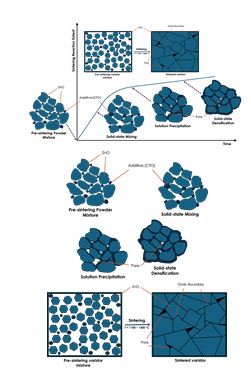
Using a traditional solid-state mixed oxide method, pelletized polycrystalline zinc oxide-based varistor ceramics were prepared with calcium titanate (CaTiO3) doping. This study examined how varying sintering temperatures affect the microstructural and electrical characteristics of the composite varistors. The samples were subjected to sintering temperatures between 1100 and 1300 °C for 90 minutes. X-ray diffraction (XRD) assessment confirmed the presence of two primary phases in the synthesized compound. Scanning electron microscopy (SEM) results showed that higher sintering temperatures promoted ZnO grain growth, increasing the average grain size from 4.66 to 10.42 µm. The average relative density of the synthesized samples exceeded 94% of the theoretical density. These results were determined to correspond with the modification in electrical properties, as the specimen sintered at 1250 °C demonstrated the most favorable electrical response, of which the nonlinear coefficient, breakdown voltage, and barrier height were 3.85, 0.99 V/mm, and 0.66 eV, respectively. The study presented in this paper can be used to discover and develop new and more efficient ZnO suppressors.
References
[1] Drabkin, M. 2002. Surge Protection of Low-Voltage AC Power by MOV-Based SPDs. In Proceedings of the 10th International Conference on Harmonics and Quality of Power. IEEE.
[2] Boumezoued, A., et al. 2019. ZnO Nanopowders Doped with Bismuth Oxide: From Synthesis to Electrical Application. Journal of Alloys and Compounds. 791: 550–58.
[3] Topcagic, Z., and T. E. Tsovilis. 2021. Varistor Electrical Properties: Microstructural Effects. In Encyclopedia of Materials: Technical Ceramics and Glasses. 254–71.
[4] Li, J., et al. 2021. Effects of Pre-Calcination and Sintering Temperature on the Microstructure and Electrical Properties of ZnO-Based Varistor Ceramics. Materials Science in Semiconductor Processing. 123.
[5] Leach, C., Z. Ling, and R. Freer. 2000. The Effect of Sintering Temperature Variations on the Development of Electrically Active Interfaces in Zinc Oxide-Based Varistors. Journal of the European Ceramic Society. 20(16): 2759–65.
[6] Borysiewicz, M. A. 2019. ZnO as a Functional Material: A Review. Crystals. 9(10).
[7] Xie, P., and J. Hu. 2019. Influence of Sintering Temperature and ZrO₂ Dopants on the Microstructure and Electrical Properties of Zinc Oxide Varistors. IEEE Access. 7: 140126–33.
[8] Hewlett, R. M., and M. A. McLachlan. 2016. Surface Structure Modification of ZnO and the Impact on Electronic Properties. Advanced Materials. 28(20): 3893–3921.
[9] Chen, T., et al. 2016. Novel Synthesis of Monodisperse ZnO-Based Core/Shell Ceramic Powders and Applications in Low-Voltage Varistors. Materials & Design. 96: 329–34.
[10] Ghazali, M. S. M., et al. 2016. The Sintering Effect of Lanthanum-Calcium Manganite Doping on Microstructure and Non-Linear Coefficient of Zinc Oxide Varistor. Materials Science Forum. 846: 142–48.
[11] Chen, G.-H., et al. 2015. Sintering Temperature Dependence of Varistor Properties and Impedance Spectroscopy Behavior in ZnO-Based Varistor Ceramics. Journal of Materials Science: Materials in Electronics. 26(4): 2389–96.
[12] Ahmed, Z. W., A. I. Khadim, and A. H. R. Alsarraf. 2019. The Effect of Doping with Some Rare Earth Oxides on Electrical Features of ZnO Varistor. Energy Procedia. 157: 909–17.
[13] Desouky, O. A., and K. E. Rady. 2016. Improvement of Sintering, Nonlinear Electrical, and Dielectric Properties of ZnO-Based Varistors Doped with TiO₂. Chinese Physics B. 25(6).
[14] de Salles, C., et al. 2016. Effects of Operation Temperature in Artificially Aging of Zinc Oxide Varistors by High-Current Short Impulses. Electric Power Systems Research. 134: 145–51.
[15] Bai, H., et al. 2016. Influence of Cr₂O₃ on Highly Nonlinear Properties and Low Leakage Current of ZnO–Bi₂O₃ Varistor Ceramics. Ceramics International. 42(9): 10547–50.
[16] Xie, P., Z. Wang, and K. Wu. 2022. Evolution of Intrinsic and Extrinsic Electron Traps at Grain Boundary during Sintering ZnO-Based Varistor Ceramics. Materials .15(3).
[17] Zhao, X., et al. 2018. Introducing a ZnO–PTFE (Polymer) Nanocomposite Varistor via the Cold Sintering Process. Advanced Engineering Materials. 20(7).
[18] Mahesh, K., et al. 2013. Effect of Two-Step Sintering on Rare Earth (RE = Y₂O₃, Pr₆O₁₁)-Doped ZnO–Bi₂O₃ Varistors Processed from ‘Nano-Precursor’ Powders. Journal of Materials Science: Materials in Electronics. 24(5): 1495–1504.
[19] Ghazali, M. S. M., et al. 2018. Conventional Sintering Effects on the Microstructure and Electrical Characteristics of Low-Voltage Ceramic Varistor. In Sintering Technology—Method and Application.
[20] Badruddin, M. A., et al. 2022. Electrical and Microstructural Evaluation of ZnO Varistor Ceramics with Different CaSiO₃ Contents. Materials Chemistry and Physics. 289.
[21] Zahid, R. 2011. Effect of Temperature Treatment on the Optical Characterization of ZnO–Bi₂O₃–TiO₂ Varistor Ceramics. International Journal of Physical Sciences. 6(6): 1388–94.
[22] Shahraki, M. M., M. A. Bahrevar, and S. M. S. Mirghafourian. 2015. The Effect of TiO₂ Addition on Microstructure and Electrical Properties of SnO₂ Varistors Prepared from Nanomaterials.” Ceramics International. 41(5): 6920–24.
[23] Tairi, L., et al. 2022. Enhanced Photoluminescence and Photocatalytic Activity of Ca²⁺ Addition into ZnS Nanoparticles Synthesized by Hydrothermal Method. Physica B: Condensed Matter. 631: 413713.
[24] Lungu, M. V. 2023. Effects of Dopants and Processing Parameters on the Properties of ZnO–V₂O₅-Based Varistors Prepared by Powder Metallurgy: A Review. Materials. 16(10): 3725.
[25] Wurst, J. 1972. Linear Intercept Technique for Measuring Grain Size in Two-Phase Polycrystalline Ceramics. Journal of the American Ceramic Society. 55: 109.
[26] Mendelson, M. I. 1969. Average Grain Size in Polycrystalline Ceramics. Journal of the American Ceramic Society. 52(8): 443–46.
[27] Anas, S., et al. 2017. Sol-Gel Materials for Varistor Devices. In Sol-Gel Materials for Energy, Environment and Electronic Applications. 23–59. Springer.
[28] Wong, J. 1980. Sintering and Varistor Characteristics of ZnO–Bi₂O₃ Ceramics. Journal of Applied Physics. 51(8): 4453–59.
[29] Mirzayi, M. 2020. The Effect of TiO₂ Concentration on the Electrical and Microstructural Properties of ZnO-Based Varistor Ceramic Prepared from Nanosize ZnO Particles. Advances in Applied Ceramics. 119(7): 373–79.
[30] Bouchekhlal, A., and M. Boulesbaa. 2022. Synthesis and Characterization of ZnO-Based Varistor Ceramics: Effect of Sintering Temperatures. Microelectronics International. 39(3): 110–20.
[31] Richardson, J. J., et al. 2011. Thermally Induced Pore Formation in Epitaxial ZnO Films Grown from Low-Temperature Aqueous Solution. Crystal Growth & Design. 11(8): 3558–63.
[32] Hembram, K., et al. 2021. CaO-Doped ZnO–Bi₂O₃ Varistors: Grain Growth Mechanism, Structure, and Electrical Properties. Ceramics International. 47(1): 1229–37.
[33] Zhang, Y., et al. 2017. Spinel and Post-Spinel Phase Assemblages in Zn₂TiO₄: An Experimental and Theoretical Study. Physics and Chemistry of Minerals. 44(2): 109–23.
[34] Syaizwadi, S. M., et al. 2021. Nonlinearity Characteristics of Low-Voltage Barium Titanate-Based Zinc Oxide Varistor Ceramics Modified by Cobalt Dopants. Journal of Integrated Circuits and Systems. 16(1): 1–7.
[35] Janani, F. Z., et al. 2022. ZnO–Zn₂TiO₄ Heterostructure for Highly Efficient Photocatalytic Degradation of Pharmaceuticals. Environmental Science and Pollution Research. 1–14.
[36] Syaizwadi, S. M., et al. 2018. Effect of Sintering Temperature on Zinc Oxide Varistor Ceramics. In IOP Conference Series: Materials Science and Engineering. IOP Publishing.
[37] Wang, C.-L., et al. 2014. Phase Formation of Zinc Titanate Precursor Prepared by a Hydrothermal Route at pH 5. Ceramics International. 40(5): 7407–15.
[38] Lokesh, B., S. Kaleemulla, and N. M. Rao. 2014. Synthesis and Characterization of Zinc Titanates by Solid-State Reaction. International Journal of ChemTech Research. 6: 1929–32.
[39] Sangeetha, A., et al. 2019. Correlation between Calcination Temperature and Optical Parameter of Zinc Oxide (ZnO) Nanoparticles. Journal of Sol-Gel Science and Technology. 91: 261–72.
[40] Upadhyay, S., K. Parekh, and B. Pandey. 2016. Influence of Crystallite Size on the Magnetic Properties of Fe₃O₄ Nanoparticles. Journal of Alloys and Compounds. 678: 478–85.
[41] Park, J. H., et al. 2015. Analysis of Oxygen Vacancy in Co-Doped ZnO Using the Electron Density Distribution Obtained Using MEM. Nanoscale Research Letters. 10(1): 186.
[42] Cui, F., et al. 2021. Low-Temperature Sintering ZnO–Bi₂O₃-Based Varistor Ceramics with Low Electrical Breakdown Voltage and High Nonlinear Coefficient. Ceramics International. 47(3): 4118–26.
[43] Shaifudin, M. S., et al. 2021. Synergistic Effects of Pr₆O₁₁ and Co₃O₄ on Electrical and Microstructure Features of ZnO–BaTiO₃ Varistor Ceramics. Materials. 14(4).
[44] Akinnifesi, J. O., and O. O. Akinwunmi. 2015. Effect of Sintering Temperature on the Microstructure and Electrical Characteristics of Low-Clamping-Voltage Zinc Oxide-Based Ceramic Varistor. Journal of Materials Science Research. 4(3): 40–48.
[45] Meng, P., et al. 2024. Breakdown Mechanism Induced by Edge Pore Defects in ZnO Varistors and Improvement of Energy Capacity by Applying an In Situ Repair Medium. Journal of the European Ceramic Society. 44(6): 3877–86.
[46] Hembram, K., et al. 2020. Influence of CaO Doping on Phase, Microstructure, Electrical, and Dielectric Properties of ZnO Varistors. Journal of Alloys and Compounds 817.
[47] Tian, T., et al. 2024. Influence of TiO₂ Doping on the Grain Growth and Electrical Properties of ZnO–Cr₂O₃-Based Varistor Ceramics. Journal of Alloys and Compounds. 1008: 176657.
Downloads
Published
Issue
Section
License
Copyright of articles that appear in Jurnal Teknologi belongs exclusively to Penerbit Universiti Teknologi Malaysia (Penerbit UTM Press). This copyright covers the rights to reproduce the article, including reprints, electronic reproductions, or any other reproductions of similar nature.