
SUPERVISED MACHINE LEARNING FOR ELECTRICITY THEFT DETECTION: A SYSTEMATIC REVIEW OF TRENDS, CHALLENGES, AND FUTURE DIRECTIONS
DOI:
https://doi.org/10.11113/jurnalteknologi.v88.24029Keywords:
Electricity Theft Detection, Supervised Machine Learning, Systematic Literature Review, Performance Evaluation Metrics, Scalability, InterpretabilityAbstract
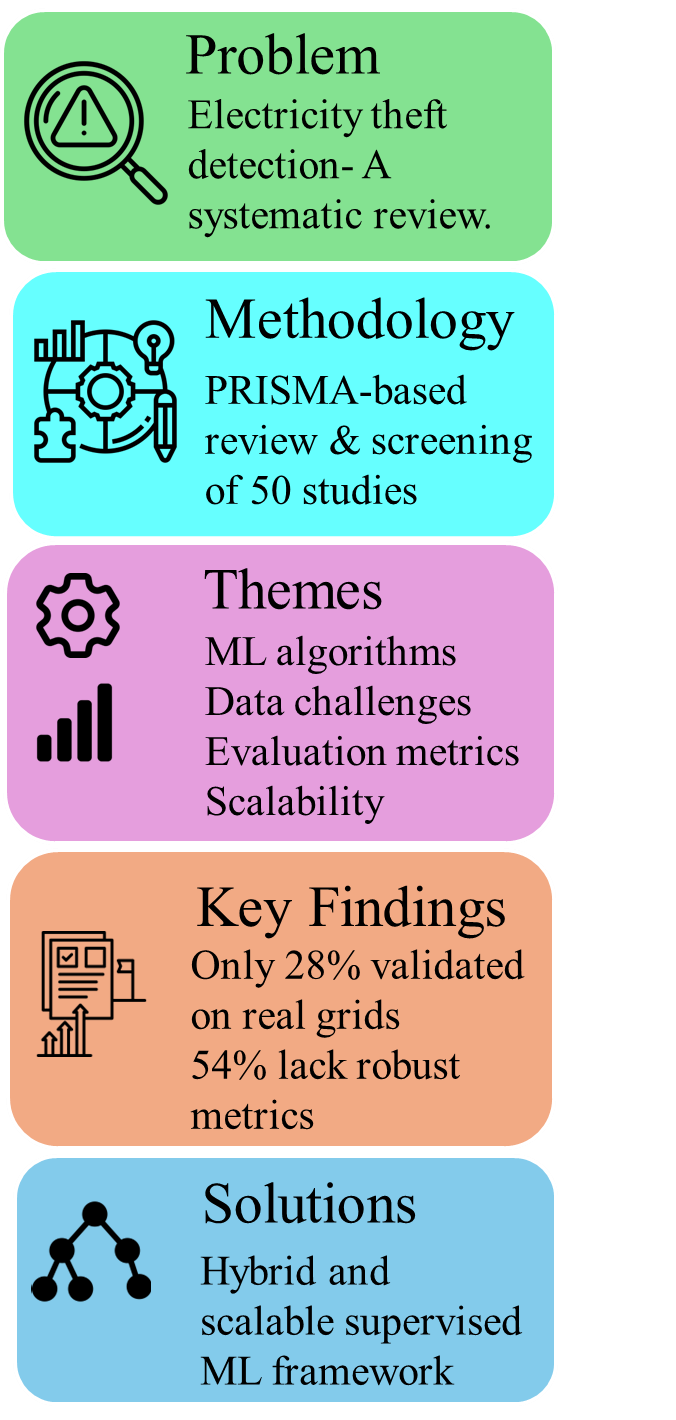
Electricity theft causes substantial financial losses and grid instability, requiring data-driven detection solutions, especially through supervised machine learning (SML) techniques. This review systematically examines 50 studies (2012–2024) from Scopus, IEEE Xplore, and Web of Science, following PRISMA guidelines to ensure a thorough and high-quality evaluation. It focuses on key themes such as algorithms, dataset challenges, performance metrics, and scalability, which are crucial for advancing electricity theft detection (ETD). SML methods such as decision trees, gradient boosting, and deep learning demonstrate high accuracy but encounter challenges, including inconsistent evaluation metrics, limited scalability for large-scale grids, and reliance on simulated datasets. Notably, only 28% of studies consider real-world scalability, and 54% lack robust evaluation metrics. Additionally, data issues such as missing values and class imbalance exacerbate these limitations. Future research should focus on developing hybrid models that effectively balance accuracy and interpretability, establishing standardized benchmarks for comparison, and incorporating real-world validation to enhance scalability and reliability in smart grid environments.
References
[1] Kumar, P., Lin, Y., Bai, G., Paverd, A., Dong, J. S., & Martin, A. 2019. Smart Grid Metering Networks: A Survey on Security, Privacy and Open Research Issues. IEEE Communications Surveys & Tutorials. 21(3): 2886–2927.
http://dx.doi.org/10.1109/comst.2019.2899354.
[2] Liu, Y., Yu, Y., Gao, N., & Wu, F. 2020. A Grid as Smart as the Internet. Engineering. 6(7): 778-788.
https://doi.org/10.1016/j.eng.2019.11.015.
[3] Kim, S., Sun, Y., Lee, S., Seon, J., Hwang, B., Kim, J., Kim, J., Kim, K., & Kim, J. 2024. Data-Driven Approaches for Energy Theft Detection: A Comprehensive Review. Energies. 17(12): 3057. https://doi.org/10.3390/en17123057.
[4] Butt, O. M., Zulqarnain, M., & Butt, T. M. 2021. Recent Advancement in Smart Grid Technology: Future Prospects in the Electrical Power Network. Ain Shams Engineering Journal. 12(1): 687–695. http://dx.doi.org/10.1016/j.asej.2020.05.004.
[5] Guerrero, J. I., Monedero, I., Biscarri, F., Biscarri, J., Millan, R., & Leon, C. 2018. Non-Technical Losses Reduction by Improving the Inspections Accuracy in a Power Utility. IEEE Transactions on Power Systems. 33(2): 1209–1218.
http://dx.doi.org/10.1109/TPWRS.2017.2721435
[6] Dineshkumar, K., Ramanathan, P., Ramasamy, S. 2015. Development of ARM Processor-based Electricity Theft Control System using GSM Network. Proceedings of the IEEE International Conference on Electrical, Computer and Communication Technologies (ICECCT). 1–6.
https://doi.org/10.1109/ICECCT.2015.7226135.
[7] Kang, C., Wang, Y., Xue, Y., Mu, G., & Liao, R. 2018. Big Data Analytics in China's Electric Power Industry: Modern Information, Communication Technologies, and Millions of Smart Meters. IEEE Power and Energy Magazine. 16(3): 54–65.
http://dx.doi.org/10.1109/mpe.2018.2790819.
[8] Gunturi, S. K., & Sarkar, D. 2020. Ensemble Machine Learning Models for Energy Theft Detection. Electric Power Systems Research. 180: 106904.
http://dx.doi.org/10.1016/j.epsr.2020.106904.
[9] Punmiya, R., & Choe, S. 2019. Energy Theft Detection Using Gradient Boosting Theft Detector with Feature Engineering-Based Preprocessing. IEEE Transactions on Smart Grid. 10(2): 2326–2334.
http://dx.doi.org/10.1109/tsg.2019.2892595.
[10] Saeed, M. S., Mustafa, M. W., Sheikh, U. U., Jumani, T. A., Khan, I., Atawneh, S., & Hamadneh, N. N. 2020. An Efficient Boosted C5.0 Decision-Tree-Based Classification Approach for Detecting Non-Technical Losses. Energies. 13(12): 3242.
http://dx.doi.org/10.3390/en13123242.
[11] Ullah, A., Javaid, N., Shoaib, M., & Sultana, T. 2021. Hybrid Deep Neural Network for Electricity Theft Detection Using Intelligent Antenna-Based Smart Meters. Wireless Communications and Mobile Computing.
http://dx.doi.org/10.1155/2021/6643901.
[12] Stracqualursi, E., Rosato, A., Di Lorenzo, G., Panella, M., & Araneo, R. 2023. Systematic Review of Energy Theft Practices and Autonomous Detection through Artificial Intelligence Methods. Renewable and Sustainable Energy Reviews. 184: 113544.
http://dx.doi.org/10.1016/j.rser.2023.113544.
[13] Guato Burgos, M. F., Morato, J., & Vizcaino Imacaña, F. P. 2024. A Review of Smart Grid Anomaly Detection Approaches Pertaining to Artificial Intelligence. Applied Sciences. 14(3): 1194.
http://dx.doi.org/10.3390/app14031194.
[14] Shehzad, F., Javaid, N., Almogren, A., Ahmed, A., Gulfam, S. M., Radwan, A. 2021. A Robust Hybrid Deep Learning Model for Detection of Non-technical Losses to Secure Smart Grids. IEEE Access. 9: 128663–128678.
https://doi.org/10.1109/ACCESS.2021.3113592.
[15] Hashim, M., Khan, L., Javaid, N., Ullah, Z., Javed, A. 2024. Stacked Machine Learning Models for Non-technical Loss Detection in Smart Grid: A Comparative Analysis. Energy Reports. 12: 1235–1253.
https://doi.org/10.1016/j.egyr.2024.06.015.
[16] Adil, M., Javaid, N., Ullah, A., Shafiq, M., & Choi, J.-G. 2020. LSTM and Bat-Based RUS Boost Approach for Electricity Theft Detection. Applied Sciences. 10(12): 4378.
http://dx.doi.org/10.3390/app10124378.
[17] Javaid, N., Gul, H., Baig, S., Shehzad, F., Xia, C., Guan, L., & Sultana, T. 2021. Using GANCNN and ERNET for Detection of Non-Technical Losses to Secure Smart Grids. IEEE Access: 9: 98679-98700.
http://dx.doi.org/10.1109/access.2021.3099289.
[18] Xia, W., Li, Y., Yu, L., and He, D. 2024. Locational Detection of False Data Injection Attacks in the Edge Space via Hodge Graph Neural Network for Smart Grids. IEEE Transactions on Smart Grid. 15(5): 5102–5114.
https://doi.org/10.1109/TSG.2024.3389948.
[19] Saeed, F., and Aldera, S. 2024. Adaptive Renewable Energy Forecasting Utilizing a Data-Driven PCA–Transformer Architecture. IEEE Access. 12: 109269–109280.
http://dx.doi.org/10.1109/ACCESS.2024.3440226.
[20] Zidi, S., Mihoub, A., Qaisar, S. M., Krichen, M., & Abu Al-Haija, Q. 2023. Theft Detection Dataset for Benchmarking and Machine Learning-Based Classification in a Smart Grid Environment. Journal of King Saud University – Computer and Information Sciences. 35(1): 13–25.
http://dx.doi.org/10.1016/j.jksuci.2022.05.007.
[21] Alshehri, A., Badr, M. M., Baza, M., & Alshahrani, H. 2024. Deep Anomaly Detection Framework Utilizing Federated Learning for Electricity Theft Zero-Day Cyberattacks. Sensors. 24(10): 3236.
http://dx.doi.org/10.3390/s24103236.
[22] Hastie, T., Tibshirani, R., & Friedman, J. 2009. The Elements of Statistical Learning: Data Mining, Inference, and Prediction. New York: Springer.
[23] Hussain, S., Mustafa, M. W., Al-Shqeerat, K. H. A., Al-Rimy, B. A. S., & Saeed, F. 2022. Electric Theft Detection in Advanced Metering Infrastructure Using Jaya Optimized Combined Kernel-Tree Boosting Classifier—A Novel Sequentially Executed Supervised Machine Learning Approach. IET Generation, Transmission & Distribution. 16(6): 1257–1275.
https://doi.org/10.1049/gtd2.12386.
[24] Nawaz, A., Ali, T., Mustafa, G., Rehman, S. U., & Rashid, M. R. 2023. A Novel Technique for Detecting Electricity Theft in Secure Smart Grids Using CNN and XG-Boost. Intelligent Systems with Applications. 17: 200168.
http://dx.doi.org/10.1016/j.iswa.2022.200168.
[25] Iranzad, R., & Liu, X. 2024. A Review of Random Forest-Based Feature Selection Methods for Data Science Education and Applications. International Journal of Data Science and Analytics. 8(1): 15–32.
https://doi.org/10.1007/s41060-024-00509-w.
[26] Abro, S. A., Hua, L. G., Laghari, J. A., Bhayo, M. A., & Memon, A. A. 2024. Machine Learning-Based Electricity Theft Detection Using Support Vector Machines. International Journal of Electrical and Computer Engineering. 14(2): 1240–1250.
http://doi.org/10.11591/ijece.v14i2.pp1240-1250.
[27] Peterson, L. E. 2009. K-nearest neighbor. Scholarpedia. 4(2): 1883.
http://dx.doi.org/10.4249/scholarpedia.1883.
[28] Iftikhar, H., Khan, N., Raza, M. A., Abbas, G., Khan, M., Aoudia, M., Touti, E., & Emara, A. 2024. Electricity Theft Detection in Smart Grid using Machine Learning. Frontiers in Energy Research. 12: Article 1383090.
https://doi.org/10.3389/fenrg.2024.1383090.
[29] Mujeeb, S., Javaid, N., Ahmed, A., Gulfam, S. M., Qasim, U., Shafiq, M., & Choi, J.-G. 2021. Electricity Theft Detection with Automatic Labeling and Enhanced RUS Boost Classification Using Differential Evolution and Jaya Algorithm. IEEE Access.
http://dx.doi.org/10.1109/ACCESS.2021.3102643.
[30] Khan, Z. A., Adil, M., Javaid, N., Saqib, M. N., Shafiq, M., & Choi, J.-G. 2020. Electricity Theft Detection Using Supervised Learning Techniques on Smart Meter Data. Sustainability. 12(19): 8023.
https://doi.org/10.3390/su12198023.
[31] Cheng, G., Zhang, Z., Li, Q., Li, Y., and Jin, W. 2021. Energy Theft Detection in an Edge Data Center Using Deep Learning. Mathematical Problems in Engineering. 2021. https://doi.org/10.1155/2021/5591769.
[32] Qu, Z., Li, H., Wang, Y., Zhang, J., Abu-Siada, A., & Yao, Y. 2020. Detection of Electricity Theft Behavior based on Improved Synthetic Minority Oversampling Technique and Random Forest Classifier. Energies. 13(8): 2039.
http://dx.doi.org/10.3390/en13082039.
[33] Lin, G., Feng, X., Guo, W., Cui, X., Liu, S., & Jin, W. 2021. Electricity Theft Detection Based on Stacked Autoencoder and the Undersampling and Resampling Based Random Forest Algorithm. IEEE Access. 9: 124044–124058.
http://dx.doi.org/10.1109/ACCESS.2021.3110510
[34] Li, S., Han, Y., Yao, X., Yingchen, S., Wang, J., & Zhao, Q. 2019. Electricity Theft Detection in Power Grids with Deep Learning and Random Forests. Journal of Electrical and Computer Engineering. 2019: Article ID 4136874.
https://doi.org/10.1155/2019/4136874.
[35] Nagi, J., Yap, K. S., Tiong, S. K., Ahmed, S. K., & Mohamad, M. 2009. Nontechnical Loss Detection for Metered Customers in Power Utility using Support Vector Machines. IEEE Transactions on Power Delivery. 25(2): 1162–1171.
http://dx.doi.org/10.1109/TPWRD.2009.2036519.
[36] Kosut, J. P., Santomauro, F., Jorysz, A., Fernández, A., Lecumberry, F., and Rodríguez, F. 2015. Abnormal Consumption Analysis for Fraud Detection: UTE–UDELAR joint Efforts. In Proceedings of the 2015 IEEE PES Innovative Smart Grid Technologies Latin America (ISGT LATAM), Montevideo, Uruguay. 887–892.
https://doi.org/10.1109/ISGT-LA.2015.7381272.
[37] Jokar, P., Arianpoo, N., & Leung, V. C. M. 2016. Electricity Theft Detection in AMI using Customers' Consumption Patterns. IEEE Transactions on Smart Grid. 7(1): 216–226. http://dx.doi.org/10.1109/TSG.2015.2425222.
[38] Jindal, A., Dua, A., Kaur, K., Singh, M., Kumar, N., & Mishra, S. 2016. Decision Tree and SVM-based Data Analytics for Theft Detection in Smart Grid. IEEE Transactions on Industrial Informatics. 12(3): 1005–1016.
http://dx.doi.org/10.1109/TII.2016.2543146.
[39] Nallathambi, S., and Ramasamy, K. 2017. Prediction of Electricity Consumption based on DT and RF: An Application on USA Country Power Consumption. In Proceedings of the 2017 IEEE International Conference on Electrical, Instrumentation and Communication Engineering (ICEICE), Karur, India. 1–7.
https://doi.org/10.1109/ICEICE.2017.8191939.
[40] Kong, X., Zhao, X., Liu, C., Li, Q., Dong, D., & Li, Y. 2021. Electricity Theft Detection in Low-voltage Stations based on Similarity Measure and DT-KSVM. International Journal of Electrical Power & Energy Systems. 125: 106544.
http://dx.doi.org/10.1016/j.ijepes.2020.106544.
[41] Bohani, F. A., Suliman, A., Saripuddin, M., Sameon, S. S., Md Salleh, N. S., & Nazeri, S. 2021. A Comprehensive Analysis of Supervised Learning Techniques for Electricity Theft Detection. Journal of Electrical and Computer Engineering. 2021: Article ID 2090-0147.
http://dx.doi.org/10.1155/2021/2090147.
[42] Fei, K., Li, Q., & Zhu, C. 2022. Non-technical losses Detection using Missing Values’ Pattern and Neural Architecture Search. International Journal of Electrical Power & Energy Systems. 134: 107410.
http://dx.doi.org/10.1016/j.ijepes.2021.107410.
[43] Zheng, Z., Yang, Y., Niu, X., Dai, H.-N., & Zhou, Y. 2018. Wide and Deep Convolutional Neural Networks for Electricity-Theft Detection to Secure Smart Grids. IEEE Transactions on Industrial Informatics. 14(4): 1606–1615. http://dx.doi.org/10.1109/TII.2017.2785963.
[44] Blazakis, K. V., Kapetanakis, T. N., & Stavrakakis, G. S. 2020. Effective Electricity Theft Detection in Power Distribution Grids Using an Adaptive Neuro Fuzzy Inference System. Energies. 13(12): 3110.
http://dx.doi.org/10.3390/en13123110.
[45] Barros, R. M. R., da Costa, E. G., & Araujo, J. F. 2021. Evaluation of Classifiers for Non-technical Loss Identification in Electric Power Systems. International Journal of Electrical Power & Energy Systems. 132: 107173.
http://dx.doi.org/10.1016/j.ijepes.2021.107173.
[46] Aslam, Z., Javaid, N., Ahmad, A., Ahmed, A., & Gulfam, S. M. 2020. A Combined Deep Learning and Ensemble Learning Methodology to Avoid Electricity Theft in Smart Grids. Energies. 13(21): 5599.
http://dx.doi.org/10.3390/en13215599.
[47] Saeed, M. S., Mustafa, M. W., Sheikh, U. U., Jumani, T. A., & Mirjat, N. H. 2019. Ensemble Bagged Tree-based Classification for Reducing Non-technical Losses in Multan Electric Power Company of Pakistan. Electronics. 8(8): 860. http://dx.doi.org/10.3390/electronics8080860.
[48] Arif, A., Javaid, N., Aldegheishem, A., & Alrajeh, N. 2021. Big Data Analytics for Identifying Electricity Theft using Machine Learning Approaches in Microgrids for Smart Communities. Concurrency and Computation: Practice and Experience. e6316.
http://dx.doi.org/10.1002/cpe.6316.
[49] Nizar, A. H., Dong, Z. Y., Zhao, J. H., & Zhang, P. 2007. A Data Mining-based NTL Analysis Method. IEEE. 1–8. http://dx.doi.org/10.1109/PES.2007.385630.
[50] Rahaman, M. A., and Idris, R. M. 2024. Enhancing Energy Fraud Detection with Ensemble Learning Techniques. In Proceedings of the IEEE International Conference on Advanced Power Engineering and Energy (APEE), Johor Bahru, Malaysia. 159–164.
https://doi.org/10.1109/APEE60256.2024.10790893.
[51] Elhassan, A., Abu-Soud, S. M., Alghanim, F., and Salameh, W. 2022. ILA4: Overcoming Missing Values in Machine Learning Datasets—An Inductive Learning Approach. Journal of King Saud University – Computer and Information Sciences. 34(7): 4284–4295.
https://doi.org/10.1016/j.jksuci.2021.02.011.
[52] Garciarena, U., and Santana, R. 2017. An extensive Analysis of the Interaction between Missing Data Types, Imputation Methods, and Supervised Classifiers. Expert Systems with Applications. 89: 52–65.
https://doi.org/10.1016/j.eswa.2017.07.026.
[53] Zhang, Y., Zhou, B., Cai, X., Guo, W., Ding, X., and Yuan, X. 2021. Missing Value Imputation in Multivariate Time Series with End-to-end Generative Adversarial Networks. Information Sciences. 551: 67–82.
https://doi.org/10.1016/j.ins.2020.11.003.
[54] Huang, M. W., Lin, W. C., Chen, C. W., Ke, S. W., Tsai, C. F., and Eberle, W. 2016. Data Preprocessing Issues for Incomplete Medical Datasets. Expert Systems. 33(5): 432–438.
https://doi.org/10.1111/exsy.12159.
[55] Xia, J., Zhang, S., Cai, G., Li, L., Pan, Q., Yan, J., and Ning, G. 2017. Adjusted Weight Voting Algorithm for Random Forests in Handling Missing Values. Pattern Recognition. 69: 52–60.
https://doi.org/10.1016/j.patcog.2017.04.011.
[56] Pati, S. K., and Das, A. K. 2017. Missing Value Estimation for Microarray Data through Cluster Analysis. Knowledge and Information Systems. 52(3): 709–750.
https://doi.org/10.1007/s10115-016-0980-6.
[57] Noor, N. M., Al Bakri Abdullah, M. M., Yahaya, A. S., and Ramli, N. A. 2015. Comparison of Linear Interpolation Method and Mean Method to Replace the Missing Values in Environmental Data Set. Applied Mechanics and Materials. 803: 278–281.
https://doi.org/10.4028/www.scientific.net/AMM.803.278.
[58] Kornelsen, K., and Coulibaly, P. 2014. Comparison of Interpolation, Statistical, and Data-driven Methods for Imputation of Missing Values in a Distributed Soil Moisture Dataset. Journal of Hydrologic Engineering. 19(1): 26–43. https://doi.org/10.1061/(ASCE)HE.1943-5584.0000767
[59] Saputra, M. D., Hadi, A. F., Riski, A., and Anggraeni, D. 2021. Handling Missing Values and Unusual Observations in Statistical Downscaling Using Kalman Filter. Journal of Physics: Conference Series. 1863: 012035.
https://doi.org/10.1088/1742-6596/1863/1/012035
[60] Li, L., Du, B., Wang, Y., Qin, L., and Tan, H. 2020. Estimation of Missing Values in Heterogeneous Traffic Data: Application of Multimodal Deep Learning Model. Knowledge-Based Systems. 194: 105592.
https://doi.org/10.1016/j.knosys.2020.105592.
[61] Gao, Y., Foggo, B., and Yu, N. 2019. A Physically Inspired Data-driven Model for Electricity Theft Detection with Smart Meter Data. IEEE Transactions on Industrial Informatics. 15(9): 5076–5088.
https://doi.org/10.1109/TII.2019.2898171.
[62] Shao, J., Meng, W., and Sun, G. 2017. Evaluation of Missing Value Imputation Methods for Wireless Soil Datasets. Personal and Ubiquitous Computing. 21(1): 113–123.
https://doi.org/10.1007/s00779-016-0980-3.
[63] Sovilj, E. E., Miche, D., Björk, Y., Nian, K. M., Akusok, R., and Lendasse, A. 2016. Extreme Learning Machine for Missing Data using Multiple Imputations. Neurocomputing. 174: 220–231.
https://doi.org/10.1016/j.neucom.2015.09.076.
[64] García-Laencina, P. J., Sancho-Gómez, J.-L., and Figueiras-Vidal, A. R. 2013. Classifying patterns with Missing Values using Multi-task Learning Perceptrons. Expert Systems with Applications. 40(4): 1333–1341.
https://doi.org/10.1016/j.eswa.2012.08.040.
[65] Laqueur, H. S., Shev, A. B., & Kagawa, R. M. C. 2022. SuperMICE: An Ensemble Machine Learning Approach to Multiple Imputation by Chained Equations. American Journal of Epidemiology. 191(3): 516–525.
http://dx.doi.org/10.1093/aje/kwab271.
[66] Stekhoven, D. J., and Bühlmann, P. 2012. MissForest—non-parametric Missing Value Imputation for Mixed-type Data. Bioinformatics. 28(1): 112–118.
https://doi.org/10.1093/bioinformatics/btr597.
[67] Tang, F., and Ishwaran, H. 2017. Random Forest Missing Data Algorithms. Statistical Analysis and Data Mining: The ASA Data Science Journal. 10(6): 363–377.
https://doi.org/10.1002/sam.11348.
[68] Depuru, S. S. S. R., Wang, L., Devabhaktuni, V., and Green, R. C. 2013. High-performance Computing for Detection of Electricity Theft. International Journal of Electrical Power & Energy Systems. 47: 21–30.
https://doi.org/10.1016/j.ijepes.2012.10.031
[69] Pereira, J., and Saraiva, F. 2020. A Comparative Analysis of Unbalanced Data Handling Techniques for Machine Learning Algorithms to Electricity Theft Detection. In Proceedings of the IEEE Congress on Evolutionary Computation (CEC), Glasgow, UK, 19–24 July. 1–8. https://doi.org/10.1109/CEC48606.2020.9185822.
[70] Kumar, S., Sharma, R., & Singh, A. K. 2024. A Novel Hybrid SMOTE-ENN Sampling Framework for Fraud Detection in Power Systems. Applied Soft Computing. 155: 111276.
http://dx.doi.org/10.1016/j.asoc.2023.111276.
[71] Yao, J., Zhang, T., & Hu, H. 2023. Adaptive Synthetic Oversampling with Feature Weighting for Imbalanced Data Classification. Knowledge-Based Systems. 284: 111252.
http://dx.doi.org/10.1016/j.knosys.2023.111252.
[72] Nguyen, H. M., Cooper, E. W., and Kamei, K. 2012. A Comparative Study on Sampling Techniques for Handling Class Imbalance in Streaming Data. In Proceedings of the IEEE ICDMW. 1762–1767.
https://doi.org/10.1109/icdmw.2012.128.
[73] Buzau, M. M., Tejedor-Aguilera, J., Cruz-Romero, P., & Gómez-Expósito, A. 2019. Detection of Non-Technical Losses Using Smart Meter Data and Supervised Learning. IEEE Transactions on Smart Grid. 10(3): 2661–2670.
https://doi.org/10.1109/tsg.2018.2807925.
[74] Gong, J., and Kim, H. 2017. RHSBoost: Improving Classification Performance in Imbalance Data. Computational Statistics & Data Analysis. 111: 1–13.
https://doi.org/10.1016/j.csda.2017.02.009.
[75] Razavi, R., Gharipour, A., Fleury, M., and Akpan, I. J. 2019. A Practical Feature-engineering Framework for Electricity Theft Detection in Smart Grids. Applied Energy. 238: 481–494.
https://doi.org/10.1016/j.apenergy.2019.01.076.
[76] Lee, L. C., and Jemain, A. A. 2021. On overview of PCA Application Strategy in Processing High Dimensionality Forensic Data. Microchemical Journal. 106608.
https://doi.org/10.1016/j.microc.2021.106608.
[77] Gul, H., Javaid, N., Ullah, I., Qamar, A. M., Afzal, M. K., and Joshi, G. P. 2020. Detection of Non-technical Losses using SOSTLink and Bidirectional Gated Recurrent Unit to Secure Smart Meters. Applied Sciences. 10(9): 3151.
https://doi.org/10.3390/app10093151
[78] Faria, L. T., Melo, J. D., and Padilha-Feltrin, A. 2015. Spatial-temporal Estimation for Nontechnical Losses. IEEE Transactions on Power Delivery. 31(1): 362–369.
https://doi.org/10.1109/TPWRD.2015.2430377.
[79] Krishnamoorthy, M., & Albert, J. R. 2024. Electricity Theft Detection in IoT-Based Smart Grids Using a Parameter-Tuned Bidirectional LSTM with Pre-Trained Feature Learning Mechanism. Electrical Engineering. 106: 5987–6001.
https://doi.org/10.1007/s00202-024-02342-7.
[80] Lepolesa, L. J., Achari, S., & Cheng, L. 2022. Electricity Theft Detection in Smart Grids Based on Deep Neural Network. IEEE Access. 10: 39638–39655.
http://dx.doi.org/10.1109/ACCESS.2022.3166146.
[81] Tehrani, S. O., Shahrestani, A., & Yaghmaee, M. H. 2022. Online Electricity Theft Detection Framework for Large-Scale Smart Grid Data. Electric Power Systems Research. 208: 107895.
http://dx.doi.org/10.1016/j.epsr.2022.107895.
[82] Ullah, A., Munawar, S., Asif, M., Kabir, B., and Javaid, N. 2021. Synthetic Theft Attacks Implementation for Data Balancing and a Gated Recurrent Unit based Electricity Theft Detection in Smart Grids. In Barolli, L., Yim, K., and Enokido, T. (eds.) Complex, Intelligent and Software Intensive Systems (CISIS 2021). Lecture Notes in Networks and Systems, vol. 278. Cham: Springer.
https://doi.org/10.1007/978-3-030-79725-6_39.
[83] Hussain, S., Mustafa, M. W., Jumani, T. A., Baloch, S. K., Alotaibi, H., Khan, I., and Khan, A. 2021. A Novel Feature Engineered–CatBoost-based Supervised Machine Learning Framework for Electricity Theft Detection. Energy Reports. 7: 4425–4436.
https://doi.org/10.1016/j.egyr.2021.07.008.
[84] Hussain, S., Mustafa, M. W., Al-Shqeerat, K. H. A., Saeed, F., and Al-rimy, B. A. S. 2021. A Novel Feature-Engineered–NGBoost Machine-Learning Framework for Fraud Detection in Electric Power Consumption Data. Sensors. 21(24): 8423.
https://doi.org/10.3390/s21248423.
[85] Page, M. J., McKenzie, J. E., Bossuyt, P. M., Boutron, I., Hoffmann, T. C., Mulrow, C. D., et al. 2021. The PRISMA 2020 Statement: An Updated Guideline for Reporting Systematic Reviews. BMJ. 372: n71.
https://doi.org/10.1136/bmj.n71.
[86] Kitchenham, B., Budgen, D., and Brereton, P. 2015. Evidence-Based Software Engineering and Systematic Reviews. Boca Raton: CRC Press.
Downloads
Published
Issue
Section
License
Copyright of articles that appear in Jurnal Teknologi belongs exclusively to Penerbit Universiti Teknologi Malaysia (Penerbit UTM Press). This copyright covers the rights to reproduce the article, including reprints, electronic reproductions, or any other reproductions of similar nature.