
CYTOTOXICITY AND IN-SILICO STUDY OF Piper aduncum EXTRACT TO INHIBIT BREAST CANCER CELL GROWTH
DOI:
https://doi.org/10.11113/jurnalteknologi.v88.24591Keywords:
Breast Cancer, Piper aduncum, Cytotoxicity, Computational Analysis, RAC1 ProteinAbstract
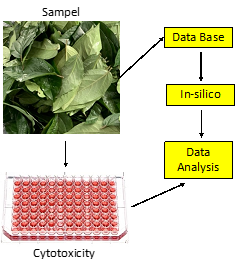
Breast cancer is the most prevalent cancer among women worldwide and a leading cause of cancer-related deaths. Piper aduncum is a tropical plant recognized for various potential medicinal properties, such as anti-breast cancer. This study aims to investigate the anti-breast cancer potential of bioactive compounds found in P. aduncum leaf ethanolic extract by measuring of cytotoxicity and using a computational approach. Analysis of cytotoxic using MTT assay. Information on active compounds was collected from the KNApSAcK database. Druglikeness, Pa, and Toxicity class were analyzed by using ADMET, Way2Drug, and Protox II. AutoDock vina was used to simulate the docking of chemicals with their protein targets. The cytotoxic analysis showed that the ethanolic extract of P. aduncum have IC50 values 105.75 μg/mL. P. aduncum contains 21 bioactive compounds. Methyl 2,2-dimethyl-8-(3'-methyl-2'-butenyl)-2H-1-chromene-6-carboxylate, 2,2-Dimethyl-8-prenylchromene 6-carboxylic acid, Methyl 2,2-dimethyl-2H-1-chromene-6-carboxylate, Anofinic acid, Asebogenin, Cardamomin were predicted to exhibit anti-breast cancer activities. Meanwhile, anofinic acid displayed the potential interaction with RAC1. In conclusion, as indicated by computational analysis, P. aduncum leaf has high potential as an anti-breast cancer agent by inhibiting protein RAC1.
References
[1] Ferlay, J., I. Soerjomataram, R. Dikshit, S. Eser, C. Mathers, M. Rebelo, D. M. Parkin, D. Forman, and F. Bray. 2015. Cancer Incidence and Mortality Worldwide: Sources, Methods and Major Patterns in GLOBOCAN 2012. International Journal of Cancer. 136(5): E359–E386.
[2] Chary, K. V., and K. Pandian. 2017. Accelerated Approval of Drugs: Ethics versus Efficacy. Indian Journal of Medical Ethics. 2(4): 244–247.
[3] Pilié, P. G., A. M. Johnson, K. L. Hanson, M. E. Dayno, A. L. Kapron, E. M. Stoffel, and K. A. Cooney. 2017. Germline Genetic Variants in Men with Prostate Cancer and One or More Additional Cancers. Cancer. 123(20): 3925–3932.
[4] Bray, F., J. Ferlay, I. Soerjomataram, R. L. Siegel, L. A. Torre, and A. Jemal. 2018. Global Cancer Statistics 2018: GLOBOCAN Estimates of Incidence and Mortality Worldwide for 36 Cancers in 185 Countries. A Cancer Journal for Clinicians. 68(6): 394–424.
[5] Monzote, L., R. Scull, P. Cos, and W. N. Setzer. 2017. Essential Oil from Piper aduncum: Chemical Analysis, Antimicrobial Assessment, and Literature Review. Medicines. 4(3): 49.
[6] Thao, N. P., B. T. T. Luyen, W. Widowati, N. Fauziah, M. Maesaroh, T. Herlina, Z. Manzoor, I. Ali, Y. S. Koh, and Y. H. Kim. 2016. Anti-inflammatory Flavonoid C-Glycosides from Piper aduncum Leaves. Planta Medica. 82: 1475–1481.
[7] Wang, Y.-H., S. L. Morris-Natschke, J. Yang, H.-M. Niu, C.-L. Long, and K.-H. Lee. 2014. Anticancer Principles from Medicinal Piper (Hu Jiao) Plants. Journal of Traditional and Complementary Medicine. 4(1): 8–16.
[8] Mayanga-Herrera, A., S. Tapia-Rojas, A. Fukusaki-Yoshizawa, Á. Marcelo-Rodríguez, and J. Amiel-Pérez. 2020. Actividad Citotóxica de la Fracción Clorofórmica de Piper aduncum y Su Efecto en el Ciclo Celular en Líneas Celulares de Cáncer Gástrico. Revista Peruana de Medicina Experimental y Salud Pública. 37(3): 471–477.
[9] Arroyo-Acevedo, J., R. J. Chávez-Asmat, A. Anampa-Guzmán, R. Donaires, and J. Ráez-Gonzáles. 2015. Protective Effect of Piper aduncum Capsule on DMBA-Induced Breast Cancer in Rats. Breast Cancer: Basic and Clinical Research. 9: 41.
[10] Ferreira, A. K., P. L. de Sá-Júnior, K. F. M. Pasqualoto, R. A. de Azevedo, D. A. D. Câmara, A. S. Costa, C. R. Figueiredo, et al. 2014. Cytotoxic Effects of Dillapiole on MDA-MB-231 Cells Involve the Induction of Apoptosis through the Mitochondrial Pathway by Inducing Oxidative Stress while Altering the Cytoskeleton Network. Biochimie. 99: 195–207.
[11] Xia, X. 2017. Bioinformatics and Drug Discovery. Current Topics in Medicinal Chemistry. 17(15): 1709–1726.
[12] Vega, F. M., and A. J. Ridley. 2008. Rho GTPases in Cancer Cell Biology. FEBS Letters. 582(14): 2093–2101.
[13] Bosco, E. E., J. C. Mulloy, and Y. Zheng. 2009. Rac1 GTPase: A ‘Rac’ of All Trades. Cellular and Molecular Life Sciences. 66(3): 370–374.
[14] Gastonguay, A., T. Berg, A. D. Hauser, N. Schuld, E. Lorimer, and C. L. Williams. 2012. The Role of Rac1 in the Regulation of NF-κB Activity, Cell Proliferation, and Cell Migration in Non-Small Cell Lung Carcinoma. Cancer Biology & Therapy. 13(8): 647–656.
[15] Marei, H., and A. Malliri. 2017. GEFs: Dual Regulation of Rac1 Signaling. Small GTPases. 8(2): 90–99.
[16] Guo, Y., J. Zhu, X. Wang, R. Li, K. Jiang, S. Chen, J. Fan, L. Xue, and D. Hao. 2019. Orai1 Promotes Osteosarcoma Metastasis by Activating the Ras–Rac1–WAVE2 Signaling Pathway. Medical Science Monitor. 25: 9227–9236.
[17] Swaminathan, K., A. Campbell, V. Papalazarou, F. Jaber-Hijazi, C. Nixon, E. McGhee, D. Strathdee, O. J. Sansom, and L. M. Machesky. 2021. The RAC1 Target NCKAP1 Plays a Crucial Role in the Progression of Braf;Pten-Driven Melanoma in Mice. Journal of Investigative Dermatology. 141(3): 628–637.e15.
[18] Zhou, H.-C., C.-X. Liu, W.-D. Pan, L.-R. Shang, J.-L. Zheng, B.-Y. Huang, J.-Y. Chen, L. Zheng, J.-H. Fang, and S.-M. Zhuang. 2021. Dual and Opposing Roles of the Androgen Receptor in VETC-Dependent and Invasion-Dependent Metastasis of Hepatocellular Carcinoma. Journal of Hepatology. 75(4): 900–911. https://doi.org/10.1016/j.jhep.2021.05.021.
[19] Nur, R. M., and L. H. Nugroho. 2017. Cytotoxic Activities of Fractions from Dioscorea bulbifera L. Chloroform and Methanol Extracts on T47D Breast Cancer Cells. Pharmacognosy Journal. 10(1): 33–38. https://doi.org/10.5530/pj.2018.1.7.
[20] Afendi, F. M., T. Okada, M. Yamazaki, A. Hirai-Morita, Y. Nakamura, K. Nakamura, S. Ikeda, H. Takahashi, M. Altaf-Ul-Amin, L. K. Darusman, K. Saito, and S. Kanaya. 2012. KNApSAcK Family Databases: Integrated Metabolite–Plant Species Databases for Multifaceted Plant Research. Plant and Cell Physiology. 53(2): e1. https://doi.org/10.1093/pcp/pcr165.
[21] Daina, A., O. Michielin, and V. Zoete. 2017. SwissADME: A Free Web Tool to Evaluate Pharmacokinetics, Drug-Likeness and Medicinal Chemistry Friendliness of Small Molecules. Scientific Reports. 7(1): 42717. https://doi.org/10.1038/srep42717.
[22] Lipinski, C. A., F. Lombardo, B. W. Dominy, and P. J. Feeney. 2001. Experimental and Computational Approaches to Estimate Solubility and Permeability in Drug Discovery and Development Settings. Advanced Drug Delivery Reviews. 46(1–3): 3–26. https://doi.org/10.1016/S0169-409X(00)00129-0.
[23] Ghose, A. K., V. N. Viswanadhan, and J. J. Wendoloski. 1999. A Knowledge-Based Approach in Designing Combinatorial or Medicinal Chemistry Libraries for Drug Discovery. 1. A Qualitative and Quantitative Characterization of Known Drug Databases. Journal of Combinatorial Chemistry. 1(1): 55–68. https://doi.org/10.1021/cc9800071.
[24] Veber, D. F., S. R. Johnson, H.-Y. Cheng, B. R. Smith, K. W. Ward, and K. D. Kopple. 2002. Molecular Properties That Influence the Oral Bioavailability of Drug Candidates. Journal of Medicinal Chemistry. 45(12): 2615–2623. https://doi.org/10.1021/jm020017n.
[25] Egan, W. J., K. M. Merz Jr., and J. J. Baldwin. 2000. Prediction of Drug Absorption Using Multivariate Statistics. Journal of Medicinal Chemistry. 43(21): 3867–3877. https://doi.org/10.1021/jm000292e.
[26] Muegge, I., S. L. Heald, and D. Brittelli. 2001. Simple Selection Criteria for Drug-like Chemical Matter. Journal of Medicinal Chemistry. 44(12): 1841–1846. https://doi.org/10.1021/jm015507e.
[27] Hu, S., Y. Xu, L. Meng, L. Huang, and H. Sun. 2018. Curcumin Inhibits Proliferation and Promotes Apoptosis of Breast Cancer Cells. Experimental and Therapeutic Medicine. 16(2): 1266–1272. https://doi.org/10.3892/etm.2018.6345.
[28] Merdad, A., S. Karim, H.-J. Schulten, A. Dallol, A. Buhmeida, F. Al-Thubaity, M. A. Gari, A. G. Chaudhary, A. M. Abuzenadah, and M. H. Al-Qahtani. 2014. Expression of Matrix Metalloproteinases (MMPs) in Primary Human Breast Cancer: MMP-9 as a Potential Biomarker for Cancer Invasion and Metastasis. Anticancer Research. 34(3): 1355–1366.
[29] Kubatka, P., A. Kapinová, P. Kružliak, M. Kello, D. Výbohová, K. Kajo, M. Novák, M. Chripková, M. Adamkov, M. Péč, J. Mojžiš, B. Bojková, M. Kassayová, N. Stollárová, and D. Dobrota. 2015. Antineoplastic Effects of Chlorella pyrenoidosa in the Breast Cancer Model. Nutrition and Cancer. 67(4). https://doi.org/10.1080/01635581.2015.1015741.
[30] Okoth, C., M. Galukande, J. Jombwe, and D. Wamala. 2013. Benign Proliferative Breast Diseases among Female Patients at a Sub-Saharan Africa Tertiary Hospital: A Cross-Sectional Study. BMC Surgery. 13(1): 9. https://doi.org/10.1186/1471-2482-13-9.
[31] Pu, X., S. J. Storr, Y. Zhang, E. A. Rakha, A. R. Green, I. O. Ellis, and S. G. Martin. 2017. Caspase-3 and Caspase-8 Expression in Breast Cancer: Caspase-3 Is Associated with Survival. Apoptosis. 22(3): 357–368. https://doi.org/10.1007/s10495-016-1335-5.
[32] Drwal, M. N., P. Banerjee, M. Dunkel, M. R. Wettig, and R. Preissner. 2014. ProTox: A Web Server for the In Silico Prediction of Rodent Oral Toxicity. Nucleic Acids Research. 42(W1): W53–W58. https://doi.org/10.1093/nar/gku401.
[33] Banerjee, P., A. O. Eckert, A. K. Schrey, and R. Preissner. 2018. ProTox-II: A Webserver for the Prediction of Toxicity of Chemicals. Nucleic Acids Research. 46(W1): W257–W263. https://doi.org/10.1093/nar/gky318.
[34] Ferrandez, Y., W. Zhang, F. Peurois, L. Akendengué, A. Blangy, M. Zeghouf, and J. Cherfils. 2017. Allosteric Inhibition of the Guanine Nucleotide Exchange Factor DOCK5 by a Small Molecule. Scientific Reports. 7(1): 14409. https://doi.org/10.1038/s41598-017-14608-8.
[35] Dassault Systèmes BIOVIA. 2019. Discovery Studio Modeling Environment. San Diego, CA: Dassault Systèmes BIOVIA.
[36] Trott, O., and A. J. Olson. 2010. AutoDock Vina: Improving the Speed and Accuracy of Docking with a New Scoring Function, Efficient Optimization, and Multithreading. Journal of Computational Chemistry. 31(2): 455–461. https://doi.org/10.1002/jcc.21334.
[37] Zheng, C., X. Wu, R. Zeng, L. Lin, L. Xu, E. Li, and G. Dong. 2021. Computational Prediction of Hot Spots and Binding Site of Inhibitor NSC23766 on Rac1 Binding with Tiam1. Frontiers in Chemistry. 8: 625437. https://doi.org/10.3389/fchem.2020.625437.
[38] Goldin, A., J. M. Venditti, J. S. Macdonald, F. M. Muggia, J. E. Henney, and V. T. DeVita. 1981. Current Results of the Screening Program at the Division of Cancer Treatment, National Cancer Institute. European Journal of Cancer. 17(2): 129–142. https://doi.org/10.1016/0014-2964(81)90184-6.
[39] Li, C., W. Jia, J. Yang, C. Cheng, and O. E. Olaleye. 2022. Multi-Compound and Drug-Combination Pharmacokinetic Research on Chinese Herbal Medicines. Acta Pharmacologica Sinica. 43(12): 3080–3095. https://doi.org/10.1038/s41401-022-00924-z.
[40] Bickerton, G. R., G. V. Paolini, J. Besnard, S. Muresan, and A. L. Hopkins. 2012. Quantifying the Chemical Beauty of Drugs. Nature Chemistry. 4(2): 90–98. https://doi.org/10.1038/nchem.1243.
[41] Benet, L. Z., C. M. Hosey, O. Ursu, and T. I. Oprea. 2016. BDDCS, the Rule of 5 and Drugability. Advanced Drug Delivery Reviews. 101: 89–98. https://doi.org/10.1016/j.addr.2016.05.007.
[42] Arnott, J. A., and S. L. Planey. 2012. The Influence of Lipophilicity in Drug Discovery and Design. Expert Opinion on Drug Discovery. 7(10): 863–875. https://doi.org/10.1517/17460441.2012.714363.
[43] Hussain, S. M., M. S. Hussain, A. A. L., and N. Arif. 2016. Characterization of Isolated Bioactive Phytoconstituents from Flacourtia indica as Potential Phytopharmaceuticals—An in Silico Perspective. Journal of Pharmacognosy and Phytochemistry. 5 (6): 323–331.
[44] Ramchandani, S., I. Naz, N. Dhudha, and M. Garg. 2020. An Overview of the Potential Anticancer Properties of Cardamonin. Exploration of Targeted Anti-Tumor Therapy. 1(6): 413–426. https://doi.org/10.37349/etat.2020.00026.
[45] Zhang, H., T. Zhang, K. M. Saravanan, L. Liao, H. Wu, H. Zhang, H. Zhang, Y. Pan, X. Wu, and Y. Wei. 2022. DeepBindBC: A Practical Deep Learning Method for Identifying Native-Like Protein–Ligand Complexes in Virtual Screening. Methods. 205: 247–262. https://doi.org/10.1016/j.ymeth.2022.04.011.
[46] Joyner, P. M., D. P. Tran, M. A. Zenaidee, and J. A. Loo. 2022. Characterization of Protein–Ligand Binding Interactions of Enoyl-ACP Reductase (FabI) by Native MS Reveals Allosteric Effects of Coenzymes and the Inhibitor Triclosan. Protein Science. 31(3): 568–579. https://doi.org/10.1002/pro.4233.
[47] Ma, N., E. Xu, Q. Luo, and G. Song. 2023. Rac1: A Regulator of Cell Migration and a Potential Target for Cancer Therapy. Molecules. 28(7): 2976. https://doi.org/10.3390/molecules28072976.
[48] Zhou, X., J. Qian, L. Hua, Q. Shi, Z. Liu, Y. Xu, B. Sang, J. Mo, and R. Yu. 2013. Geranylgeranyltransferase I Promotes Human Glioma Cell Growth through Rac1 Membrane Association and Activation. Journal of Molecular Neuroscience. 49(1): 130–139. https://doi.org/10.1007/s12031-012-9910-7.
[49] Zhu, L., Y. Sun, Q. Wu, C. Zhang, and J. Ling. 2020. “CAPN6 Regulates Uterine Leiomyoma Cell Proliferation and Apoptosis through the Rac1-Dependent Signaling Pathway.” Annals of Clinical and Laboratory Science 50 (1): 24–30.
[50] Bid, H. K., R. D. Roberts, P. K. Manchanda, and P. J. Houghton. 2013. RAC1: An Emerging Therapeutic Option for Targeting Cancer Angiogenesis and Metastasis. Molecular Cancer Therapeutics. 12(10): 1925–1934. https://doi.org/10.1158/1535-7163.MCT-13-0164.
Downloads
Published
Issue
Section
License
Copyright of articles that appear in Jurnal Teknologi belongs exclusively to Penerbit Universiti Teknologi Malaysia (Penerbit UTM Press). This copyright covers the rights to reproduce the article, including reprints, electronic reproductions, or any other reproductions of similar nature.