
IN VITRO ANTIBACTERIAL ACTIVITY OF RAED® SABUN MANDIAN SEMAMBU BODY WASH PRODUCT AGAINST SKIN BACTERIA
DOI:
https://doi.org/10.11113/jurnalteknologi.v88.24794Keywords:
Antibacterial body wash, Bactericidal Effect, Natural Products, Semambu, Skin InfectionAbstract
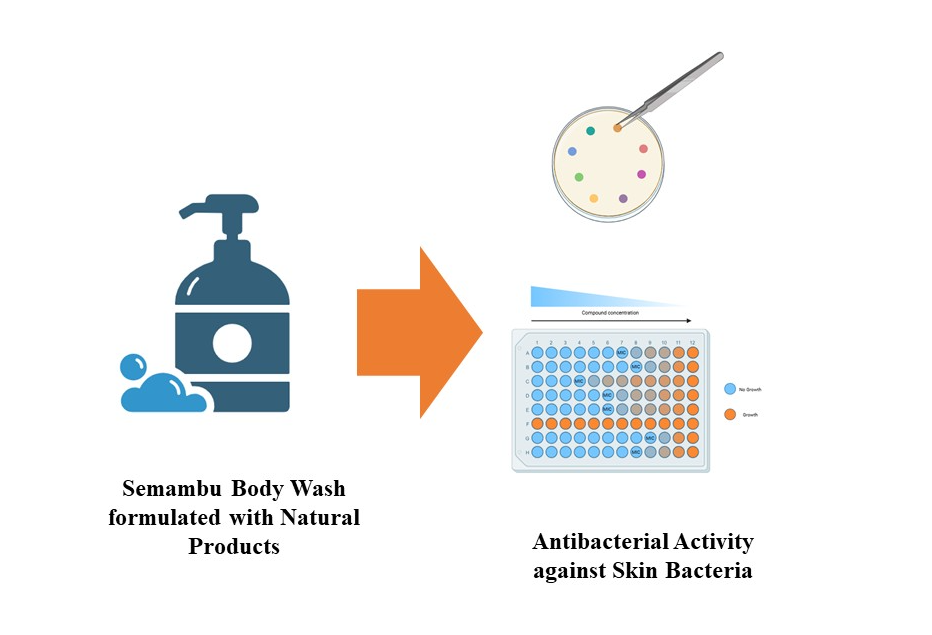
Common bacteria associated with skin infections include Staphylococcus aureus, Staphylococcus epidermidis, and Streptococcus pyogenes. Antibacterial body washes containing natural products are preferred for preventing skin infections without adverse effects, and Raed Sabun Mandian Semambu® is formulated with such natural ingredients. The aim of this study was to determine antibacterial activity of Raed Sabun Mandian Semambu® against bacteria that cause skin infection. Antibacterial activity was determined using diameter of zone of inhibition, minimal inhibitory concentration (MIC) and minimal bactericidal concentration (MBC). The time-kill assay was conducted at 0.5x MIC and 1x MIC for S. aureus and S. epidermidis, and at 0.5x MIC, 1x MIC, and 2x MIC for S. pyogenes, with incubation at 0, 2, 4, 6, 8, 10, and 24 hours. Results show inhibition zone diameters at product concentrations of 25%, 50%, 75%, and 100%. The MIC values indicate that the product inhibited the growth of all tested bacteria. The MBC/MIC ratio demonstrates bactericidal effect on all bacterial strains. The time-kill assay revealed bactericidal effect at 1x MIC for S. aureus and S. epidermidis, and at 2x MIC for S. pyogenes. In conclusion, Raed Sabun Mandian Semambu® exhibits a bactericidal effect on all tested bacteria.
References
[1] R, T. K., M. D. A. Bhat, R. Zaman, and F. A. Najar. 2022. Efficacy of Herbal Anti-Microbial Soap in Tinea corporis: A Randomized Controlled Study. Journal of Ethnopharmacology. 287: 114934. https://doi.org/10.1016/j.jep.2021.114934.
[2] Meißner, A., D. Hasenclever, O. Brosteanu, and I. F. Chaberny. 2017. Effect of Daily Antiseptic Body Wash with Octenidine on Nosocomial Primary Bacteraemia and Nosocomial Multidrug-Resistant Organisms in Intensive Care Units: Design of a Multicentre, Cluster-Randomised, Double-Blind, Cross-Over Study. BMJ Open. 7(11): e016251. https://doi.org/10.1136/bmjopen-2017-016251.
[3] Choi, D., and S. Oh. 2019. Removal of Chloroxylenol Disinfectant by an Activated Sludge Microbial Community. Microbes and Environments. 34(2): 129–135. https://doi.org/10.1264/jsme2.ME18124.
[4] Luo, N., J. Chen, X. Chen, M. Wang, X. Niu, G. Chen, C. Deng, Y. Gao, G. Li, and T. An. 2024. Toxicity Evolution of Triclosan during Environmental Transformation and Human Metabolism: Misgivings in the Post-Pandemic Era. Environment International. 190: 108927. https://doi.org/10.1016/j.envint.2024.108927.
[5] Bhattacharya, R., A. Chatterjee, S. Chatterjee, and N. C. Saha. 2021. Acute Toxicity and Sublethal Effects of Sodium Laureth Sulfate on Oxidative Stress Enzymes in Benthic Oligochaete Worm, Tubifex tubifex. Comparative Biochemistry and Physiology Part C: Toxicology & Pharmacology. 243: 108998. https://doi.org/10.1016/j.cbpc.2021.108998.
[6] Collis, R. W., and D. M. Sheinbein. 2020. Cocamidopropyl Betaine Is Commonly Found in Hypoallergenic Personal Care Products for Children. Journal of the American Academy of Dermatology. 82(5): 1245–1247. https://doi.org/10.1016/j.jaad.2019.12.036.
[7] Cheung, G. Y. C., J. S. Bae, and M. Otto. 2021. Pathogenicity and Virulence of Staphylococcus aureus. Virulence. 12(1): 547–569. https://doi.org/10.1080/21505594.2021.1878688.
[8] Severn, M. M., and A. R. Horswill. 2023. Staphylococcus epidermidis and Its Dual Lifestyle in Skin Health and Infection. Nature Reviews Microbiology. 21(2): 97–111. https://doi.org/10.1038/s41579-022-00780-3.
[9] Brouwer, S., T. Rivera-Hernandez, B. F. Curren, N. Harbison-Price, D. M. P. de Oliveira, M. G. Jespersen, M. R. Davies, and M. J. Walker. 2023. Pathogenesis, Epidemiology and Control of Group A Streptococcus Infection. Nature Reviews Microbiology. 21(7): 431–447. https://doi.org/10.1038/s41579-023-00865-7.
[10] Wylie, M. R., and D. S. Merrell. 2022. The Antimicrobial Potential of the Neem Tree (Azadirachta indica). Frontiers in Pharmacology. 13: 891535. https://doi.org/10.3389/fphar.2022.891535.
[11] Lee, S.-H., Y. Heo, and Y.-C. Kim. 2010. Effect of German Chamomile Oil Application on Alleviating Atopic Dermatitis-Like Immune Alterations in Mice. Journal of Veterinary Science. 11(1): 35–41. https://doi.org/10.4142/jvs.2010.11.1.35.
[12] Dai, Y. L., Y. Li, Q. Wang, F. J. Niu, K. W. Li, Y. Y. Wang, J. Wang, C. Z. Zhou, and L. N. Gao. 2022. Chamomile: A Review of Its Traditional Uses, Chemical Constituents, Pharmacological Activities and Quality Control Studies. Molecules. 28(1): 133. https://doi.org/10.3390/molecules28010133.
[13] Hossain, T. J. 2024. Methods for Screening and Evaluation of Antimicrobial Activity: A Review of Protocols, Advantages, and Limitations. European Journal of Microbiology & Immunology. 14(2): 97–115. https://doi.org/10.1556/1886.2024.00035.
[14] Alrabiah, M. A., A. A. Hassan, M. A. Mubaraki, A. M. Albarrag, M. A. Dkhil, A. M. Somily, D. Delic, and T. A. Hafiz. 2025. Unexpected Efficacy of Albumin-Bound Glycerol Monolaurate against Multidrug-Resistant Bacterial Isolates: A Time-Kill Assay Study. Infection and Drug Resistance. 18: 1581–1593. https://doi.org/10.2147/IDR.S502165.
[15] Rajagopal, M., A. Adhikari, T. Nizam, R. Ramli, and C. Wiart. 2020. Antibacterial Activities of the Extracts, Fractions and Isolated Compounds from Canarium patentinervium Miq. against Bacterial Clinical Isolates. BMC Complementary Medicine and Therapies. 20: 55. https://doi.org/10.1186/s12906-020-2837-5.
[16] Bansal, V., M. Gupta, T. Bhaduri, S. A. Shaikh, F. R. Sayed, V. Bansal, and A. Agrawal. 2019. Assessment of Antimicrobial Effectiveness of Neem and Clove Extract against Streptococcus mutans and Candida albicans: An In Vitro Study. Nigerian Medical Journal. 60(6): 285–289. https://doi.org/10.4103/nmj.NMJ_20_19.
[17] Abers, M., S. Schroeder, L. Goelz, A. Sulser, T. St. Rose, K. Puchalski, and J. Langland. 2021. Antimicrobial Activity of the Volatile Substances from Essential Oils. BMC Complementary Medicine and Therapies. 21(1): 124. https://doi.org/10.1186/s12906-021-03285-3.
[18] Khatri, P., A. Rani, S. Hameed, S. Chandra, C. M. Chang, and R. P. Pandey. 2023. Current Understanding of the Molecular Basis of Spices for the Development of Potential Antimicrobial Medicine. Antibiotics. 12(2): 270. https://doi.org/10.3390/antibiotics12020270.
[19] Adusei, E. B. A., R. K. Adosraku, J. Oppong-Kyekyeku, C. D. K. Amengor, and Y. Jibira. 2019. Resistance Modulation Action, Time-Kill Kinetics Assay, and Inhibition of Biofilm Formation Effects of Plumbagin from Plumbago zeylanica Linn. Journal of Tropical Medicine. 2019: 1250645. https://doi.org/10.1155/2019/1250645.
[20] Zadrazilova, I., S. Pospisilova, K. Pauk, A. Imramovsky, J. Vinsova, A. Cizek, and J. Jampilek. 2015. In Vitro Bactericidal Activity of 4- and 5-Chloro-2-hydroxy-N-[1-oxo-1-(phenylamino)alkan-2-yl]benzamides against MRSA. BioMed Research International. 2015: 349534. https://doi.org/10.1155/2015/349534.
Downloads
Published
Issue
Section
License
Copyright of articles that appear in Jurnal Teknologi belongs exclusively to Penerbit Universiti Teknologi Malaysia (Penerbit UTM Press). This copyright covers the rights to reproduce the article, including reprints, electronic reproductions, or any other reproductions of similar nature.