
PREDICTION OF DISSOLUTION-INDUCED STRUCTURAL MODIFICATION IN LITHIUM ALUMINATE BORATE GLASS: COMPUTATIONAL MODELLING
DOI:
https://doi.org/10.11113/jurnalteknologi.v88.24806Keywords:
Bioactive Glass, Borate, FTIR, Gaussian, ComputationalAbstract
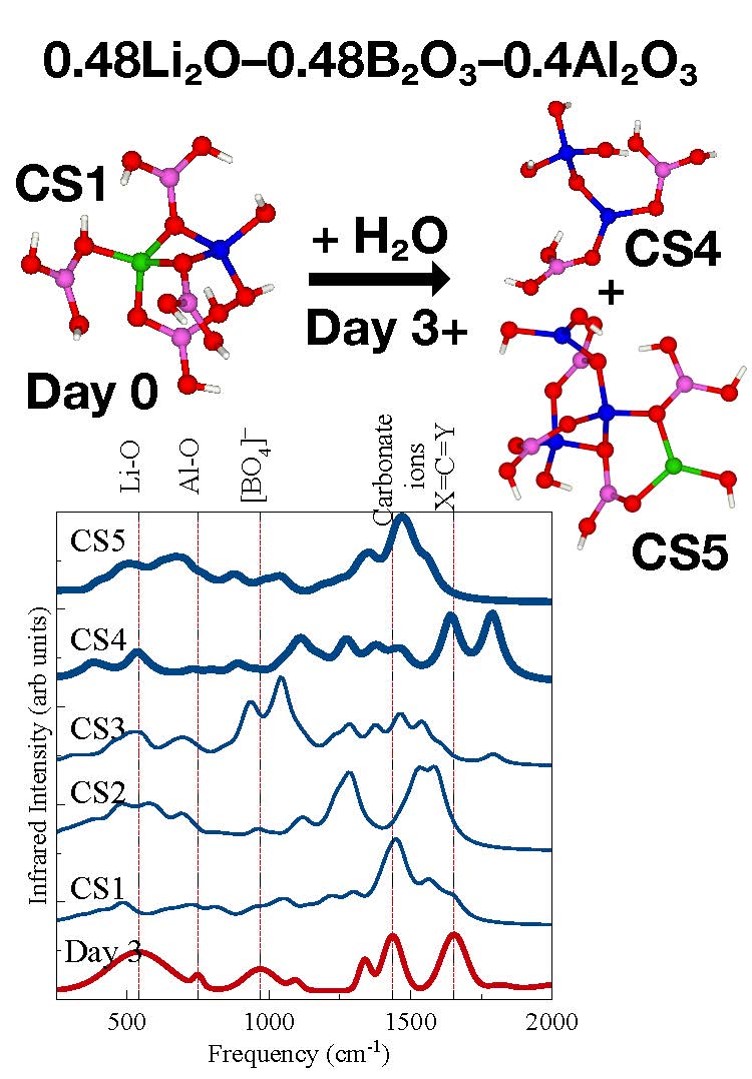
Borate-based bioactive glass systems became interesting due to their faster degradation rate and better conversion into hydroxyapatite-like complex structures than silicate glasses. Unravelling the mechanism of structural modification and biomineralization in borate bioactive glass remains challenging. Thus, a computational model study was conducted to predict the dissolution-assisted structural changes in the lithium aluminate borate glass (LABG). The model simulation results were validated by the Fourier transformed infrared (FTIR) spectral analysis of LABG (of the form 0.48Li2O-0.48B2O3-0.4Al2O3) referred in [1]. Deionised water (DIW) dissolution-mediated changes in the molecular networks of the glasses were ascertained from the experimental FTIR band characteristics. The interaction of the glass network structures with DIW were determined by modelling five molecular clusters (in microcrystalline phase) matched to the experimental configuration. The selected clusters were based on the Li3Al(BO3)2 crystal structure comparable to the experimental glass. The density functional theory (DFT) calculation on these optimized clusters was performed using Gaussian 09. The geometrical analyses were carried out at various dissolution periods (0, 3, 7 and 14 days) to compare with the experimental FTIR spectra. The glass after 3 days of dissolution showed the existence of two clusters accompanied by an ambiguous IR peak corresponding to the stretching vibration of [BO3]-2 together with two non-bridging oxygen. It was asserted that the proposed computational approach for the dissolution-enabled network structural modifications in LABG can be useful to predict various mechanisms in bioactive glass evolution.
References
[1] Ali, N. F. M. 2019. Structural and Durability Study of Lithium Aluminate Borate Glasses. BSc thesis, Universiti Teknologi Malaysia.
[2] Baino, F., and C. Vitale-Brovarone. 2011. Three-Dimensional Glass-Derived Scaffolds for Bone Tissue Engineering: Current Trends and Forecasts for the Future. Journal of Biomedical Materials Research Part A. 97A(4): 514–535. https://doi.org/10.1002/jbm.a.33072.
[3] El-Ghannam, A., P. Ducheyne, and I. M. Shapiro. 1999. Effect of Serum Proteins on Osteoblast Adhesion to Surface-Modified Bioactive Glass and Hydroxyapatite. Journal of Orthopaedic Research. 17(3): 340–345. https://doi.org/10.1002/jor.1100170307.
[4] Ducheyne, P. 1998. Stimulation of Biological Function with Bioactive Glass. MRS Bulletin. 23(11): 43–49. https://doi.org/10.1557/S0883769400030992.
[5] Pazarçeviren, A. E., A. Tahmasebifar, A. Tezcaner, D. Keskin, and Z. Evis. 2018. Investigation of Bismuth-Doped Bioglass/Graphene Oxide Nanocomposites for Bone Tissue Engineering. Ceramics International. 44(4): 3791–3799. https://doi.org/10.1016/j.ceramint.2017.11.164.
[6] Khorami, M., S. Hesaraki, A. Behnamghader, H. Nazarian, and S. Shahrabi. 2011. In Vitro Bioactivity and Biocompatibility of Lithium-Substituted 45S5 Bioglass. Materials Science and Engineering: C. 31(7): 1584–1592. https://doi.org/10.1016/j.msec.2011.07.011.
[7] Tripathi, H., C. Rath, A. S. Kumar, P. P. Manna, and S. P. Singh. 2019. Structural, Physico-Mechanical and In Vitro Bioactivity Studies on SiO₂–CaO–P₂O₅–SrO–Al₂O₃ Bioactive Glasses. Materials Science and Engineering: C. 94: 279–290. https://doi.org/10.1016/j.msec.2018.09.041.
[8] Marion, N. W., W. Liang, G. C. Reilly, D. E. Day, M. N. Rahaman, and J. J. Mao. 2005. Borate Glass Supports the In Vitro Osteogenic Differentiation of Human Mesenchymal Stem Cells. Mechanics of Advanced Materials and Structures. 12(3): 239–246. https://doi.org/10.1080/15376490590928615.
[9] Brink, M., T. Turunen, R. P. Happonen, and A. Yli-Urpo. 1997. Compositional Dependence of Bioactivity of Glasses in the System Na₂O–K₂O–MgO–CaO–B₂O₃–P₂O₅–SiO₂. Journal of Biomedical Materials Research. 37(1): 114–121. https://doi.org/10.1002/(SICI)1097-4636(199710)37:1
[10] Fernandes, H. R., A. Gaddam, A. Rebelo, D. Brazete, G. E. Stan, and J. M. F. Ferreira. 2018. Bioactive Glasses and Glass-Ceramics for Healthcare Applications in Bone Regeneration and Tissue Engineering. Materials. 11(12): 2530. https://doi.org/10.3390/ma11122530.
[11] Rao, R. B., and R. A. Gerhardt. 2008. Effect of Alkaline Earth Modifier Ion on the Optical, Magnetic and Electrical Properties of Lithium Nickel Borate Glasses. Materials Chemistry and Physics. 112: 186–197. https://doi.org/10.1016/j.matchemphys.2008.05.046.
[12] Clément-Lacroix, P., et al. 2005. Lrp5-Independent Activation of Wnt Signaling by Lithium Chloride Increases Bone Formation and Bone Mass in Mice. Proceedings of the National Academy of Sciences of the United States of America. 102(48): 17406–17411. https://doi.org/10.1073/pnas.0505259102.
[13] Rabiee, S. M., N. Nazparvar, M. Azizian, D. Vashaee, and L. Tayebi. 2015. Effect of Ion Substitution on Properties of Bioactive Glasses: A Review. Ceramics International. 41(6): 7241–7251. https://doi.org/10.1016/j.ceramint.2015.02.140.
[14] Rada, S., E. Culea, and M. Neumann. 2010. Experimental and Theoretical Studies of the Structure of Tellurate-Borate Glasses Network. Journal of Molecular Modeling. 16(8): 1333–1338. https://doi.org/10.1007/s00894-009-0641-8.
[15] Rada, S., and E. Culea. 2009. FTIR Spectroscopic and DFT Theoretical Study on Structure of Europium-Phosphate-Tellurate Glasses and Glass Ceramics. Journal of Molecular Structure. 929(1–3): 141–148. https://doi.org/10.1016/j.molstruc.2009.04.021.
[16] Stoch, P., A. Stoch, M. Ciecińska, I. Krakowiak, and M. Sitarz. 2016. Structure of Phosphate and Iron-Phosphate Glasses by DFT Calculations and FTIR/Raman Spectroscopy. Journal of Non-Crystalline Solids. 450: 48–60. https://doi.org/10.1016/j.jnoncrysol.2016.07.027.
[17] Montazerian, M., E. D. Zanotto, and J. C. Mauro. 2020. Model-Driven Design of Bioactive Glasses: From Molecular Dynamics through Machine Learning. International Materials Reviews. 65(5): 297–321. https://doi.org/10.1080/09506608.2019.1694779.
[18] Alencar, V., J. Oliveira, A. Pereira, and S. Lucena. 2023. Molecular Simulation and Machine Learning Tools to Predict Bioglass Modulus of Elasticity. Journal of Non-Crystalline Solids. https://doi.org/10.1016/j.jnoncrysol.2023.122507.
[19] Lemm, D., G. F. von Rudorff, and O. A. von Lilienfeld. 2021. Machine Learning–Based Energy-Free Structure Predictions of Molecules, Transition States, and Solids. Nature Communications. 12: 4468. https://doi.org/10.1038/s41467-021-24525-7.
[20] Hasnip, P. J., K. Refson, M. I. J. Probert, J. R. Yates, S. J. Clark, and C. J. Pickard. 2014. Density Functional Theory in the Solid State. Philosophical Transactions of the Royal Society A: Mathematical, Physical and Engineering Sciences. 372 (2011). https://doi.org/10.1098/rsta.2013.0270.
[21] GaussView 6 Official Information Page. Accessed July 2, 2026. https://gaussian.com/gaussview6/
Downloads
Published
Issue
Section
License
Copyright of articles that appear in Jurnal Teknologi belongs exclusively to Penerbit Universiti Teknologi Malaysia (Penerbit UTM Press). This copyright covers the rights to reproduce the article, including reprints, electronic reproductions, or any other reproductions of similar nature.