
PRODUCTION OF TRANSGENIC Arabidopsis thaliana CARRYING THE OIL PALM Eg4CL1 GENE
DOI:
https://doi.org/10.11113/jurnalteknologi.v88.24847Keywords:
Oil palm, Eg4CL1, Transgenic, Arabidopsis thaliana, TransformationAbstract
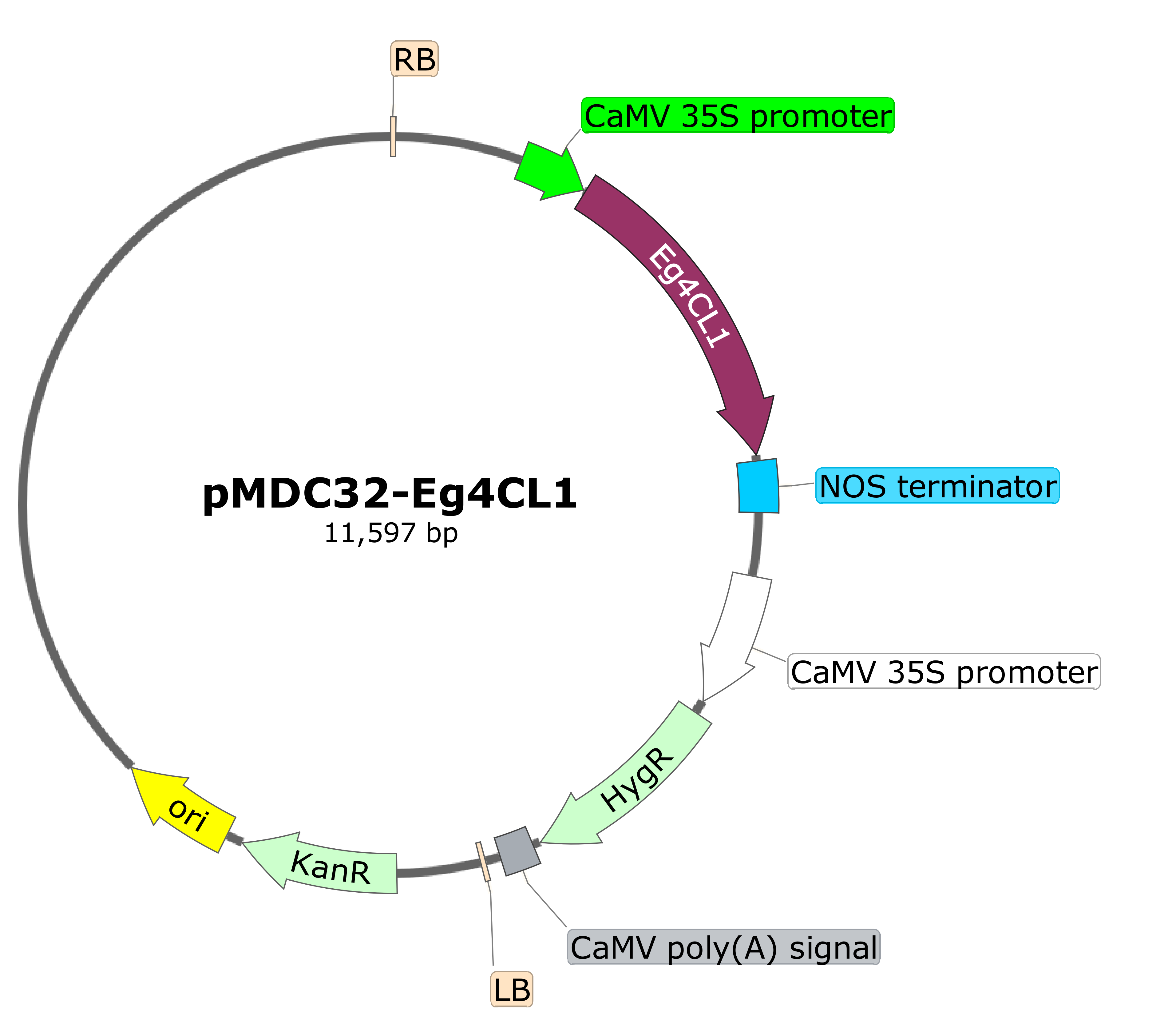
Oil palm (Elaeis guineensis) is a major source of biomass for biofuel production, in addition to yielding edible oil. However, its high lignin content limits biofuel production efficiency, presenting challenges for industrial applications. The oil palm Eg4CL1 gene has been suggested to play a key role in lignin biosynthesis, but its function remains unverified. Developing transgenic plants that express Eg4CL1 could aid in understanding its potential role. This study aims to generate transgenic Arabidopsis thaliana plants expressing the oil palm Eg4CL1 gene, which will serve as a tool for functional studies. The 1,623-bp Eg4CL1 gene was PCR amplified, cloned into the pMDC32 vector, and introduced into Arabidopsis using Agrobacterium tumefaciens through the floral dip method. Putative transgenic seedlings were selected on hygromycin-containing MS media and cultivated on substrate for molecular analysis. Ten putative transgenic lines were randomly selected and verified for transgene integration using PCR. Out of 3,000 seeds screened, 70 hygromycin-resistant seedlings were identified. PCR analysis produced a product of target size (≈1786 bp) from all lines analyzed, reflecting stable integration of the Eg4CL1 gene. These results indicate the genetic transformation of Arabidopsis was successfully accomplished. The establishment of transgenic Arabidopsis expressing Eg4CL1 will support future functional analysis.
References
[1] Murphy, D. J., K. Goggin, and R. R. M. Paterson. 2021. Oil Palm in the 2020s and Beyond: Challenges and Solutions. CABI Agriculture and Bioscience. 2(1): 39. https://doi.org/10.1186/s43170-021-00058-3.
[2] Awoh, E. T., J. Kiplagat, S. K. Kimutai, and A. C. Mecha. 2023. Current Trends in Palm Oil Waste Management: A Comparative Review of Cameroon and Malaysia. Heliyon. 9(11). https://doi.org/10.1016/j.heliyon.2023.e21410.
[3] Obada, D. O., M. O. Kekung, T. Levonyan, and G. W. Norval. 2023. Palm Oil Mill Derived Empty Palm Fruit Bunches as a Feed Stock for Renewable Energy Applications in Nigeria: A Review. Bioresource Technology Reports. 24: 101666. https://doi.org/10.1016/j.biteb.2023.101666.
[4] Li, J., D. Guan, S. Xia, Y. Fan, K. Zhao, Z. Zhao, et al. 2024. Recent Advances, Challenges, and Opportunities in Lignin Valorization for Value-Added Chemicals, Biofuels, and Polymeric Materials. Energy Conversion and Management. 322: 119123. https://doi.org/10.1016/j.enconman.2024.119123.
[5] Rashid, T., A. A. Taqvi, F. Sher, S. Rubab, M. Thanabalan, M. Bilal, et al. 2021. Enhanced Lignin Extraction and Optimisation from Oil Palm Biomass Using Neural Network Modelling. Fuel. 293: 120485. https://doi.org/10.1016/j.fuel.2021.120485.
[6] Saberi Riseh, R., F. Fathi, A. Lagzian, M. Vatankhah, and J. F. Kennedy. 2024. Modifying Lignin: A Promising Strategy for Plant Disease Control. International Journal of Biological Macromolecules. 271: 132696. https://doi.org/10.1016/j.ijbiomac.2024.132696.
[7] Choi, S. J., Z. Lee, S. Kim, E. Jeong, and J. S. Shim. 2023. Modulation of Lignin Biosynthesis for Drought Tolerance in Plants. Frontiers in Plant Science. 14. https://doi.org/10.3389/fpls.2023.1116426.
[8] Beig, B., M. Riaz, S. R. Naqvi, M. Hassan, Z. Zheng, K. Karimi, et al. 2021. Current Challenges and Innovative Developments in Pretreatment of Lignocellulosic Residues for Biofuel Production: A Review. Fuel. 287: 119670. https://doi.org/10.1016/j.fuel.2020.119670.
[9] Zhang, J., Y. Wang, X. Du, and Y. Qu. 2020. Selective Removal of Lignin to Enhance the Process of Preparing Fermentable Sugars and Platform Chemicals from Lignocellulosic Biomass. Bioresource Technology. 303: 122846. https://doi.org/10.1016/j.biortech.2020.122846.
[10] Wu, Z., N. Wang, H. Hisano, Y. Cao, F. Wu, W. Liu, et al. 2019. Simultaneous Regulation of F5H in COMT-RNAi Transgenic Switchgrass Alters Effects of Suppression on Syringyl Lignin Biosynthesis. Plant Biotechnology Journal. 17(4): 836–45. https://doi.org/10.1111/pbi.13019.
[11] Ahmad, K., and R. Ming. 2024. Harnessing Genetic Tools for Sustainable Bioenergy: A Review of Sugarcane Biotechnology in Biofuel Production. Agriculture. 14(8): 1312. https://doi.org/10.3390/agriculture14081312.
[12] Yusuf, C. Y. L., N. S. Nabilah, N. A. A. M. Taufik, I. A. Seman, and M. P. Abdullah. 2022. Genome-Wide Analysis of the CAD Gene Family Reveals Two Bona Fide CAD Genes in Oil Palm 3. Biotech. 12(7): 149. https://doi.org/10.1007/s13205-022-03208-0.
[13] Farhan, A. M., M. S. Hilman, M.-O. Abdullah, M. Y. Abdul Masani, N. A. Shaharuddin, and C. Y. L. Yusuf. 2024. Genetic Engineering of Lignin Biosynthesis for Enhanced Plant Traits: Applications in Bioenergy, Agriculture and Industry - A Review. GADING Journal of Science and Technology. 7(2): 73–84. https://myjms.mohe.gov.my/index.php/gjst/article/view/27379.
[14] Li, X., W. Chen, Y. Zhao, Y. Xiang, H. Jiang, S. Zhu, et al. 2013. Downregulation of Caffeoyl-CoA O-Methyltransferase (CCoAOMT) by RNA Interference Leads to Reduced Lignin Production in Maize Straw. Genetics and Molecular Biology. 36(4): 540–46. https://doi.org/10.1590/s1415-47572013005000039.
[15] Huang, S., X. Kang, R. Fu, L. Zheng, P. Li, F. Tang, et al. 2024. Simultaneous Down-Regulation of Dominant Cinnamoyl CoA Reductase and Cinnamyl Alcohol Dehydrogenase Dramatically Altered Lignin Content in Mulberry. Plants. 13(24). https://doi.org/10.3390/plants13243512.
[16] Wang, M., L. Jia, Y. Liu, C. Zhang, Y. Chen, Y. Lin, et al. 2024. Genome-Wide Identification, Evolutionary Analysis of 4CL Gene Family and Expression Analysis in Banana. Food and Agricultural Immunology. 35(1): 2287958. https://doi.org/10.1080/09540105.2023.2287958.
[17] Afifi, O. A., Y. Tobimatsu, P. Y. Lam, A. F. Martin, T. Miyamoto, Y. Osakabe, et al. 2022. Genome-Edited Rice Deficient in Two 4-COUMARATE:COENZYME A LIGASE Genes Displays Diverse Lignin Alterations. Plant Physiology. 190(4): 2155–72. https://doi.org/10.1093/plphys/kiac450.
[18] Yusuf, C. Y. L., I. Abu Seman, N. A. Ab Shukor, M. N. Mohd Nor, and M. P. Abdullah. 2018. Cloning and Analysis of the Eg4CL1 Gene and Its Promoter from Oil Palm (Elaeis guineensis Jacq.). Sains Malaysiana. 47(8): 1709–23. https://doi.org/10.17576/jsm-2018-4708-10.
[19] Yusuf, C. Y. L., J. O. Abdullah, N. A. Shaharuddin, I. Abu Seman, and M. P. Abdullah. 2018. Characterization of Promoter of EgPAL1, a Novel PAL Gene from the Oil Palm Elaeis guineensis Jacq. Plant Cell Reports. 37(2): 265–78. https://doi.org/10.1007/s00299-017-2228-7.
[20] Wang, X., Y. Sun, R. Wang, X. Li, Y. Li, T. Wang, et al. 2025. Overexpression of the GmPM35 Gene Significantly Enhances Drought Tolerance in Transgenic Arabidopsis and Soybean. Agronomy. 15(1): 192. https://doi.org/10.3390/agronomy15010192.
[21] Yang, Q.-Q., F. Yang, C.-Y. Liu, Y.-Q. Zhao, X.-J. Lu, J. Ge, et al. 2024. Genome-Wide Analysis of the HSF Family in Allium sativum L. and AsHSFB1 Overexpression in Arabidopsis under Heat Stress. BMC Genomics. 25(1): 1072. https://doi.org/10.1186/s12864-024-11002-w.
[22] Ferjani, A., H. Tsukagoshi, and V. Vassileva. 2023. Editorial: Model Organisms in Plant Science: Arabidopsis thaliana. Frontiers in Plant Science. 14. https://doi.org/10.3389/fpls.2023.1279230.
[23] Yusuf, C. Y. L., O. Nawawi, M. F. Azhari, M. S. Hilman, T. Bai, C. Zhang, et al. 2025. Functional Characterisation of the EgPAL5 Promoter from Oil Palm (Elaeis guineensis Jacq.) Reveals Its Potential Roles in Plant Growth and Adaptation to Drought. Journal of Horticultural Science and Biotechnology. 1–18. https://doi.org/10.1080/14620316.2025.2519330.
[24] Amack, S. C., and M. S. Antunes. 2020. CaMV35S Promoter – A Plant Biology and Biotechnology Workhorse in the Era of Synthetic Biology. Current Plant Biology. 24: 100179. https://doi.org/10.1016/j.cpb.2020.100179.
[25] Hilman, M. S., O. Nawawi, M. F. Azhari, T. Bai, C. Zhang, M. P. Abdullah, et al. 2025. A Comprehensive Method to Generating and Identifying Transgenic Tobacco Lines with a Single Transgene Integration Locus for Functional Analysis. Pertanika Journal of Tropical Agricultural Science. 48(1): 31–58. https://doi.org/10.47836/pjtas.48.1.03.
[26] Cabañas, M. J., D. Vázquez, and J. Modolell. 1978. Dual Interference of Hygromycin B with Ribosomal Translocation and with Aminoacyl-tRNA Recognition. European Journal of Biochemistry. 87(1): 21–27. https://doi.org/10.1111/j.1432-1033.1978.tb12347.x.
[27] Sundar, I. K., and N. Sakthivel. 2008. Advances in Selectable Marker Genes for Plant Transformation. Journal of Plant Physiology. 165(16): 1698–1716. https://doi.org/10.1016/j.jplph.2008.08.002.
[28] Miki, B., and S. McHugh. 2004. Selectable Marker Genes in Transgenic Plants: Applications, Alternatives and Biosafety. Journal of Biotechnology. 107(3): 193–232. https://doi.org/10.1016/j.jbiotec.2003.10.011.
[29] Martinez-Trujillo, M., V. Limones-Briones, J. L. Cabrera-Ponce, and L. Herrera-Estrella. 2004. Improving Transformation Efficiency of Arabidopsis thaliana by Modifying the Floral Dip Method. Plant Molecular Biology Reporter. 22 (1): 63–70. https://doi.org/10.1007/BF02773350.
[30] Akama, K., H. Shiraishi, S. Ohta, K. Nakamura, K. Okada, and Y. Shimura. 1992. Efficient Transformation of Arabidopsis thaliana: Comparison of the Efficiencies with Various Organs, Plant Ecotypes and Agrobacterium Strains. Plant Cell Reports. 12(1): 7–11. https://doi.org/10.1007/BF00232413.
[31] Ghedira, R., S. De Buck, J. Nolf, and A. Depicker. 2013. The Efficiency of Arabidopsis thaliana Floral Dip Transformation Is Determined Not Only by the Agrobacterium Strain Used but Also by the Physiology and the Ecotype of the Dipped Plant. Molecular Plant-Microbe Interactions. 26(7): 823–32. https://doi.org/10.1094/MPMI-11-12-0267-R.
[32] Mara, C., B. Grigorova, and Z. Liu. 2010. Floral-Dip Transformation of Arabidopsis thaliana to Examine pTSO2: Beta-Glucuronidase Reporter Gene Expression. Journal of Visualized Experiments. 40. https://doi.org/10.3791/1952.
[33] Li, S. S., Y. Chang, B. Li, S. L. Shao, and Z.-Z. Zhen. 2020. Functional Analysis of 4-Coumarate: CoA Ligase from Dryopteris fragrans in Transgenic Tobacco Enhances Lignin and Flavonoids. Genetics and Molecular Biology. 43(2): e20180355. https://doi.org/10.1590/1678-4685-gmb-2018-0355.
[34] Zhong, X.-L., S.-H. Zhu, Q. Zhao, Q. Luo, K. Wang, Z.-F. Chen, et al. 2023. Ag4CL3 Related to Lignin Synthesis in Apium graveolens L. Agronomy. 13(8): 2025. https://doi.org/10.3390/agronomy13082025.
Downloads
Published
Issue
Section
License
Copyright of articles that appear in Jurnal Teknologi belongs exclusively to Penerbit Universiti Teknologi Malaysia (Penerbit UTM Press). This copyright covers the rights to reproduce the article, including reprints, electronic reproductions, or any other reproductions of similar nature.