
DETAILED KINETICS OF TETRACYCLINE ADSORPTION IN AQUEOUS SOLUTION BY PALM SHELL-DERIVED ACTIVAED CARBON
DOI:
https://doi.org/10.11113/jurnalteknologi.v88.25000Keywords:
Activated carbon, adsorption, pore volume and surface diffusion model, tetracycline, wastewater treatmentAbstract
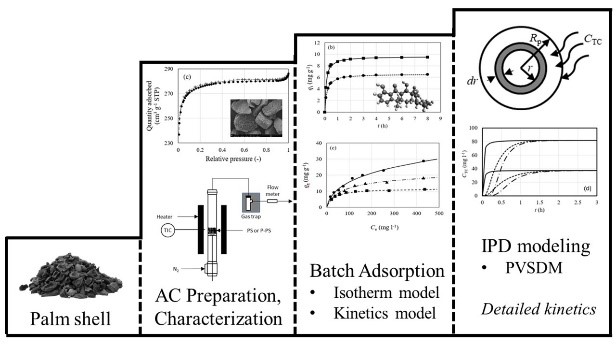
The excessive excretion of antibiotics in wastewater poses significant environmental risks. Adsorption is expected as highly efficient, cost-effective, and sustainable methods for treating these contaminants. This study investigated the adsorption of tetracycline hydrochloride (TC) on palm shell derived activated carbon (PSAC) using the advanced pore volume and surface diffusion model (PVSDM). Scanning electron microscopy and N2 adsorption isotherm revealed a highly microporous PSAC with a specific surface area of 852.85 m2 g-1, an average pore diameter of 2.068 nm and a micropore proportion of 0.72. In the developing PVSDM, conventional isotherms (e.g. Langmuir, Freundlich and Redlich-Peterson) and global kinetics models (e.g. pseudo-first order, pseudo-second order and Elovich) were comprehensively analyzed and the most suitable isotherm and global kinetics models were incorporated into the PVSDM. External film diffusion and intraparticle diffusion (IPD) investigation, according to Weber-Morris and Boyd, consistently confirmed strong IPD control. The PVSDM effectively reproduced time-dependent adsorption capacity in batch experiment and was verified by reasonable prediction of the dynamic change of adsorption capacity within the PSAC particle. The determined mass transfer parameters indicated that pore volume diffusion was the dominant mechanism, while surface diffusion was insignificant. This study demonstrates the effectiveness of PVSDM for quantifying mass transfer resistances in adsorption of TC on PSAC, providing valuable insights for the design and optimization of large-scale adsorption equipment for treatment of antibiotics in wastewater.
References
[1] Chopra, I., and M. Roberts. 2001. Tetracycline Antibiotics: Mode of Action, Applications, Molecular Biology, and Epidemiology of Bacterial Resistance. Microbiology and Molecular Biology Reviews. 65: 232–260.
[2] Minarini, L. A. D. R., L. N. de Andrade, E. De Gregorio, F. Grosso, T. Naas, R. Zarrilli, and I. L. B. C. Camargo. 2020. Editorial: Antimicrobial Resistance as a Global Public Health Problem: How Can We Address It? Frontiers in Public Health. 8: 1–6.
[3] Hou, J., C. Wang, D. Mao, and Y. Luo. 2016. The Occurrence and Fate of Tetracyclines in Two Pharmaceutical Wastewater Treatment Plants of Northern China. Environmental Science and Pollution Research. 23: 1722–1731.
[4] Martins, A. C., O. Pezoti, A. L. Cazetta, K. C. Bedin, D. A. S. Yamazaki, G. F. G. Bandoch, T. Asefa, J. V. Visentainer, and V. C. Almeida. 2015. Removal of Tetracycline by NaOH-Activated Carbon Produced from Macadamia Nut Shells: Kinetic and Equilibrium Studies. Chemical Engineering Journal. 260: 291–299.
[5] Marzbali, M. H., M. Esmaieli, H. Abolghasemi, and M. H. Marzbali. 2016. Tetracycline Adsorption by H₃PO₄-Activated Carbon Produced from Apricot Nut Shells: A Batch Study. Process Safety and Environmental Protection 102: 700–709.
[6] Huang, H., J. Tang, K. Gao, R. He, H. Zhao, and D. Werner. 2017. Characterization of KOH Modified Biochars from Different Pyrolysis Temperatures and Enhanced Adsorption of Antibiotics. RSC Advances. 7: 14640–14648.
[7] Hidayu, A. R., N. F. Mohamad, S. Matali, and A. S. A. K. Sharifah. 2013. Characterization of Activated Carbon Prepared from Oil Palm Empty Fruit Bunch Using BET and FT-IR Techniques. Procedia Engineering. 68: 379–384.
[8] Hidayu, A. R., and N. Muda. 2016. Preparation and Characterization of Impregnated Activated Carbon from Palm Kernel Shell and Coconut Shell for CO₂ Capture. Procedia Engineering. 148: 106–113.
[9] Souza, P. R., G. L. Dotto, and N. P. G. Salau. 2017. Detailed Numerical Solution of Pore Volume and Surface Diffusion Model in Adsorption Systems. Chemical Engineering Research and Design. 122: 298–307.
[10] Wilke, C. R., and P. Chang. 1955. Correlation of Diffusion Coefficients in Dilute Solutions. AIChE Journal. 1: 264–270.
[11] Shi, S., A. Luo, J. Hao, S. Xie, and J. Feng. 2023. "Three-Dimensional Mass Transfer Modeling of Hydroquinone Adsorption on Phragmites australis Biochar. Toxics. 11: 1–13.
[12] Abdel Daiem, M. M., M. Sánchez-Polo, A. S. Rashed, N. Kamal, and N. Said. 2019. Adsorption Mechanism and Modelling of Hydrocarbon Contaminants onto Rice Straw Activated Carbons. Polish Journal of Chemical Technology. 21: 1–12.
[13] Benoit, B., Pierre Le Cloirec, and Dominique W. 2008. Revisiting the Determination of Langmuir Parameters—Application to Tetrahydrothiophene Adsorption onto Activated Carbon. Langmuir. 24: 6420–6424.
[14] Hubbe, M., S. Azizian, and S. Douven. 2019. Implications of Apparent Pseudo-Second-Order Adsorption Kinetics onto Cellulosic Materials: A Review. BioResources. 14: 7582–7626.
[15] Hubbe, M. A., J. Park, and S. Park. 2014. "Cellulosic Substrates for Removal of Pollutants from Aqueous Systems: A Review. Part 4. Dissolved Petrochemical Compounds." BioResources 9: 7782–7925.
[16] Tran, H. N., S. J. You, A. Hosseini-Bandegharaei, and H. P. Chao. 2017. Mistakes and Inconsistencies Regarding Adsorption of Contaminants from Aqueous Solutions: A Critical Review. Water Research. 120: 88–116.
[17] Wang, J., and X. Guo. 2022. Rethinking of the Intraparticle Diffusion Adsorption Kinetics Model: Interpretation, Solving Methods and Applications. Chemosphere. 309: 136732.
[18] Wang, G., Z. T. Chen, X. Y. Lan, W. Wang, C. M. Xu, and J. S. Gao. 2011. Restricted Diffusion of Residual Molecules in Catalyst Pores under Reactive Conditions. Chemical Engineering Science. 66: 1200–1211.
[19] Fogler, H. Scott. 2006. Elements of Chemical Reaction Engineering. 4th ed. Upper Saddle River, NJ: Prentice Hall, 814–816.
[20] Fröhlich, A. C., R. Ocampo-Pérez, V. Diaz-Blancas, N. P. G. Salau, and G. L. Dotto. 2018. Three-Dimensional Mass Transfer Modeling of Ibuprofen Adsorption on Activated Carbon Prepared by Sonication. Chemical Engineering Journal. 341: 65–74.
Downloads
Published
Issue
Section
License
Copyright of articles that appear in Jurnal Teknologi belongs exclusively to Penerbit Universiti Teknologi Malaysia (Penerbit UTM Press). This copyright covers the rights to reproduce the article, including reprints, electronic reproductions, or any other reproductions of similar nature.