
PERFORMANCE OPTIMIZATION OF SUSTAINABLE RAMMED EARTH BLOCKS REINFORCED WITH JUTE AND LIMESTONE CALCINED CLAY CEMENT (LC3)
DOI:
https://doi.org/10.11113/jurnalteknologi.v88.25046Keywords:
Jute Fiber Reinforcement, Limestone Calcined Clay Cement Stabilization, Rammed Earth, Durability, Microstructural AnalysisAbstract
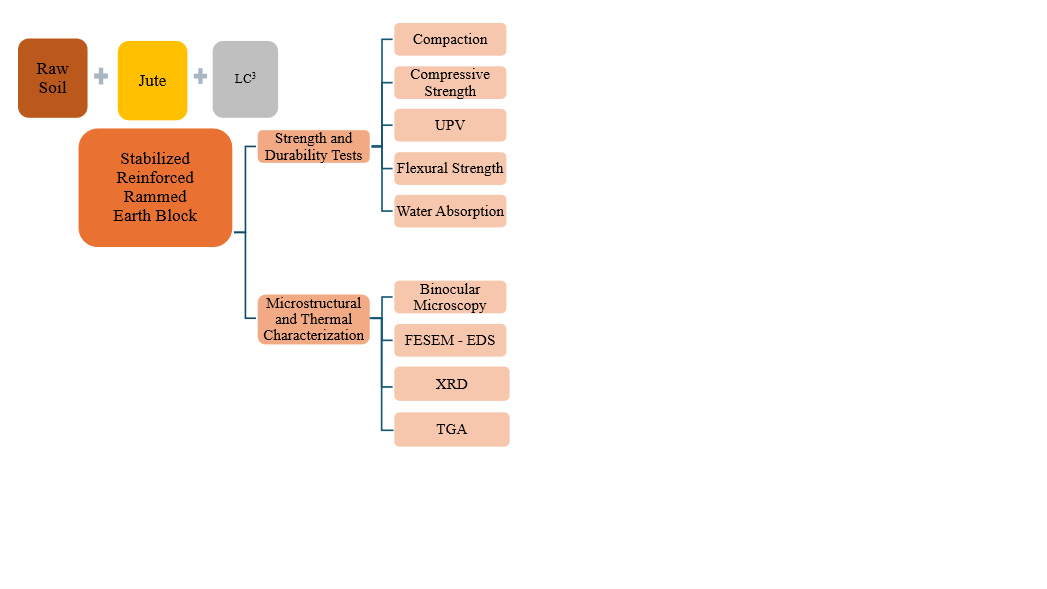
Rammed earth blocks (REBs) are attracting renewed attention as sustainable building materials due to their low embodied energy and use of locally sourced soil, yet their limited tensile strength and moisture sensitivity restrict wider structural applications. This study investigates a dual enhancement approach, combining natural jute fiber reinforcement (0.25–1.25% by weight) with 10% Limestone Calcined Clay Cement (LC3) stabilization. To evaluate performance, mechanical tests—including compaction, compressive strength (dry and wet), flexural strength, ultrasonic pulse velocity (UPV), and water absorption—were performed. Microstructural evolution was examined through binocular microscopy, FESEM-EDS, XRD, and TGA analyses. Results indicated that 1% jute fiber provided the best balance of strength and ductility, while LC3 contributed to matrix densification and improved durability. The combined system achieved a compressive strength of 4.32 MPa, a flexural strength of 1.17 MPa, and reduced water absorption to 13.18%. Microstructural observations confirmed the formation of pozzolanic products and a refined pore network, highlighting the potential of this composite for durable, low-carbon, and cost-effective construction.
References
[1] Paul, S., M. S. Islam, and T. E. Elahi. 2022. Comparative Effectiveness of Fibers in Enhancing Engineering Properties of Earth as a Building Material: A Review. Construction and Building Materials. 332: 127366. https://doi.org/10.1016/j.conbuildmat.2022.127366.
[2] Deepak, M., Y. R. Reddy, and R. Nagendra. 2024. Experimental Investigation on Strength, Durability, and Microstructural Characteristics of Slag-Based Cement Mortar. International Journal of Engineering, Transactions A: Basics. 37(4): 763–78. https://doi.org/10.5829/IJE.2024.37.04A.15.
[3] Matos, A. M., and H. Varum. 2022. Self-Compacting Earth-Based Composites: Mixture Design and Multi-Performance Characterisation. Buildings. 12(5): 612. https://doi.org/10.3390/buildings12050612.
[4] Losini, A. E., L. Lavrik, M. Caruso, M. Woloszyn, A. C. Grillet, G. Dotelli, et al. 2021. Mechanical Properties of Rammed Earth Stabilized with Local Waste and Recycled Materials. Critical Trends in Applied Sciences. 1: 113–23. https://doi.org/10.4028/www.scientific.net/CTA.1.113.
[5] Deegoda, I., S. Buddika, H. Yapa, S. Navaratnam, and G. Zhang. 2023. Review on the Application of Organic Fibers as Substitutes for Asbestos in Thin Fiber Cement Sheets from a Sri Lankan Perspective. Sustainability. 15(13): 10235. https://doi.org/10.3390/su151310235.
[6] Abedi, M., O. Hassanshahi, A. Rashiddel, H. Ashtari, M. Seddik Meddah, D. Dias, et al. 2023. A Sustainable Cementitious Composite Reinforced with Natural Fibers: An Experimental and Numerical Study. Construction and Building Materials. 378: 131093. https://doi.org/10.1016/j.conbuildmat.2023.131093.
[7] Mekonnen, B. Y., and Y. J. Mamo. 2020. Tensile and Flexural Analysis of a Hybrid Bamboo/Jute Fiber-Reinforced Composite with Polyester Matrix as a Sustainable Green Material for Wind Turbine Blades. International Journal of Engineering, Transactions B: Applications. 33(2): 314–19. https://doi.org/10.5829/ije.2020.33.02b.16.
[8] Abedi, M., F. Gulisano, B. Han, R. Fangueiro, and A. G. Correia. 2024. The Pioneer of Intelligent and Sustainable Construction in Tunnel Shotcrete Applications: A Comprehensive Experimental and Numerical Study on a Self-Sensing and Self-Heating Green Cement-Based Composite. Measurement Science and Technology. 35(6): 065601. https://doi.org/10.1088/1361-6501/ad338e.
[9] Kafodya, I., D. Basuroy, J. M. Marangu, G. Kululanga, R. Maddalena, and V. I. Novelli. 2023. Mechanical Performance and Physico-Chemical Properties of Limestone Calcined Clay Cement (LC3) in Malawi. Buildings. 13(3): 740. https://doi.org/10.3390/buildings13030740.
[10] Randeep, S. Srivastava, and V. Soamidas. 2025. Performance Evaluation and Microstructural Characterisation of Stabilised Rammed Earth Blocks Using Limestone Dust Powder and LC3. Iranian Journal of Science and Technology, Transactions of Civil Engineering. https://doi.org/10.1007/s40996-025-01991-3.
[11] Baghban, M. H., and R. Mahjoub. 2020. Natural Kenaf Fiber and LC3 Binder for Sustainable Fiber-Reinforced Cementitious Composite: A Review. Applied Sciences. 10(1): 357. https://doi.org/10.3390/app10010357.
[12] Guo, D., M. Guo, F. Xing, Y. Zhou, Z. Huang, and W. Cao. 2023. Using Limestone Calcined Clay Cement and Recycled Fine Aggregate to Make Ultra-High-Performance Concrete: Properties and Environmental Impact. Construction and Building Materials. 394: 132026. https://doi.org/10.1016/j.conbuildmat.2023.132026.
[13] Girinivas, K., and M. M. Hanamasagar. 2024. Unconfined Compressive Strength of Cement-Stabilized Soil Using Industrial Wastes Including Optimization of Polypropylene Fiber. International Journal of Engineering, Transactions B: Applications. 37(9): 1847–56. https://doi.org/10.5829/IJE.2024.37.09C.14.
[14] Zamanian, M., M. Salimi, M. Payan, A. Noorzad, and M. Hassanvandian. 2023. Development of High-Strength Rammed Earth Walls with Alkali-Activated Ground Granulated Blast Furnace Slag (GGBFS) and Waste Tire Textile Fiber (WTTF) as a Step towards Low-Carbon Building Materials. Construction and Building Materials. 394: 132180. https://doi.org/10.1016/j.conbuildmat.2023.132180.
[15] Suresh, A. 2007. Certified Organization. International Journal of Innovative Research in Science, Engineering and Technology. 3297. http://www.ijirset.com.
[16] Schmitz, L. P., J. Gosslar, E. Dorresteijn, D. Lowke, and H. Kloft. 2024. Experimental Investigations on the Compaction Energy for a Robotic Rammed Earth Process. Frontiers in Built Environment. 10: 1363804. https://doi.org/10.3389/fbuil.2024.1363804.
[17] Malkanthi, S. N., and A. A. D. A. J. Perera. 2019. Particle Packing Application for Improvement in the Properties of Compressed Stabilized Earth Blocks with Reduced Clay and Silt. Engineering, Technology & Applied Science Research. 9(4): 4538–42. https://doi.org/10.48084/etasr.3002.
[18] Carmel, V. A., and T. Vinu. n.d. Stabilization of Soft Clay Using Lime and Jute Fibres. http://www.ijert.org.
[19] Kumar, D., S. Nigam, A. Nangia, and S. Tiwari. 2015. California Bearing Ratio Variations in Soil Reinforced with Natural Fibres: A Case Study of Bhopal Bypass Road. International Journal on Emerging Technologies. 6(2): 95–104. http://www.researchtrend.net.
[20] Majumder, A., F. Stochino, A. Frattolillo, M. Valdes, G. Mancusi, and E. Martinelli. 2023. Jute Fiber-Reinforced Mortars: Mechanical Response and Thermal Performance. Journal of Building Engineering. 66: 105888. https://doi.org/10.1016/j.jobe.2023.105888.
[21] Kumar, S., A. K. Sahu, and S. Naval. 2020. Influence of Jute Fibre on CBR Value of Expansive Soil. Civil Engineering Journal. 6(6): 1180–94. https://doi.org/10.28991/cej-2020-03091539.
[22] Hamid, A., and H. Shafiq. 2017. Subgrade Soil Stabilization Using Jute Fibre as a Reinforcing Material. International Journal of Engineering Development and Research. 5(1). http://www.ijedr.org.
[23] Araya-Letelier, G., F. C. Antico, C. Burbano-Garcia, J. Concha-Riedel, J. Norambuena-Contreras, J. Concha, et al. 2021. Experimental Evaluation of Adobe Mixtures Reinforced with Jute Fibers. Construction and Building Materials. 276: 122127. https://doi.org/10.1016/j.conbuildmat.2020.122127.
[24] Fidelis, M. E. A., R. D. Toledo Filho, F. de Andrade Silva, B. Mobasher, S. Müller, and V. Mechtcherine. 2019. Interface Characteristics of Jute Fiber Systems in a Cementitious Matrix. Cement and Concrete Research. 116: 252–65. https://doi.org/10.1016/j.cemconres.2018.12.002.
[25] Barbhuiya, Salim, Jaya Nepal, and Bibhuti Bhusan Das. 2023. Properties, Compatibility, Environmental Benefits, and Future Directions of Limestone Calcined Clay Cement (LC3) Concrete: A Review. Journal of Building Engineering. 79: 107794. https://doi.org/10.1016/j.jobe.2023.107794.
[26] Ijaz, N., W. Ye, Z. ur Rehman, and Z. Ijaz. 2022. Novel Application of Low-Carbon Limestone Calcined Clay Cement (LC3) in Expansive Soil Stabilization: An Eco-Efficient Approach. Journal of Cleaner Production. 371: 133492. https://doi.org/10.1016/j.jclepro.2022.133492.
[27] Bureau of Indian Standards. 1980. IS 2720-7: Methods of Test for Soils, Part 7: Determination of Water Content–Dry Density Relation Using Light Compaction. New Delhi: Bureau of Indian Standards.
[28] Bureau of Indian Standards. 1970. IS 4332-5: Methods of Test for Stabilized Soils, Part 5: Determination of Unconfined Compressive Strength of Stabilized Soils. New Delhi: Bureau of Indian Standards.
[29] Bureau of Indian Standards. 1972. IS 4332-6: Methods of Test for Stabilized Soils, Part 6: Flexural Strength of Soil-Cement Using Simple Beam with Third-Point Loading. New Delhi: Bureau of Indian Standards.
[30] Bureau of Indian Standards. 1992. IS 13311-1: Method of Non-Destructive Testing of Concrete, Part 1: Ultrasonic Pulse Velocity. New Delhi: Bureau of Indian Standards.
[31] Bureau of Indian Standards. 1992. IS 3495, Parts 1–4: Methods of Tests of Burnt Clay Building Bricks. New Delhi: Bureau of Indian Standards.
[32] Utkarsh, and P. K. Jain. 2024. A Review on Innovative Approaches to Expansive Soil Stabilization: Focusing on EPS Beads, Sand, and Jute. Science and Engineering of Composite Materials. 31(1). https://doi.org/10.1515/secm-2024-0005.
[33] Kumar, S. K. M., S. Ayesha Siddiqa, and M. U. B. Habiba. n.d. Stabilization of Black Cotton Soil Using Jute Fibre. http://www.ijert.org.
[34] Kanth, K. R., and K. Deepthi. 2019. An Experimental Study on Stabilization of Loose Soil by Using Jute Fiber. International Journal of Trend in Scientific Research and Development. https://doi.org/10.31142/ijtsrd26441.
[35] Sharma, Y., G. M. Purohit, and S. Sharma. 2017. Improvement of Soil Properties by Using Jute Fibre as Soil Stabilizer. American Journal of Engineering Research. 6: 123–29. http://www.ajer.org.
[36] Song, H., J. Liu, K. He, and W. Ahmad. 2021. A Comprehensive Overview of Jute Fiber-Reinforced Cementitious Composites. Case Studies in Construction Materials. 15: e00724. https://doi.org/10.1016/j.cscm.2021.e00724.
[37] Fagone, M., F. Loccarini, and G. Ranocchiai. 2017. Strength Evaluation of Jute Fabric for the Reinforcement of Rammed Earth Structures. Composites Part B: Engineering. 113: 1–13. https://doi.org/10.1016/j.compositesb.2016.12.054.
[38] Shojaei Baghini, M., A. Ismail, B. Kheradmand, M. H. Hafezi, and A. Almansob. 2013. The Potentials of Portland Cement and Bitumen Emulsion Mixture on Soil Stabilization in Road Base Construction. Jurnal Teknologi. http://www.jurnalteknologi.utm.my.
[39] Maslinda, A. B., M. S. Abdul Majid, M. J. M. Ridzuan, M. Afendi, and A. G. Gibson. 2017. Effect of Water Absorption on the Mechanical Properties of Hybrid Interwoven Cellulosic–Cellulosic Fibre-Reinforced Epoxy Composites. Composite Structures. 167: 227–37. https://doi.org/10.1016/j.compstruct.2017.02.023.
[40] Tech, H. M. M., and S. Chouhan. 2023. A Review on Soil Stabilization with Natural Materials: Jute and Gypsum. International Journal for Research in Engineering Application & Management. 9: 1.
[41] Moreira, G., A. M. de Souza, F. P. da F. Elói, G. J. B. Silva, D. S. de Oliveira, and J. M. F. de Carvalho. 2025. Study of the Use of LC3 Cements Containing Different Calcined Clays and Fillers. Ambiente Construído. 25. https://doi.org/10.1590/s1678-86212025000100859.
[42] Wu, H., H. Song, X. Sun, Y. Bi, S. Fu, and N. Yang. 2023. Geo-Environmental Properties and Microstructural Characteristics of Sustainable Limestone Calcined Clay Cement (LC3) Binder-Treated Zn-Contaminated Soils. Journal of Zhejiang University–Science A. 24(10): 898–911. https://doi.org/10.1631/jzus.A2200531.
[43] Kasinikota, P., and D. D. Tripura. 2021. Evaluation of Compressed Stabilized Earth Block Properties Using Crushed Brick Waste. Construction and Building Materials. 280: 122520. https://doi.org/10.1016/j.conbuildmat.2021.122520.
[44] Khan, S., A. Ali, T. Bibi, and F. Wadood. 2024. Improving the Durability and Mechanical Performance of Self-Compacting Mortar Utilizing Natural and Synthetic Fibers. Innovative Infrastructure Solutions. 9(8). https://doi.org/10.1007/s41062-024-01646-8.
[45] Mawlod, A. O. 2025. Fresh and Hardened Performance of Fiber-Reinforced Limestone Calcined Clay Cement (LC3) Composite. Innovative Infrastructure Solutions. 10 (3). https://doi.org/10.1007/s41062-025-01905-2.
[46] Sangma, S., and D. D. Tripura. 2021. Flexural Strength of Cob Wallettes Reinforced with Bamboo and Steel Mesh. Construction and Building Materials. 272: 121662. https://doi.org/10.1016/j.conbuildmat.2020.121662.
[47] Galán-Marín, C., C. Rivera-Gómez, and J. Petric. 2010. Clay-Based Composite Stabilized with Natural Polymer and Fibre. Construction and Building Materials. 24(8): 1462–68. https://doi.org/10.1016/j.conbuildmat.2010.01.008.
[48] Raavi, S. S. D., and D. D. Tripura. 2021. Predicting the Effect of Weathering and Corrosion on the Bond Properties of Bamboo- and Steel-Reinforced Cement-Stabilized Rammed Earth Blocks. Advances in Structural Engineering. 24(14): 3267–80. https://doi.org/10.1177/13694332211026222.
[49] Raheem, A. A. 2012. A Comparative Study of Cement- and Lime-Stabilized Lateritic Interlocking Blocks. http://www.akamaiuniversity.us/PJST.htm.
[50] Narloch, P., and P. Woyciechowski. 2020. Assessing Cement-Stabilized Rammed Earth Durability in a Humid Continental Climate. Buildings. 10(2): 26. https://doi.org/10.3390/buildings10020026.
[51] Abdul, K., H. Saeed, K. A. Kassim, N. Zurairahetty, M. Yunus, H. Nur, et al. 2015. Physico-Chemical Characterization of Lime-Stabilized Tropical Kaolin Clay. Jurnal Teknologi. 72. https://doi.org/10.11113/jt.v72.4021.
[52] Wu, H., H. Song, X. Sun, Y. Bi, S. Fu, and N. Yang. 2023. Geo-Environmental Properties and Microstructural Characteristics of Sustainable Limestone Calcined Clay Cement (LC3) Binder-Treated Zn-Contaminated Soils. Journal of Zhejiang University–Science A. 24(10): 898–911. https://doi.org/10.1631/jzus.A2200531.
[53] Zunino, F., and K. Scrivener. 2022. Microstructural Developments of Limestone Calcined Clay Cement (LC3) Pastes after Long-Term (3 Years) Hydration. Cement and Concrete Research. 153: 106693. https://doi.org/10.1016/j.cemconres.2021.106693.
[54] Dhandapani, Y., T. Sakthivel, M. Santhanam, R. Gettu, and R. G. Pillai. 2018. Mechanical Properties and Durability Performance of Concretes with Limestone Calcined Clay Cement (LC3). Cement and Concrete Research. 107: 136–51. https://doi.org/10.1016/j.cemconres.2018.02.005.
[55] Fahad, M., Z. Farooq, M. Abrar, K. H. Shah, T. Iqbal, and S. Saeed. 2018. Elemental Analysis of Limestone by Laser-Induced Breakdown Spectroscopy, Scanning Electron Microscopy Coupled with Energy-Dispersive X-Ray Spectroscopy, and Electron Probe Microanalysis. Laser Physics. 28(12). https://doi.org/10.1088/1555-6611/aae49d.
[56] Kasim, F., A. Marto, N. A. Abdul Rahman, and C. S. Tan. 2015. Unconfined Compressive Strength and Microstructure of Clay Soil Stabilised with Biomass Silica. Jurnal Teknologi. 77. https://doi.org/10.11113/jt.v77.6382.
[57] Bernal, I. M. R., S. Shirani, A. Cuesta, I. Santacruz, and M. A. G. Aranda. 2021. Phase and Microstructure Evolutions in LC3 Binders by a Multi-Technique Approach Including Synchrotron Microtomography. Construction and Building Materials. 300: 124054. https://doi.org/10.1016/j.conbuildmat.2021.124054.
[58] Gowri, K., and A. Abdul Rahim. 2024. Studies on Hybrid Quaternary Blended Limestone Calcined Clay Cement (LC3) for Sustainable Concrete. Innovative Infrastructure Solutions. 9(11). https://doi.org/10.1007/s41062-024-01742-9.
Downloads
Published
Issue
Section
License
Copyright of articles that appear in Jurnal Teknologi belongs exclusively to Penerbit Universiti Teknologi Malaysia (Penerbit UTM Press). This copyright covers the rights to reproduce the article, including reprints, electronic reproductions, or any other reproductions of similar nature.