
EXPERIMENTAL STUDY OF SCOUR DOWNSTREAM TWO PARALLEL CULVERTS
DOI:
https://doi.org/10.11113/jurnalteknologi.v89.25067Keywords:
Circular culverts, Erosion, Aggregation bedsAbstract
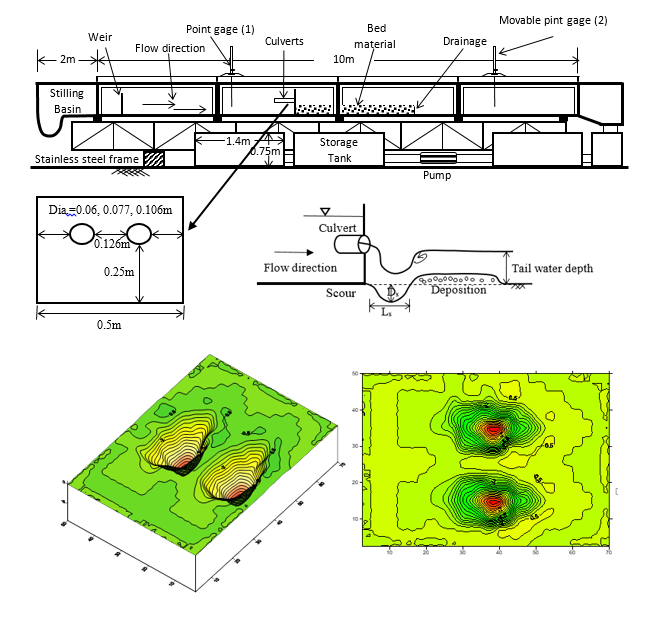
An experimental study was conducted to investigate scour downstream of two parallel circular culverts, where the culvert spacing was equal to the distance between the channel wall and the culvert edge. The study focused on scour hole characteristics, specifically depth and length, under varying conditions. Experiments were performed using three aggregate sizes with median diameters (D₅₀) of 3.25 mm, 4.5 mm, and 7.5 mm as the downstream bed material. Three culvert diameters (60 mm, 77 mm, and 106 mm) were tested for each aggregate size. Results indicated that increasing discharge led to greater scour depth and length, whereas larger bed material reduced the dimensions of scour. At higher discharges, overlapping scour holes formed beneath the culvert gates. Two empirical equations were derived to estimate relative scour depth and length.
References
[1] Ghdhban, I.I., Irzooki, R.H. (2024). Estimation of annual evaporation losses for the Makhoul Dam reservoir (under construction). NTU Journal for Renewable Energy, Vol. 6 (1): 42-59. https://journals.ntu.edu.iq/index.php/NTU-JRE. https://doi.org/10.56286/s95p8x11
[2] Day, R.A., Liriano, S.L., & White, W.R. (2001). Effect of tailwater depth and model scale on scour at culvert outlets, 148(3):189-197. https://doi.org/10.1680/maen.148.3.189.40098
[3] Alrahhawi, G.(2024). STEEPED SPILLWAY AS A MEAN FOR ENERGY DISSIPATION - A REVIEW. Advanced Engineering Letters. Vol.3, No.3, 118-131. https://doi.org/10.46793/adeletters.2024.3.3.4
[4] Abdel Aal G. M., El-Saiad A.A., Elnikhely E., Elshahat E.M. (2019). Minimizing of Scour Downstream the outlets of the Box Culvert. International Journal of Civil Engineering and Technology, 10(3):3172-3188.
[5] Younis, S.S., Hassan, K.F., (2021). Validity of Some International Rainfall Erosivity Models for Mosul Climatic Condition in Northern Iraq. NTU Journal of Agriculture and Vaeterinay Sciences (NTU-JAVS). Vol 1 No. 1 PP. 43-47.
[6] Ali, K.H.M., & Lim, S.Y. (1986). Local scour caused by submerged wall jets. Proceedings of the Institution of Civil Engineers, 81(4), 607-645. https://doi.org/10.1680/iicep.1986.464
[7] Ali, K.H.M., NEYSHABOURY, S., & NEYSHABOURY, A.A.S. (1991). LOCALIZED SCOUR DOWNSTREAM OF A DEEPLY SUBMERGED HORIZONTAL JET. Proceedings of the Institution of Civil Engineers, 91(1), 1-18. https://doi.org/10.1680/iicep.1991.13579
[8] Lim, S.-Y., & Lim, Y. (1995). Wriften discussion closes Scour below unsubmerged culvert outlets. In Proc. Instn Civ. Engrs Wat., Marit. &Energy (Vol. 112). https://doi.org/10.1680/iwtme.1995.27659
[9] Liriano, S. L., Day, R.A., & Rodney White, W. (2002). Scour at culvert outlets as influenced by the turbulent flow structure. Journal of Hydraulic Research, 40(3), 367-376.
https://doi.org/10.1080/00221680209499951
[10] Mazurek, K.A., Rajaratnam, N., & Sego, D.C. (2003). Scour of a cohesive soil by submerged plane turbulent wall jets. Journal of Hydraulic Research, 41(2), 195-206. https://doi.org/10.1080/00221680309499961
[11] Ghodsian, M., B. Melville, and D. Tajkarimi. "Local scour due to free overfall jet." Proceedings of the Institution of Civil Engineers-Water Management. Vol. 159. No. 4. Thomas Telford Ltd, 2006. https://doi.org/10.1680/wama.2006.159.4.253
[12] Hoffmans, J., Gijs, J., & Hg. (2006). Scour Caused by Rectangular Impinging Jet in Cohesiveless Beds. https://hdl.handle.net/20.500.11970/100019
[13] Azamathulla, H.M., Asce, M., & Ghani, A.A. (2011). ANFIS-Based Approach for Predicting the Scour Depth at Culvert Outlets, Journal of Pipeline Systems Engineering and Practice, 2(1). https://doi.org/10.1061/(ASCE)PS.1949-1204.0000066
[14] Jafari, S., Vaghefi, M., Mahmoudi, A., (2024). Experimental investigation of temporal evaluations of scouring downstream of culvert, Applied Water Science 14(6):1-23. https://doi.org/10.1007/s13201-024-02202-6
[15] Israa A. Mohammed Jawad, Thamer Ahmad Mohammad (2025). Assessment of Scour Depth Downstream of Sharp Crested Weirs: An Experimental Study. Journal of Engineering 31 (8): 12-25. https://doi.org/10.31026/j.eng.2025.08.02.
[16] Saleh, L.A.M., Khassaf, S.L. (2023). Effects of Chute Block Geometry on the Performance of the USBR II Stilling Basin. Jordan Journal of Civil Engineering, 17(3). https://doi.org/10.14525/JJCE.v17i3.12
[17] Alwan, H.H., Saleh, L.A.M., Saleh, L.A.M., AL-Mohammed, F.M., Abdulredha, M.A. (2020). Experimental Prediction of the Discharge Coefficients for Rectangular Weir with Bottom Orifices. Journal of Engineering Science and Technology, 15(5), 3265-3280.
[18] Simons, D. B., & Şentürk, F. (1992). Sediment transport technology: water and sediment dynamics. Water Resources Publication.
[19] Melville, B. W., & Sutherland, A. J. (1988). Design method for local scour at bridge piers. Journal of Hydraulic Engineering, 114(10), 1210e1226. https://doi.org/10.1061/(ASCE)0733-9429(1988)114:10(1210)
[20] Abdulhafedh, A. Y., Alomari, N. K., & Al-Janabi, A. M. S. (2023). Scour hole reduction at a diversion channel junction using different entrance edge shapes. International Journal of Sediment Research, 38(6), 811-820. https://doi.org/10.1016/j.ijsrc.2023.07.001
[21] Abddalla, M.G., Abdel Hady, M.A., Ahmed, M.W., (2016). Studying Scour Hole Development Around Rectangular Bridge Piers, MANSOURA ENGINEERING JOURNAL, 4(1).
[22] Golden Software Inc. (1999). Surfer 7 Users Guide: Contouring and 3D Surface Mapping for Scientists and Engineers. Gold Software Incorporated, 1999.
[23] Munson, Bruce R., Theodore H. Okiishi, Wade W. Huebsch, and Alric P. Rothmayer. 2013. Fundamentals of Fluid Mechanics. 7th ed. Wiley.
[24] Ahmed, K.O., Kavianpour, M.R., Amini, A., Aminpour, Y., (2024). A state- of- the- art review of physical modeling of scouring at the culvert outlet. ISH JOURNAL OF HYDRAULIC ENGINEERING,30(4). https://doi.org/10.1080/09715010.2024.2340626
[25] Ahmed, K.O., Nariman, N., Hawez, D.M., Kisi, O., Amini, A., (2023). Predicting and Optimizing the Infuenced Parameters for Culvert Outlet Scouring Utilizing Coupled FLOW 3D Surrogate Modeling. Iranian Journal of Science and Technology, Transactions of Civil Engineering, 47, 1763-1776, https://doi.org/10.1007/s40996-023-01096-9.
[26] Ruff, J. F., Abt, S. R., Mendoza, C., Shaikh, A., & Kloberdanz, R. (1982). Scour at culvert outlets in mixed bed materials (No. FHWA/RD-82/011). United States. Federal Highway Administration. Office of Research and Development.
[27] Alrahhawi, G., Hayawi, G. (2023). The Effect of Screen Walls' Properties on Scour Downstream Sluice Gate. AL-Rafdain Engineering Journal (AREJ) 28(2):186-198. https://doi.org/10.33899/rengj.2023.138602.1237
[28] Natassha Selvaraj, (2024). Linear Regression in Excel: A comprehensive Guide for Beginners. A step-by-step guide one performing linear regression in Excel, interpreting results, and visualizing data for actionable insights. https://www.datacamp.com/tutorial/linear-regression-in-excel
Downloads
Published
Issue
Section
License
Copyright of articles that appear in Jurnal Teknologi belongs exclusively to Penerbit Universiti Teknologi Malaysia (Penerbit UTM Press). This copyright covers the rights to reproduce the article, including reprints, electronic reproductions, or any other reproductions of similar nature.