
INVESTIGATION OF GAS PERMEABILITY IN PET/GRAPHENE NANOCOMPOSITES FOR FOOD PACKAGING APPLICATIONS
DOI:
https://doi.org/10.11113/jurnalteknologi.v88.25114Abstract
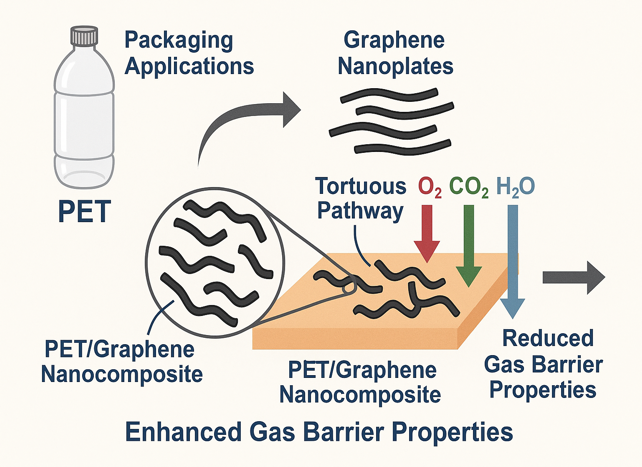
Polyethylene terephthalate (PET) is widely used in packaging applications due to its excellent mechanical and thermal properties. However, its intrinsic gas permeability limits its performance in high-barrier applications. The incorporation of graphene-based nanofillers into the PET matrix has emerged as a promising strategy to significantly enhance gas barrier properties. In this study, the gas permeability behavior of PET/graphene nanocomposites was investigated using a 3D-structured graphene nanoplatelet (GNP) network designed to maximize tortuosity within the polymer matrix. The addition of graphene nanoplatelets introduces a highly tortuous three-dimensional diffusion pathway that impedes the transport of gas molecules, thereby markedly containing 0.3 wt% graphene nanoplatelets. This improvement correlates with microstructural changes evidenced by BET analysis, where the specific surface area increased from 0.53 m²/g for neat PET to 1.18 m²/g for the 0.3 wt% GNP composite, and the total pore volume increased from 4.33 × 10⁻⁴ cm³/g to 1.07 × 10⁻³ cm³/g, reflecting the development of a more complex 3D internal pathway. The degree of barrier enhancement was strongly dependent on dispersion quality, graphene loading, aspect ratio, and interfacial interaction between the filler and polymer matrix. This combination of low graphene content, quantified barrier improvement, and a tailored 3D tortuous network showed the novelty of this work and highlights the potential of PET/graphene nanocomposites for advanced packaging, electronics encapsulation, and functional barrier applications.
References
[1] Usman, I. U., and Kunlin. 2024. Influence of Polyethylene Terephthalate (PET) Utilization on the Engineering Properties of Asphalt Mixtures: A Review. Construction and Building Materials. https://doi.org/10.1016/j.conbuildmat.2023.134439.
[2] Combeau, M., et al. 2023. A Comparative Study on Crystallisation for Virgin and Recycled Polyethylene Terephthalate (PET): Multiscale Effects on Physico-Mechanical Properties. Polymers. 15(23): 4613. https://doi.org/10.3390/polym15234613.
[3] Kim, D., et al. 2021. Diamine Vapor Treatment of Viscoelastic Graphene Oxide Liquid Crystal for Gas Barrier Coating. Scientific Reports. 11. https://doi.org/10.1038/s41598-021-88955-5.
[4] Al-Bustami, H., A. Al-Jabareen, G. Marom, and H. Harel. 2012. Improving the Oxygen Barrier Properties of Polyethylene Terephthalate by Graphite Nanoplatelets. Journal of Applied Polymer Science. 128: 1534–39. https://doi.org/10.1002/app.38302.
[5] Cui, Y., S. Kumar, S. Kundalwal, and S. Kumar. 2016. Gas Barrier Performance of Graphene/Polymer Nanocomposites. Carbon. 98: 313–33. https://doi.org/10.1016/j.carbon.2015.11.018.
[6] Ramzan, N., S. Qamar, and W. Aleem. 2024. Graphene Dispersion, Functionalization Techniques, and Applications: A Review. Synthetic Metals. https://doi.org/10.1016/j.synthmet.2024.117697.
[7] Kanny, K., A. P. Rath, and S. G. Krishnan. 2023. Studies on Polyethylene Terephthalate Hybrid Polymer Nanocomposites. Polymer Bulletin. https://doi.org/10.1007/s00289-023-04799-1.
[8] Allahbakhsh, A. 2017. High Barrier Graphene/Polymer Nanocomposite Films. In Graphene-Based Polymer Nanocomposites in Electronics. Elsevier. https://doi.org/10.1016/B978-0-12-804302-8.00020-0.
[9] Saxena, D., N. Soundararajan, V. Katiyar, D. Rana, and P. Maiti. 2020. Structural, Mechanical, and Gas Barrier Properties of Poly(ethylene terephthalate) Nanohybrid Using Nanotalc. Journal of Applied Polymer Science. 137(27): 1–12. https://doi.org/10.1002/app.48607.
[10] Ashfaq, J., et al. 2023. Enhancement of Thermal and Gas Barrier Properties of Graphene-Based Nanocomposite Films. ACS Omega. 8(44): 41054–63. https://doi.org/10.1021/acsomega.3c02885.
[11] Zhou, M., et al. 2024. Mechanism of Gas Barrier Improvement of Graphene/Polypropylene Nanocomposites for New-Generation Lightweight Hydrogen Storage. Composites Science and Technology. 110483. https://doi.org/10.1016/j.compscitech.2024.110483.
[12] Hareesha, M., B. Yogesha, L. L. Naik, and D. Saravanabavan. 2021. Development on Graphene-Based Polymer Composite Materials and Their Applications: A Recent Review. AIP Conference Proceedings. 2316. https://doi.org/10.1063/5.0036854.
[13] Lawal, A. T. 2020. Recent Progress in Graphene-Based Polymer Nanocomposites. Cogent Chemistry. 6(1): 1833476. https://doi.org/10.1080/23312009.2020.1833476.
[14] Noh, M. I. C. M., M. A. Mohamed, A. G. Ismail, M. H. Ani, and B. Y. Majlis. 2019. Improvement of Gas Barrier Properties of Polyethylene Terephthalate (PET) by Graphene Nanoplatelets (GNP). Materials Today: Proceedings. 7: 808–15. https://doi.org/10.1016/j.matpr.2018.12.079.
[15] Lee, H.-M., S.-H. Kang, B.-J. Kim, and K.-W. Kim. 2021. Synthesis and Characterization of Activated Carbon Fibers Derived from Linear Low-Density Polyethylene Fibers Stabilized at a Low Temperature. Polymers. 13(22): 3918. https://doi.org/10.3390/polym13223918.
[16] Wang, Y., et al. 2023. Precise Preparation of Biomass-Based Porous Carbon with Pore Structure-Dependent VOCs Adsorption/Desorption Performance by Bacterial Pretreatment and Its Forming Process. Environmental Pollution. 121134. https://doi.org/10.1016/j.envpol.2023.121134.
[17] Dilokekunakul, W., P. Teerachawanwong, N. Klomkliang, S. Supasitmongkol, and S. Chaemchuen. 2020. Effects of Nitrogen and Oxygen Functional Groups and Pore Width of Activated Carbon on Carbon Dioxide Capture: Temperature Dependence. Chemical Engineering Journal. 389: 124413. https://doi.org/10.1016/j.cej.2020.124413.
[18] Perovic, M., Q. Qin, and M. Oschatz. 2020. From Molecular Precursors to Nanoparticles—Tailoring the Adsorption Properties of Porous Carbon Materials by Controlled Chemical Functionalization. Advanced Functional Materials. 30: 1908371. https://doi.org/10.1002/adfm.201908371.
[19] Chen, C., X. Ding, Y. Wang, Z. Luo, and P. Zhai. 2022. Fractal Dimension Analysis of Structure and Bending Strength of Porous Alumina Prepared Using Starch and Carbon Fiber as Pore-Forming Agents. Fractal and Fractional. 6(10): 574. https://doi.org/10.3390/fractalfract6100574.
[20] Deng, S., et al. 2020. Solving Two Environmental Issues Simultaneously: Waste Polyethylene Terephthalate Plastic Bottle-Derived Microporous Carbons for Capturing CO₂. Chemical Engineering Journal. 397: 125350. https://doi.org/10.1016/j.cej.2020.125350.
[21] Abu-Dief, A., et al. 2024. Recent Advances in Heteroatom-Doped/Hierarchically Porous Carbon Materials: Synthesis, Design, and Potential Applications. Progress in Materials Science. 101408. https://doi.org/10.1016/j.pmatsci.2024.101408.
[22] Zhang, M., et al. 2020. Polymer-Derived Heteroatom-Doped Porous Carbon Materials. Chemical Reviews. https://doi.org/10.1021/acs.chemrev.0c00080.
Downloads
Published
Issue
Section
License
Copyright of articles that appear in Jurnal Teknologi belongs exclusively to Penerbit Universiti Teknologi Malaysia (Penerbit UTM Press). This copyright covers the rights to reproduce the article, including reprints, electronic reproductions, or any other reproductions of similar nature.