
A BIBLIOMETRIC ANALYSIS OF THE BIM ROBUSTNESS IN THE SUCCESS OF BUILDING REFURBISHMENT
DOI:
https://doi.org/10.11113/jurnalteknologi.v88.25138Keywords:
Building Information Modelling, Building Refurbishment, Architectural Design, Sustainability, Bibliometric AnalysisAbstract
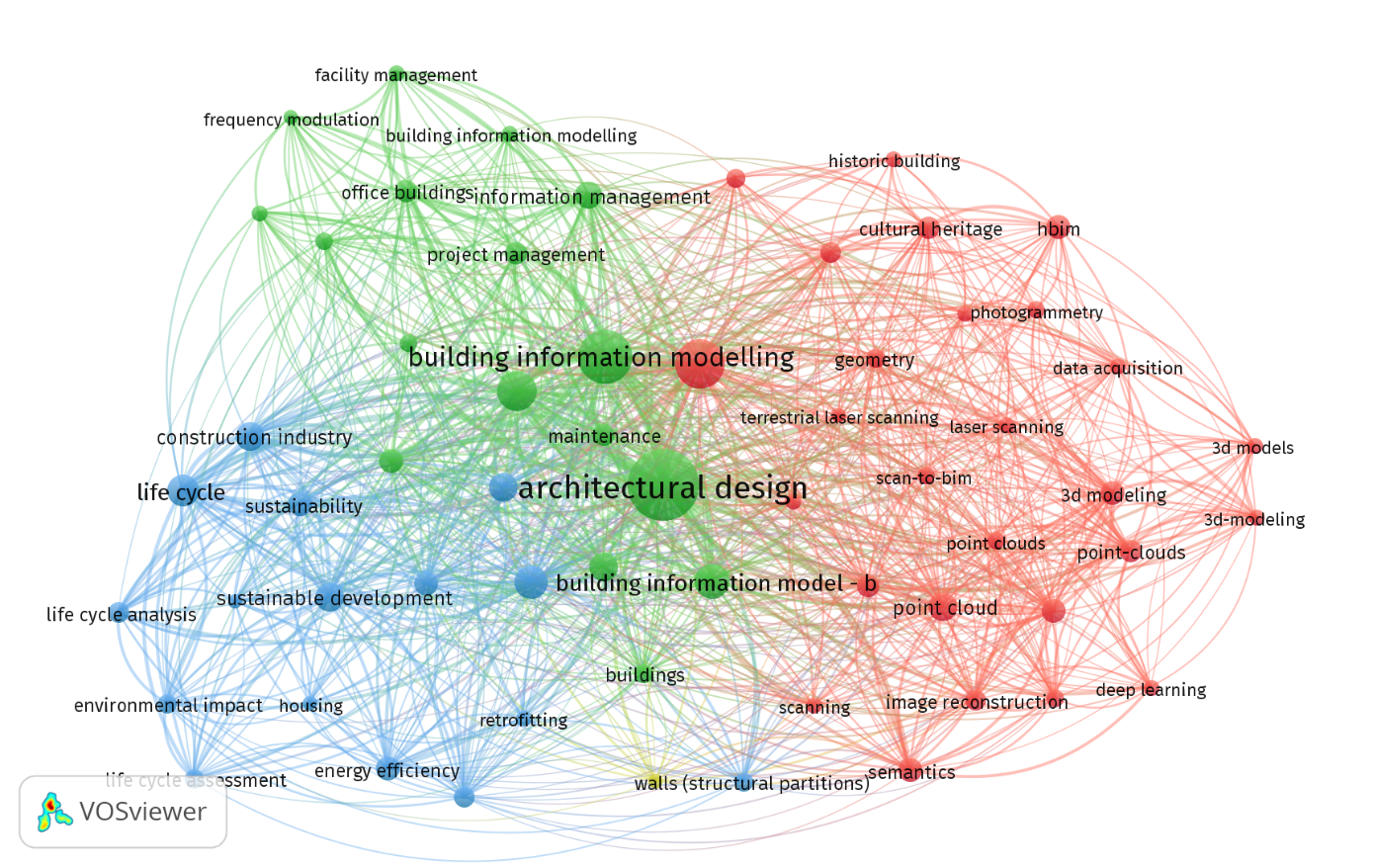
Building refurbishment is increasingly acknowledged as more complex than new construction due to uncertainties in existing structures, limited documentation, and higher risk levels. In response, Building Information Modeling (BIM) has evolved as a vital digital tool, offering powerful solutions for data integration, visualization, and multidimensional coordination. This paper presents a bibliometric analysis to examine the trends and impact of research on BIM robustness in the context of building refurbishment projects. A total of 339 publications from the Scopus database were analyzed using Scopus Analyzer and VOSviewer to explore patterns in publication growth, citation networks, co-authorship collaborations, and keyword co-occurrence. The analysis shows that during the past ten years, there has been a major increase in scholarly interest, with notable contributions from nations including the United States, China, and the United Kingdom. Four (4) key themes identified include architectural design, BIM, sustainability, and structural design. These findings reflect the evolving research landscape and growing emphasis on BIM’s potential to address the complexities of refurbishment projects. This study contributes to the field by mapping existing knowledge and emphasizing the need for strategic benchmarking and further exploration of BIM’s role in enhancing the success and efficiency of building refurbishment initiatives.
References
1] Artopoulos, G., Fokaides, P., Lysandrou, V., Deligiorgi, M., Sabatakos, P., & Agapiou, A. 2024. Data-Driven Multi-Scale Study of Historic Urban Environments by Accessing Earth Observation and Non-Destructive Testing Information via an HBIM-Supported Platform. International Journal of Architectural Heritage, 18(6), 920–939.
DOI: https://doi.org/10.1080/15583058.2023.2199408
[2] Bahreini, F., & Hammad, A. 2024. Developing an Ontology for Concrete Surface Defects to Enhance Inspection, Diagnosis and Repair Information Modeling. Infrastructures, 9(12), 220.
DOI: https://doi.org/10.3390/infrastructures9120220
[3] Bragadin, M.A., Guardigli, L., Calistri, M., & Ferrante, A. 2023. Demolishing or Renovating? Life Cycle Analysis in the Design Process for Building Renovation: The ProGETonE Case. Sustainability, 15(11), 8614.
DOI: https://doi.org/10.3390/su15118614
[4] Zadeh, P. A., Han, S., & Staub-French, S. 2023. Exploring BIM Implementation Challenges in Complex Renovation Projects: A Case Study of UBC’s BRDF Expansion. Applied Sciences, 13(23), 12563.
DOI: https://doi.org/10.3390/app132312563
[5] Husin, S., Zaki, N., & Husain, M. 2019. Implementing sustainability in existing building through retrofitting measures. International Journal of Civil Engineering and Technology (IJCIET), 10(1), 1450–1471.
[6] Wang, H., Cheng, R., Chen, J., & Zhang, M. 2024. Streamlining BIM models for GIS integration: An advanced approach to building envelope extraction. International Journal of Digital Earth, 17(1), 2368708.
DOI: https://doi.org/10.1080/17538947.2024.2368708
[7] She, Y., Udawatta, N., Liu, C., & Tokede, O. 2024. Circular Economy-Related Strategies to Minimise Construction and Demolition Waste Generation in Australian Construction Projects. Buildings, 14(8), 2487.
DOI: https://doi.org/10.3390/buildings14082487
[8] IEA. 2022. Renovation of near 20% of Existing Building Stock to Zero-Carbon-Ready by 2030 Is Ambitious but Necessary—Analysis. International Energy Agency. Retrieved from https://www.iea.org/reports/renovation-of-near-20-of-existing-building-stock-to-zero-carbon-ready-by-2030-is-ambitious-but-necessary.
[9] Soust-Verdaguer, B., Gutiérrez, J.A., & Llatas, C. 2023. Development of a Plug-In to Support Sustainability Assessment in the Decision-Making of a Building Envelope Refurbishment. Buildings, 13(6), 1472.
DOI: https://doi.org/10.3390/buildings13061472
[10] Collins. 2023. Collins English Dictionary (14th ed.)
[11] Lee, C C T and Egbu, C. 2005. Capturing client needs in refurbishment projects. In: Khosrowshahi, F (Ed.), 21st Annual ARCOM Conference, 7-9 September 2005, SOAS, University of London. Association of Researchers in Construction Management, 2:865-74.
[12] Mansfield, J.R. 2011. Sustainable refurbishment: some practical regulatory hurdles. Structural Survey, 29(2), 120-132,
DOI: http://doi.org/10.1108/02630801111132803
[13] Kamaruzzaman, S. N., Lou, E. C. W., Wong, P. F., Edwards, R.,Hamzah, N. & Ghani, M. K. 2019. Development of a non-domestic building refurbishment scheme for Malaysia: A Delphi approach. Energy, 167, 804-818.
DOI https://doi.org/10.1016/j.energy.2018.11.020.
[14] Khairi, M., Jaapar, A., & Yahya, Z. 2017. The application, benefits and challenges of retrofitting the existing buildings. In IOP Conference Series: Materials Science and Engineering (Vol. 271, p. 012030). IOP Publishing.
DOI: https://doi.org/10.1088/1757-899X/271/1/012030
[15] Sayyad, S. U., Patil, P. V., & Attarb, P. R. 2024. Cost Comparison of a Sewage Treatment Plant Unit by Conventional Method and BIM Approach. ASEAN Engineering Journal.
DOI: https://doi.org/10.26480/aseanj.02.2024.149.152
[16] Zhuo, L., Zhang, J., & Hong, X. 2024. Cultural heritage characteristics and damage analysis based on multidimensional data fusion and HBIM–taking the former residence of HSBC bank in Xiamen, China as an example. Heritage Science, 12(1), 128.
DOI: https://doi.org/10.1186/s40494-024-01238-w
[17] Borkowski, A. S., & Maroń, M. 2024. Semantic Enrichment of Non-Graphical Data of a BIM Model of a Public Building from the Perspective of the Facility Manager. Big Data and Cognitive Computing, 8(10), 138.
DOI: https://doi.org/10.3390/bdcc8100138
[18] Jamalluddin, A. H., Yusoff, M. A., & Ismail, F. 2022. Building Information Modelling (BIM) adoption in Malaysian construction industry: A systematic review. International Journal of Engineering and Industrial Revolution, 4(12), 48–56.
[19] Zheng, H., Chen, L., Hu, H., Wang, Y., & Wei, Y. 2024. Research on the Digital Preservation of Architectural Heritage Based on Virtual Reality Technology. Buildings, 14(5), 1436.
DOI: https://doi.org/10.3390/buildings14051436
[20] Monchetti, S., Betti, M., Borri, C., Gerola, C., Matta, C., & Francalanci, B. 2023. Insight on HBIM for Conservation of Cultural Heritage: The Galleria dell’Accademia di Firenze. Heritage, 6(9), 6950–6966.
DOI: https://doi.org/10.3390/heritage6090365
[21] Wang, D., Jiang, Q., & Liu, J. 2024. Deep-Learning-Based Automated Building Information Modeling Reconstruction Using Orthophotos with Digital Surface Models. Buildings, 14(8), 808.
DOI: https://doi.org/10.3390/buildings14080808
[22] Won, J., & Cheng, J. C. P. 2017. Identifying potential opportunities of Building Information Modeling for construction and demolition waste management and minimization. Automation in Construction, 79, 3–18.
DOI: https://doi.org/10.1016/j.autcon.2017.02.002
[23] Cinquepalmi, F., & Tiburcio, V. A. (2023). Sustainable Restoration of Cultural Heritage in the Digital Era. Vitruvio - International Journal of Architectural Technology and Sustainability, 8(2), 76–87. [22]
DOI: https://doi.org/10.4995/vitruvio-ijats.2023.20545
[24] She, Y., Udawatta, N., Liu, C., & Tokede, O. 2024. Circular economy-related strategies to minimize construction and demolition waste generation in Australian construction projects. Buildings, 14(8), 2487.
DOI: https://doi.org/10.3390/buildings14082487
[25] Dan, L. 2015. Building Information Modeling (BIM) and its Application in the Construction Industry. International Journal of Emerging Technology and Advanced Engineering, 5(7), 476–481.
[26] Aleš Tomek & Petr Matějka. 2014. The Impact of BIM on Risk Management as an Argument for its Implementation in a Construction Company, Procedia Engineering, Volume 85, 501-509.
DOI: https://doi.org/10.1016/j.proeng.2014.10.577
[27] Savitri D M et al. 2020. Building Information Modelling for Renovation Project. IOP Conf. Ser.: Earth Environ. Sci. 426 012002.
DOI: https://doi.org/10.1088/1755-1315/426/1/012002
[28] Mohd Javaid, Abid Haleem, Ravi Pratap Singh, Rajiv Suman, & Ernesto Santibañez Gonzalez. 2022. Understanding the adoption of Industry 4.0 technologies in improving Environmental Sustainability, Sustainable Operations and Computers, Volume 3, 203-217.
DOI: https://doi.org/10.1016/j.susoc.2022.01.008
[29] Hosseini, M. R., Banihashemi, S., Chileshe, N., Namzadi, M. O., Udaeja, C., Rameezdeen, R., and McCuen, T. 2016. BIM adoption within Australian Small and Medium-sized Enterprises (SMEs): An Innovation Diffusion Model. Construction Economics and Building, 16(3), 71–86.
DOI: https://doi.org/10.5130/ajceb.v16i3.5159
[30] Hmidah, N. A., Bin Haron, N. A., Hizami, A. A., Law, T. H., & Altohami, A. B. A. 2023. Energy Consumption of Retrofitting Existing Public Buildings in Malaysia under BIM Approach: Pilot Study. Sustainability, 15(13), 10293.
DOI: https://doi.org/10.3390/su151310293
[31] Public Works Department Malaysia (PWD). 2018. Construction Report 2018.
[32] Lu, K., Deng, X., Jiang, X., Cheng, B., & Tam, V. W. Y. 2023. A Review on Life Cycle Cost Analysis of Buildings Based on Building Information Modeling. Journal of Civil Engineering and Management, 29(3), 268–288.
DOI: https://doi.org/10.3846/jcem.2023.18473
[33] Zhang, M., Fan, L., Liu, Y., Zhang, S., & Zeng, D. 2023. The Relationship between BIM Application and Project Sustainability Performance: Mediation Role of Green Innovation and Moderating Role of Institutional Pressures. Buildings, 13(12), 3126.
DOI: https://doi.org/10.3390/buildings13123126
[34] Namaki, P., Vegesna, B. S., Bigdellou, S., Chen, R., & Chen, Q. 2024. An Integrated Building Information Modeling and Life-Cycle Assessment Approach to Facilitate Design Decisions on Sustainable Building Projects in Canada. Sustainability, 16(11), 4718.
DOI: https://doi.org/10.3390/su16114718
[35] Saipudin, N. A., & Ishak, N. 2024. A bibliometric analysis of Building Information Modeling (BIM) integration in Industrialized Building Systems (IBS): Trends, gaps, and future directions. International Journal of Innovation and Industrial Revolution, 6(19), 176–190.
DOI: https://doi.org/10.35631/IJIREV.619014
[36] Mêda, P., Calvetti, D., & Sousa, H. 2023. Exploring the Potential of iPad-LiDAR Technology for Building Renovation Diagnosis: A Case Study. Buildings, 13(2), 456. DOI:
https://doi.org/10.3390/buildings13020456
[37] Mazur, Ł., & Olenchuk, A. 2023. Life Cycle Assessment and Building Information Modeling Integrated Approach: Carbon Footprint of Masonry and Timber-Frame Constructions in Single-Family Houses. Sustainability, 15(21), 15486.
DOI: https://doi.org/10.3390/su152115486
[38] Jafari, M., Khoshand, A., Sadeghi, N., & Abdollahi Mirzanagh, P. 2024. A comparative LCA of external wall assemblies in context of Iranian market: Considering embodied and operational energy through BIM application. Environmental Science and Pollution Research, 31(6), 7364–7379.
DOI: https://doi.org/10.1007/s11356-023-31451-2
[39] Cheng, M.-L., Tsai, F., & Teo, T.-A. 2024. Spatial analysis with detailed indoor building models for emergency services. Buildings, 14(9), 2798.
DOI: https://doi.org/10.3390/buildings14092798
[40] Rubens, T., Ribeiro, G., Paulo, R., Bessa, M., Moreira, E., Vieira, M., & Mesquita, E. 2023. Digitalization based on high-resolution scanning and HBIM tools for damage assessment of the José de Alencar house. Journal of Building Pathology and Rehabilitation, 8(1), 30.
DOI: https://doi.org/10.1007/s41024-023-00275-5
[41] Cascone, S., Parisi, G., & Caponetto, R. 2024. BIM-Based Strategies for the Revitalization and Automated Management of Buildings: A Case Study. Sustainability, 16(16), 6720.
DOI: https://doi.org/10.3390/su161606720DOI
[42] Pacheco MP, Pereira SM, Rego IE. 2020. Seismic preparedness of families with children: measures and dynamics. Int J Psychol.
DOI: https://doi.org/10.1002/ijop.12694
[43] Lockwood C, Munn Z, Porritt K. 2015. Qualitative research synthesis. Int J Evid Based Healthc 13(3):179–187.
DOI: https://doi.org/10.1097/XEB.0000000000000062
[44] Shorten A., Bratches R., & Shorten B. 2025. What is a meta-analysis? Evidence-Based. Nursing, 28:74-76.
DOI: https://doi.org/10.1136/ebnurs-2024-104230
[45] Alves, J. L., Borges, I. B., & De Nadae, J. 2021. Sustainability in complex projects of civil construction: Bibliometric and bibliographic review. Gestao e Producao, 28(4).
DOI: https://doi.org/10.1590/1806-9649-2020v28e5389
[46] Assyakur, D. S., & Rosa, E. M. 2022. Spiritual Leadership in Healthcare: A Bibliometric Analysis. Jurnal Aisyah: Jurnal Ilmu Kesehatan, 7(2).
DOI: https://doi.org/10.30604/jika.v7i2.914
[47] Wu, Y. C. J., & Wu, T. 2017. A decade of entrepreneurship education in the Asia Pacific for future directions in theory and practice. In Management Decision (Vol. 55, Issue 7, pp.1333–1350).
DOI: https://doi.org/10.1108/MD-05-2017-0518
[48] Kraus S, Breier M, Dasí-Rodríguez S. 2020. The art of crafting a systematic literature review in entrepreneurship research. Int Entrepreneurship Manag J, 16(3):1023–1042. DOI: https://doi.org/10.1007/s11365-020-00635-4
[49] Viorica Pătrăucean, Iro Armeni, Mohammad Nahangi, Jamie Yeung, Ioannis Brilakis, Carl Haas. 2015. State of research in automatic as-built modelling, Advanced Engineering Informatics, Volume 29, Issue 2, 162-171,
DOI: https://doi.org/10.1016/j.aei.2015.01.001
[50] Haishan Xia, Zishuo Liu, Maria Efremochkina, Xiaotong Liu, Chunxiang Lin. 2022. Study on City Digital Twin Technologies for Sustainable Smart City Design: A Review and Bibliometric Analysis of Geographic Information System and Building Information Modeling Integration, Sustainable Cities and Society, Volume 84, 104009.
DOI: https://doi.org/10.1016/j.scs.2022.104009
[51] Rabia Charef, Hafiz Alaka, Stephen Emmitt. 2018. Beyond the third dimension of BIM: A systematic review of literature and assessment of professional views, Journal of Building Engineering, Volume 19, Pages 242-257.
DOI: https://doi.org/10.1016/j.jobe.2018.04.028
[52] Thomson, C., & Boehm, J. 2015. Automatic Geometry Generation from Point Clouds for BIM. Remote Sensing, 7(9), 11753-11775.
DOI: https://doi.org/10.3390/rs70911753
[53] Sebastian Ochmann, Richard Vock, & Reinhard Klein. 2019. Automatic Reconstruction of Fully Volumetric 3D Building Models from Oriented Point Clouds, ISPRS Journal of Photogrammetry and Remote Sensing, Volume 151, Pages 251-262.
DOI: https://doi.org/10.1016/j.isprsjprs.2019.03.017
[54] Karoline Figueiredo, Rodrigo Pierott, Ahmed W.A. Hammad, & Assed Haddad. 2021. Sustainable Material Choice for Construction Projects: A Life Cycle Sustainability Assessment framework based on BIM and Fuzzy-AHP, Building and Environment, Volume 196, 107805.
DOI: https://doi.org/10.1016/j.buildenv.2021.107805
[55] Arayici, Y. 2008. Towards Building Information Modeling for Existing Structures, Structural Survey, Vol. 26 No. 3, pp. 210-222.
DOI: https://doi.org/10.1108/02630800810887108
[56] Carlo Biagini, Pietro Capone, Vincenzo Donato, & Nora Facchini. 2016. Towards the BIM implementation for Historical Building Restoration Sites, Automation in Construction, Volume 71, Part 1, Pages 74-86.
DOI: https://doi.org/10.1016/j.autcon.2016.03.003
[57] Hosseini, M. Reza; Maghrebi, Mojtaba; Akbarnezhad, Ali; Martek, Igor; Arashpour, & Mehrdad. 2018. Analysis of Citation Networks in Building Information Modeling Research. Journal of Construction Engineering and Management, Volume 144, Issue 8.
DOI: https://doi.org/10.1061/(ASCE)CO.1943-7862.0001492
[58] Zhikun Ding, Shan Liu, Longhui Liao, & Liang Zhang. 2019. A Digital Construction Framework Integrating Building Information Modeling and Reverse Engineering Technologies for Renovation Projects, Automation in Construction, Volume 102, Pages 45-58.
Downloads
Published
Issue
Section
License
Copyright of articles that appear in Jurnal Teknologi belongs exclusively to Penerbit Universiti Teknologi Malaysia (Penerbit UTM Press). This copyright covers the rights to reproduce the article, including reprints, electronic reproductions, or any other reproductions of similar nature.