
EVALUATING THE ROLE OF CONDUCTIVE EPOXY COMPOSITE LAYER IN MULTI-LAYER CERAMIC CAPACITORS UNDER ENVIRONMENTAL AND THERMAL STRESSES
DOI:
https://doi.org/10.11113/jurnalteknologi.v88.25216Keywords:
Cu-Epoxy Layer, Delamination, Thermal Cycling, Humidity Preconditioning, Surface Mount Assembly (SMA)Abstract
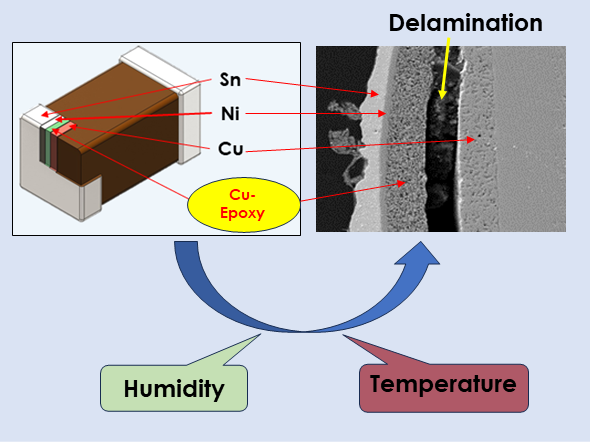
Multi-Layer Ceramic Capacitors (MLCCs) are vital components in modern electronics, where reliability under harsh environmental and thermal conditions is essential. This study evaluates the role of conductive epoxy composite (Cu-Epoxy) layer in the MLCC during simulated reflow thermal cycling. Structural analysis revealed that the Cu-epoxy layer mitigates mechanical and thermal stresses in standard conditions, maintaining an intact interface. However, prolonged humidity exposure and thermal cycling led to delamination at the Cu-epoxy/Cu interface, compromising mechanical integrity and electrical performance. Elemental mapping confirmed alumina infiltration in delaminated area, providing evidence of structural degradation. These findings underscore the importance of optimizing reflow profiles and Cu-epoxy formulations to improve adhesion strength, moisture resistance, and thermal stability. This study offers actionable recommendations for enhancing MLCC reliability in surface mount assembly processes and demanding operating environments.
References
[1] Li, D., P. Peng, C. Xu, Y. Zhang, and C. Di. 2009. Study on the Mechanical-Electric Effect Law of Dynamic Output Voltage of Board Level Mounted BaTiO3-MLCC under High Impact. Measurement. 190: 110639. https://doi.org/10.1016/j.measurement.2021.110639.
[2] Li, N. M., S. Manoharan, D. Das, and P. McCluskey. 2018. Analysis of Indentation Measured Mechanical Properties on Multilayer Ceramic Capacitors (MLCCs). Microelectronics Reliability. 88–90: 528–533. https://doi.org/10.1016/j.microrel.2018.07.116.
[3] Keimasi, M., M. H. Azarian, and M. Pecht. 2007. Isothermal Aging Effects on Flex Cracking of Multilayer Ceramic Capacitors with Standard and Flexible Terminations. Microelectronics Reliability. 47(12): 2215–2225. https://doi.org/10.1016/j.microrel.2006.12.005.
[4] Bachok, Z., et al. 2023. Investigation of Moisture-Induced Crack Propagation in the Soft-Termination Multi-Layer Ceramic Capacitor during Thermal Reflow Process. Soldering & Surface Mount Technology. 35(5): 305–318. https://doi.org/10.1108/SSMT-01-2023-0001.
[5] Cao, R., Y. Wu, D. Zhou, X. Hou, L. Duan, and H. Zhu. 2023. Failure Analysis and Improvement Research on Flexible Termination Multilayer Ceramic Capacitors. In 2023 24th International Conference on Electronic Packaging Technology (ICEPT). 1–5. https://doi.org/10.1109/ICEPT59018.2023.10492249.
[6] Chen, F., et al. 2024. Three-Point Bending Test and Finite Element Analysis of Flexible Termination Multilayer Ceramic Capacitors. In 2024 25th International Conference on Electronic Packaging Technology (ICEPT). 1–4. https://doi.org/10.1109/ICEPT63120.2024.10668729.
[7] Lee, C. H., and J. R. Yoon. 2022. The Effect of Ag-Epoxy Electrodes on the Thermal and Mechanical Properties of Multilayer Ceramic Capacitor. Journal of Ceramic Processing Research. 23(2): 181–187. https://doi.org/10.36410/jcpr.2022.23.2.181.
[8] Vargas, O. L., S. B. Valdez, M. L. Veleva, K. R. Zlatev, W. M. Schorr, and G. J. Terrazas. 2009. The Corrosion of Silver in Indoor Conditions of an Assembly Process in the Microelectronics Industry. Anti-Corrosion Methods and Materials. 56(4): 218–225. https://doi.org/10.1108/00035590910969347.
[9] Lin, J. C., and J. Y. Chan. 1996. On the Resistance of Silver Migration in Ag-Pd Conductive Thick Films under Humid Environment and Applied D.C. Field. Materials Chemistry and Physics. 43(3): 256–265. https://doi.org/10.1016/0254-0584(95)01642-8.
[10] Donnelly, N. J., and C. A. Randall. 2009. Refined Model of Electromigration of Ag/Pd Electrodes in Multilayer PZT Ceramics under Extreme Humidity. Journal of the American Ceramic Society. 92(2): 405–410. https://doi.org/10.1111/j.1551-2916.2008.02891.x.
[11] Stewart, M. 2005. A Soft Termination MLCC Solution to Guard against Capacitor Crack Failures. In Proceedings of the 25th Symposium for Passive Components (CARTS). Palm Springs, CA, USA. 21–24.
[12] Apalowo, R. K., et al. 2023. Investigation of Hygrothermally Induced Failures in Multilayer Ceramic Capacitors during Thermal Reflow Process. Microelectronics Reliability. 146: 115028. https://doi.org/10.1016/j.microrel.2023.115028.
[13] Tsai, T. N. 2012. Thermal Parameters Optimization of a Reflow Soldering Profile in Printed Circuit Board Assembly: A Comparative Study. Applied Soft Computing. 12(8): 2601–2613. https://doi.org/10.1016/j.asoc.2012.03.066.
[14] Prymak, J. D., et al. 2009. Flexible Termination – Reliability in Stringent Environments. Accessed from https://api.semanticscholar.org/CorpusID:110870251.
[15] Ardebili, H., E. H. Wong, and M. Pecht. 2003. Hygroscopic Swelling and Sorption Characteristics of Epoxy Molding Compounds Used in Electronic Packaging. IEEE Transactions on Components and Packaging Technologies. 26(1): 206–214. https://doi.org/10.1109/TCAPT.2002.806172.
[16] Hölck, O., and B. Wunderle. 2015. Microelectronics Packaging Materials: Investigating the Influence of Moisture by Molecular Dynamics Simulations. In Molecular Modeling and Multiscaling Issues for Electronic Material Applications: Volume 2, edited by A. Wymyslowski, N. Iwamoto, M. Yuen, and H. Fan, 41–66. Cham: Springer International Publishing. https://doi.org/10.1007/978-3-319-12862-7_4.
[17] Apalowo, R. K., et al. 2024. Deformation and Crack Growth in Multilayered Ceramic Capacitor during Thermal Reflow Process: Numerical and Experimental Investigation. Microelectronics International. 41(3): 162–171. https://doi.org/10.1108/MI-03-2023-0025.
[18] Xian, G., et al. 2024. Water Absorption and Property Evolution of Epoxy Resin under Hygrothermal Environment. Journal of Materials Research and Technology. 31: 3982–3997. https://doi.org/10.1016/J.JMRT.2024.07.123.
[19] Fan, X., G. Q. Zhang, W. D. van Driel, and L. J. Ernst. 2008. Interfacial Delamination Mechanisms during Soldering Reflow with Moisture Preconditioning. IEEE Transactions on Components and Packaging Technologies. 31(2): 252–259. https://doi.org/10.1109/TCAPT.2008.921629.
[20] Akçay, S. B., M. Kocaman, M. Çelebi, O. Güler, and T. Varol. 2024. Surface Modification for Improving Interfacial, Mechanical and Thermal Performance Characteristics in Epoxy Composites: Electroless Nickel Enhancement of Dendritic Copper Particle-Reinforced Epoxy. Surface and Coatings Technology. 478: 130417. https://doi.org/10.1016/j.surfcoat.2024.130417.
Downloads
Published
Issue
Section
License
Copyright of articles that appear in Jurnal Teknologi belongs exclusively to Penerbit Universiti Teknologi Malaysia (Penerbit UTM Press). This copyright covers the rights to reproduce the article, including reprints, electronic reproductions, or any other reproductions of similar nature.