
NUMERICAL APPROXIMATION OF SURFACE AREAS OF GEOMETRIES THROUGH INTEGRATION USING INTERACTIVE MATLAB GUI
DOI:
https://doi.org/10.11113/jurnalteknologi.v88.25322Keywords:
Numerical Integration, surface area, Netgen mesh generator, Graphical User InterfaceAbstract
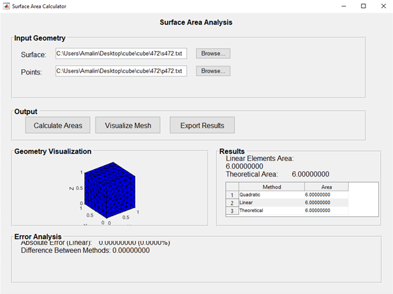
In computational geometry, numerical integration is a widely used approach to estimate the surface area of geometric shapes by subdividing complex curves and surfaces into manageable elements known as meshes. Estimating surface area is a fundamental problem in geometry with important implications in scientific and engineering applications. This paper presents a numerical framework for surface area approximation using discrete linear and quadratic elements applied to several geometric models. Meshes for each geometry are generated using the NETGEN mesh generator, and surface areas are computed through numerical integration. The results are compared with analytical solutions to evaluate accuracy and convergence behavior. To enhance user interaction and improve accessibility, an interactive graphical user interface (GUI) is developed using MATLAB. The GUI allows users to input geometry parameters, visualize the mesh, and perform surface area calculations automatically. Findings show that higher-order (quadratic) elements provide better accuracy than linear elements, especially for curved surfaces. This study contributes to the development of efficient and user-friendly computational tools for surface area approximation, particularly in educational and engineering contexts
References
[1] Abgrall, R., J. Nordström, P. Öffner, and S. Tokareva. 2020. Analysis of the SBP-SAT Stabilization for Finite Element Methods, Part I: Linear Problems. Journal of Scientific Computing. 85(2): 1–29. https://doi.org/10.1007/s10915-020-01349-z.
[2] Benvenuti, E., A. Chiozzi, G. Manzini, and N. Sukumar. 2022. Extended Virtual Element Method for Two-Dimensional Linear Elastic Fracture. Computer Methods in Applied Mechanics and Engineering. 390: 114352. https://doi.org/10.1016/j.cma.2021.114352.
[3] Chai, Y., W. Li, and Z. Liu. 2022. Analysis of Transient Wave Propagation Dynamics Using the Enriched Finite Element Method with Interpolation Cover Functions. Applied Mathematics and Computation. 412: 126564. https://doi.org/10.1016/j.amc.2021.126564.
[4] Du, Q., and X. Feng. 2020. The Phase Field Method for Geometric Moving Interfaces and Their Numerical Approximations. Handbook of Numerical Analysis. 21: 425–508. https://doi.org/10.1016/bs.hna.2019.05.001.
[5] Elsheltat, S. F., A. A. Alshara, and W. Elshara. 2024. Aerodynamic Evaluation of a Symmetrical Airfoil Using Wind Tunnel Testing. African Journal of Advanced Pure and Applied Sciences (AJAPAS). 49–56.
[6] Geng, D., N. Dai, P. Guo, S. Zhou, and H. Di. 2021. Implicit Numerical Integration of Highly Nonlinear Plasticity Models. Computers and Geotechnics. 132: 103961. https://doi.org/10.1016/j.compgeo.2020.103961.
[7] Khairuddin, T. K. A., M. A. K. Ahmad, Z. Majid, A. M. Samad, and I. Ma’arof. 2024. Volume and Surface Area of 3D Mesh Objects: A MATLAB GUI. Semarak International Journal of Fundamental and Applied Mathematics. 1(1): 13–23. https://doi.org/10.37934/sijfam.1.1.1323.
[8] Lehrenfeld, C. 2016. High-Order Unfitted Finite Element Methods on Level Set Domains Using Isoparametric Mappings. Computer Methods in Applied Mechanics and Engineering. 300: 716–33. https://doi.org/10.48550/arXiv.1509.02762.
[9] Luo, Y., X. Liu, F. Chen, H. Zhang, and X. Xiao. 2023. Numerical Simulation on Crack–Inclusion Interaction for Rib-to-Deck Welded Joints in Orthotropic Steel Deck. Metals. 13(8): 1402. https://doi.org/10.3390/met13081402.
[10] Müzel, D. S., E. P. Bonhin, N. M. Guimarães, and E. S. Guidi. 2020. Application of the Finite Element Method in the Analysis of Composite Materials: A Review. Polymers. 12(4): 818. https://doi.org/10.3390/polym12040818.
[11] Ray, N., D. Wang, X. Jiao, and J. Glimm. 2012. High-Order Numerical Integration over Discrete Surfaces. SIAM Journal on Numerical Analysis. 50(6): 3061–83. https://doi.org/10.1137/110857404.
[12] Schöberl, J. 2009. Getting Started: Netgen 4.X Mesh Generator. https://netgen-mesher.sourceforge.net/docs/ng4.pdf.
[13] Scroggs, M. W., J. S. Dokken, C. N. Richardson, and G. N. Wells. 2022. Construction of Arbitrary-Order Finite Element Degree-of-Freedom Maps on Polygonal and Polyhedral Cell Meshes. ACM Transactions on Mathematical Software. 48(2): 1–23. https://doi.org/10.1145/3524456.
[14] Smyth, G. K. 1998. Numerical Integration. In Encyclopedia of Biostatistics. 3088–95.
[15] Sukri, S. A., Y. S. Hoe, and T. K. A. Khairuddin. 2020. Quadratic Element Integration of Approximated First-Order Polarization Tensor for Sphere. Malaysian Journal of Fundamental and Applied Sciences. 16(5): 560–65. https://doi.org/10.11113/mjfas.v16n5.1916.
[16] Sukri, S. A., Y. S. Hoe, and T. K. A. Khairuddin. 2021. Study of Different Order of Gaussian Quadrature Using Linear Element Interpolation in First-Order Polarization Tensor. Malaysian Journal of Fundamental and Applied Sciences. 17(4): 343–53. https://doi.org/10.11113/mjfas.v17n4.2051.
[17] Sukri, S. A., Y. S. Hoe, and T. K. A. K. Khairuddin. 2021. First-Order Polarization Tensor Approximation Using Multivariate Polynomial Interpolation Method via Least-Square Minimization Technique. Journal of Physics: Conference Series. 1988(1): 012013. https://doi.org/10.1088/1742-6596/1988/1/012013.
[18] Taborda, D. M., L. Zdravković, D. M. Potts, H. J. Burd, B. W. Byrne, K. G. Gavin, G. T. Houlsby, R. J. Jardine, T. Liu, C. M. Martin, and R. A. McAdam. 2020. Finite-Element Modelling of Laterally Loaded Piles in a Dense Marine Sand at Dunkirk. Géotechnique. 70(11): 1014–29. https://doi.org/10.1680/jgeot.18.PISA.006.
[19] Viguerie, A., G. Lorenzo, F. Auricchio, D. Baroli, T. J. Hughes, A. Patton, A. Reali, T. E. Yankeelov, and A. Veneziani. 2021. Simulating the Spread of COVID-19 via a Spatially Resolved Susceptible–Exposed–Infected–Recovered–Deceased (SEIRD) Model with Heterogeneous Diffusion. Applied Mathematics Letters. 111: 106617. https://doi.org/10.1016/j.aml.2020.106617.
[20] Wang, Y., Q. Pang, M. Li, and Y. Liu. 2024. Comparative Study of Algorithms for the Conversion from Surface Mesh Models to Volume Mesh Models. Advances in Civil Engineering. 2024(1): 4669855. https://doi.org/10.1155/2024/4669855.
[21] Wolfrom, R. 2023. An Introduction to Surface Area.” Particle Technology Labs. https://particletechlabs.com/ptl-press/introduction-to-surface-area/.
Downloads
Published
Issue
Section
License
Copyright of articles that appear in Jurnal Teknologi belongs exclusively to Penerbit Universiti Teknologi Malaysia (Penerbit UTM Press). This copyright covers the rights to reproduce the article, including reprints, electronic reproductions, or any other reproductions of similar nature.