
IMPROVING HEAT TOLERANCE IN POTATO (SOLANUM TUBERSOUM L.) CULTIVAR BIO GRANOLA THROUGH GAMMA RAY IRRADIATION AND IN VITRO SELECTION
DOI:
https://doi.org/10.11113/jurnalteknologi.v88.25329Keywords:
Anatomical characters, growth response, heat stress, microtuber, radiosensitivityAbstract
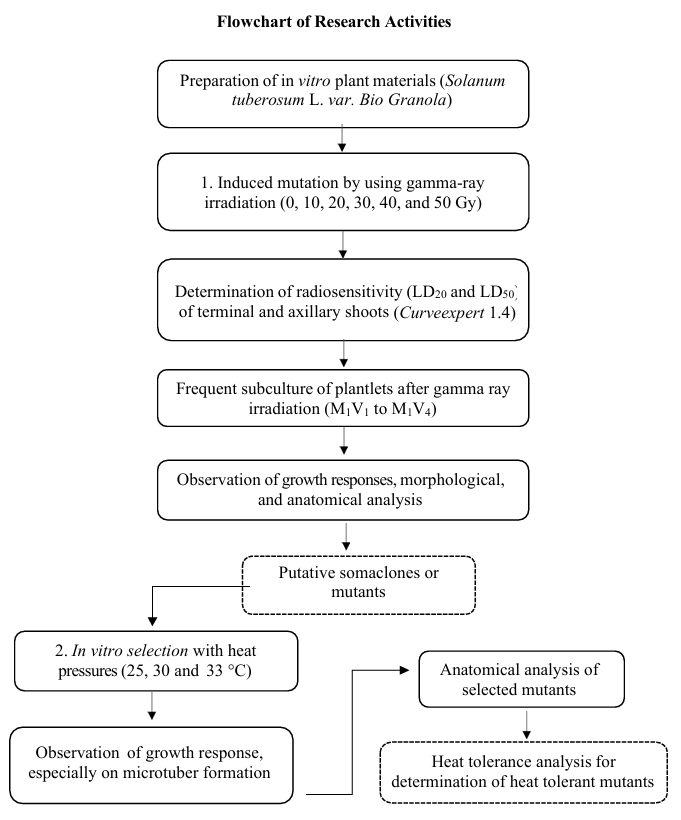
The potato variety Bio Granola is resistant to late blight disease, however it can only adapt to highland areas. Sexual hybridization in potatoes is constrained by biological barriers which make mutagenesis is considered to be applied. This study aimed to determine the radiosensitivity response of in vitro shoots to gamma ray irradiation and to analyze the morphological and anatomical characteristics after in vitro selection under high temperature pressures. This study consisted of two experiments: (1) Induced mutation by gamma ray irradiation (0, 10, 20, 30, 40, and 50 Gy) using explant types of terminal and axillary shoots from less and more than 1 year period of motherstock, and (2) In vitro selection with temperature pressure (25, 30, and 33 °C). Observations were conducted on growth responses, morphological, and anatomical characters. The results showed variations in growth response and morphological characters of plantlets after gamma ray irradiation. Anatomical analysis showed changes in stomatal density and size, and number of chloroplasts. Gamma ray irradiation combined with in vitro selection under temperature pressure successfully generated putative mutants derived from potato cultivar Bio Granola with enhanced tolerance to high temperatures. The most effective method utilized terminal shoot explants from young motherstock (<one year old) treated with irradiation doses of 20–30 Gy. This treatment promoted high survival rates, vigorous growth, and the capacity to form microtubers under 30 °C stress. Plantlets that produce microtubers under heat stress are considered as potential heat-tolerant genotypes. Further evaluation through field trials in medium- and low-altitude environments is required.
References
[1] Tessema, L., W. Mohammed, and T. Abebe. 2020. Evaluation of Potato (Solanum tuberosum L.) Varieties for Yield and Some Agronomic Traits. Open Agriculture. 5(1): 63–74. https://doi.org/10.1515/opag-2020-0006.
[2] Chauhan, A. P. S., D. Singh, A. Sharma, S. Chouhan, N. Kushwah, N. Singh, and J. Sharma. 2023. Assessment of Potato (Solanum tuberosum L.) Performance for Yield and Quality Production under Natural Farming System in Gird Region of Madhya Pradesh, India. Journal of Experimental Agriculture International. 45(12): 16–22.
[3] Lal, M. K., R. K. Tiwari, A. Kumar, A. Dey, R. Kumar, D. Kumar, A. Jaiswal, et al. 2022. Mechanistic Concept of Physiological, Biochemical, and Molecular Responses of the Potato Crop to Heat and Drought Stress. Plants. 11(21): 2857. https://doi.org/10.3390/plants11212857.
[4] Pramono, E. 2022. Bio Granola, GMO Potatoes That Are Food and Environmentally Safe. UMKO. https://www.litbang.pertanian.go.id/info-teknologi/4416/.
[5] Hadiarto, T., and A. D. Ambarwati. 2024. Breeding of Genetically Engineered Indonesian Potato, Bio Granola, Resistant to Late Blight Pathogen Phytophthora infestans. Potato Research. 67: 695–709. https://doi.org/10.1007/s11540-023-09662-4.
[6] Li, F., A. Shimizu, T. Nishio, N. Tsutsumi, and H. Kato. 2019. Comparison and Characterization of Mutations Induced by Gamma-Ray and Carbon-Ion Irradiation in Rice (Oryza sativa L.) Using Whole-Genome Resequencing. G3: Genes, Genomes, Genetics. 9(11): 3743–51. https://doi.org/10.1534/g3.119.400555.
[7] Beyaz, R., and M. Yildiz. 2017. The Use of Gamma Irradiation in Plant Mutation Breeding. IntechOpen. https://doi.org/10.5772/intechopen.69974.
[8] Chusreeaeom, K., and O. Khamsuk. 2019. Effects of Gamma Irradiation on Lipid Peroxidation, Survival, and Growth of Turmeric In Vitro Culture. Journal of Physics: Conference Series. 1285(1): 012003. https://doi.org/10.1088/1742-6596/1285/1/012003.
[9] Barquero-Miranda, M., and R. Céspedes. 2023. Mutation Induction Using Gamma-Ray Irradiation and High-Frequency Embryogenic Callus from Coffee (Coffea arabica L.). In Mutation Breeding in Coffee with Special Reference to Leaf Rust, edited by I. L. Ingelbrecht, M. C. L. da Silva, and J. Jankowicz-Cieslak. Springer. https://doi.org/10.1007/978-3-662-67273-0_6.
[10] Hoffmann, A. A., and C. M. Sgrò. 2011. Climate Change and Evolutionary Adaptation. Nature. 470: 479–85.
[11] Cavallaro, V., A. Pellegrino, R. Muleo, and I. Forgione. 2022. Light and Plant Growth Regulators on In Vitro Proliferation. Plants. 11(7): 844. https://doi.org/10.3390/plants11070844.
[12] Slimen, I. B., T. Najar, A. Ghram, H. Dabbebi, M. Ben Mrad, and M. Abdrabbah. 2014. Reactive Oxygen Species, Heat Stress, and Oxidative-Induced Mitochondrial Damage: A Review. International Journal of Hyperthermia. 30: 513–23.
[13] Czarnocka, W., and S. Karpiński. 2018. Friend or Foe? Reactive Oxygen Species Production, Scavenging, and Signaling in Plant Response to Environmental Stresses. Free Radical Biology and Medicine. 122: 4–20.
[14] Garg, M., N. Sharma, S. Sharma, P. Kapoor, A. Kumar, V. Chunduri, and P. Arora. 2018. Biofortified Crops Generated by Breeding, Agronomy, and Transgenic Approaches Are Improving the Lives of Millions of People around the World. Frontiers in Nutrition. 5: 12.
[15] Kusmana, and E. Sofiari. 2007. Potato Line Selection from Cross-Bred Progeny. Buletin Plasma Nutfah. 13(2).
[16] Kiani, D., A. Borzouei, S. Ramezanpour, et al. 2022. Application of Gamma Irradiation on Morphological, Biochemical, and Molecular Aspects of Wheat (Triticum aestivum L.) under Different Seed Moisture Contents. Scientific Reports. 12: 11082. https://doi.org/10.1038/s41598-022-14949-6.
[17] Subrahmanyeswari, T., S. Gantait, S. N. Kamble, et al. 2023. Radio-Sensitivity Assessment of In Vitro Tissues of Stevia (Stevia rebaudiana Bert.) for Induced Mutagenesis.” Sugar Tech 25: 1520–30. https://doi.org/10.1007/s12355-023-01305-9.
[18] Spencer-Lopes, M., B. P. Forster, and L. Jankuloski, eds. 2018. Manual on Mutation Breeding. 3rd ed. Joint FAO/IAEA Division of Nuclear Techniques in Food and Agriculture, Food and Agriculture Organization of the United Nations.
[19] Moeljani, I. R., and E. Wahyuni. 2021. Estimation of Genetic Diversity and LD50 Determination of Red Onion (Allium cepa var. ascalonicum L.) Variety Bauji Resulting from Gamma Irradiation with ⁶⁰Co. Jurnal Hortikultura Indonesia. 12(3): 183–90.
[20] Ngoenngam, L., P. Pongtongkam, and J. Arananant. 2019. In Vitro Effect of Gamma Irradiation and Plant Growth Regulators (PGRs) on the Induction and Development of Stylosanthes hamata cv. Verano.
[21] Iqbal, M., Anisiyah, E. Rahmawati, Dasumiati, and W. Puspitasari. 2024. Effects of Gamma-Ray Irradiation Dose and Dose Rates on the Growth and Radiosensitivity of Soybean Varieties Grobogan and Mutiara 1. IOP Conference Series: Earth and Environmental Science. 1377: 012104. https://doi.org/10.1088/1755-1315/1377/1/012104.
[22] Royani, J. I., L. Sudarsono, Abdullah, and S. I. Aisyah. 2021. Radio-Sensitivity of Irradiated Seed, Plantlets, Callus, and In Vitro Leaves from Indigofera zollingeriana Miq. by Gamma Rays. IOP Conference Series: Earth and Environmental Science. 913: 012061. https://doi.org/10.1088/1755-1315/913/1/012061.
[23] Nurchasanah, S., A. P. Fitrianto, S. R. Suparto, P. Purwanto, and E. Oktaviani. 2022. Qualitative Parameters of Potato Plant Mutant (Solanum tuberosum L.) after Gamma-Ray Irradiation. J-PEN Borneo: Jurnal Ilmu Pertanian. 5(2).
[24] Zafar, S. A., M. Aslam, M. Albaqami, A. Ashraf, A. Hassan, J. Iqbal, A. Maqbool, et al. 2022. Gamma Rays Induced Genetic Variability in Tomato (Solanum lycopersicum L.) Germplasm. Saudi Journal of Biological Sciences. 29(5): 3300–3307.
[25] Mukminah, F., M. Trinawaty, and T. Prihatin. 2021. Multiplication of Potato Plantlets (Solanum tuberosum L.) In Vitro on MS Media with the Addition of NAA and Coconut Water. Jurnal Agroekoteknologi. 13(2): 213–23.
[26] Samone, S. L., and V. K. Sari. 2019. Induction of Micro-Bulbs and Direct In Vitro Sprout Regeneration in Medium-Plains Potato Plants Using Several Types of Auxins and Variations in Sucrose Concentrations. Agrin: Jurnal Penelitian Pertanian. 23(1): 71.
[27] Nettleton, D. 2013. Selection of Variables and Factor Derivation. In Commercial Data Mining. 79–104.
[28] Long, J., F. Yu, Y. Wu, Z. Xu, and X. Liu. 2024. Regulation of Different Lights on Energy Acquisitions, Microtuber Formation, and Growth of In Vitro-Grown Solanum tuberosum L. Agronomy. 14(6): 1232. https://doi.org/10.3390/agronomy14061232.
[29] Hutabarat, S., B. Sirait, and A. I. Manurung. 2023. The Effect of Growtone and ZA on the Growth of Mas Kirana Banana Seedlings (Musa acuminata L.) Originating from Tissue Culture in a Screen House. Jurnal Darma Agung. 31(3): 22–29.
[30] Kusumawati, A. 2020. Correlation Study of Chlorophyll Content to Productivity of Durian (Durio zibethinus Murr.) Clone MDURR 88.
[31] Posumah, D. 2017. Chlorophyll Content Test of Red Chili Plant Leaves (Capsicum annuum L.) through the Utilization of Several Liquid Organic Fertilizers. Jurnal MIPA. 6(2): 101–4.
Downloads
Published
Issue
Section
License
Copyright of articles that appear in Jurnal Teknologi belongs exclusively to Penerbit Universiti Teknologi Malaysia (Penerbit UTM Press). This copyright covers the rights to reproduce the article, including reprints, electronic reproductions, or any other reproductions of similar nature.