
MATERIAL REMOVAL MECHANISM AND SURFACE QUALITY IN MILLING OF SINTERED SOFT MAGNETIC COMPOSITES
DOI:
https://doi.org/10.11113/jurnalteknologi.v88.25338Keywords:
Machining parameters, material removal mechanism, milling process, soft magnetic composite, surface qualityAbstract
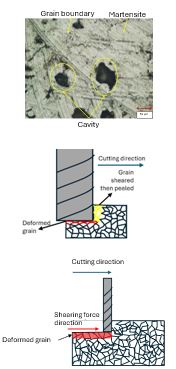
Sintered Soft Magnetic Composites (SMCs) are widely used in electromechanical industries due to their favorable magnetic properties, such as high permeability and low hysteresis loss. However, their inherently brittle mechanical characteristics pose significant challenges during machining processes, particularly milling. This study aims to investigate the fundamental mechanisms of material removal during the milling process and to optimize machining parameters in enhancing surface quality under controlled and specified machining conditions. Milling experiments were conducted by cutting groove profiles in the workpiece for every set of varying parameters, which consisted of spindle speed, axial depth of cut, feed rate, and coolant usage as varying parameters, while radial depth of cut and tool path remained fixed. Surface roughness was analyzed using Response Surface Methodology (RSM) and Analysis of Variance (ANOVA). The surface morphology of machined surface is observed by using optical microscope. The results indicate that cooling conditions, spindle speed, and axial depth of cut affects significantly the machined surface quality, where the combination of spindle speed and axial depth of cut has a more significant effect than when considered individually. The smoothest surface roughness obtained from the experiment has surface roughness with Ra value of 1.42 µm. The surface morphology of the machined surface indicates that during milling, the surface material grains are deformed, leading to deformation-induced phase transformation, and it founds out that deeper axial depth of cut could result to smoother surface finish and coolant usage not always give smoother surface.
References
[1] Shokrollahi, H., and K. Janghorban. 2007. Soft Magnetic Composite Materials (SMCs). Journal of Materials Processing Technology. https://doi.org/10.1016/j.jmatprotec.2007.02.034.
[2] Tri Waloyo, H., et al. 2025. Proses Produksi Soft Magnetic Composite (SMC) Berbahan Dasar Fe. https://doi.org/10.36289/jtmi.v20i1.765.
[3] Kang, S., and S. Lee. 2024. Application of Soft Magnetic Composite in XEV Motor Core Manufacturing: Process Effects and Performance Analysis. Metals. 14(10). https://doi.org/10.3390/met14101163.
[4] Can, A. 2019. Study on the Machinability of SMC Composites During Hole Milling: Influence of Tool Geometry and Machining Parameters. Arabian Journal for Science and Engineering. 44(9): 7599–7616. https://doi.org/10.1007/s13369-019-03865-z.
[5] Kulkarni, H., C. Blais, and V. V. Dabhade. 2024. Analysis of Machining a Sinter-Hardened Powder Metallurgy Steel: Significance of Localized Densification of Uncut Chip Material during Chip Formation. Journal of Materials Engineering and Performance. https://doi.org/10.1007/s11665-024-09879-5.
[6] Kulkarni, H., and V. V. Dabhade. 2023. Machinability of a Sinter-Hardened Powder Metallurgy Steel: Combined Analysis of Cutting Force and Chip Characteristics. Powder Metallurgy and Metal Ceramics. 62(7–8): 445–458. https://doi.org/10.1007/s11106-024-00406-8.
[7] Hu, B., R. W. III, S. Ropar, and A. Neilan. 2017. The Effect of Porosity on Machinability of PM Materials. International Journal of Powder Metallurgy. 53(1): 27–36.
[8] Rajput, A., and S. K. Paul. 2023. Influence of Hard Inclusion on Bauschinger Effect and Cyclic Deformation Behavior: An Atomistic Simulation on Single-Crystal and Polycrystal Aluminum. Materials Today Communications. 34. https://doi.org/10.1016/j.mtcomm.2022.105126.
[9] Astakhov, V. P., and S. Shvets. 2004. The Assessment of Plastic Deformation in Metal Cutting. Journal of Materials Processing Technology. 146(2): 193–202. https://doi.org/10.1016/j.jmatprotec.2003.10.015.
[10] Usca, Ü. A., et al. 2022. Tool Wear, Surface Roughness, Cutting Temperature and Chips Morphology Evaluation of Al/TiN Coated Carbide Cutting Tools in Milling of Cu–B–CrC Based Ceramic Matrix Composites. Journal of Materials Research and Technology. 16: 1243–1259. https://doi.org/10.1016/j.jmrt.2021.12.063.
[11] Jauhari, K., A. Z. Rahman, M. Al Huda, M. Azka, A. Widodo, and T. Prahasto. 2024. A Feature Extraction Method for Intelligent Chatter Detection in the Milling Process. Journal of Intelligent Manufacturing. https://doi.org/10.1007/s10845-024-02486-0.
[12] Maslo, S., B. Menezes, P. Kienast, P. Ganser, and T. Bergs. 2020. Improving Dynamic Process Stability in Milling of Thin-Walled Workpieces by Optimization of Spindle Speed Based on a Linear Parameter-Varying Model. In Procedia CIRP. 850–855. Elsevier. https://doi.org/10.1016/j.procir.2020.03.092.
[13] Majid, N. C., et al. 2024. Vibration Response Analysis in Turn-Milling of SUS 410 Using Raster and Vortex Strategy. In AIP Conference Proceedings. American Institute of Physics. https://doi.org/10.1063/5.0206550.
[14] Aziz, A., et al. 2023. Influence of Lubrication on Vibration Response and Surface Roughness in Milling of Aluminum 6061. Evergreen. 10(3). https://doi.org/10.5109/7151725.
[15] Azka, M., K. Yamada, M. Al Huda, K. Mani, R. Tanaka, and K. Sekiya. 2020. Hilbert-Huang Transform Analysis of Machining Stability in Ball-Nose End-Milling of Curved Surface. International Journal of Automation Technology. 14(3): 500–511. https://doi.org/10.20965/IJAT.2020.P0500.
[16] Azka, M., K. Yamada, M. Al Huda, R. Tanaka, and K. Sekiya. 2020. Influence of Tool Posture and Position on Stability in Milling with Parallel Kinematic Machine Tool. International Journal of Precision Engineering and Manufacturing. 21(12): 2359–2373. https://doi.org/10.1007/s12541-020-00416-7.
[17] Alizadeh, E. 2008. Factors Influencing the Machinability of Sintered Steels.
[18] Yang, D., L. Lu, and Z. Wan. 2020. Material Removal Mechanism of Green Machining on Powder Metallurgy Parts during Orthogonal Cutting. Advances in Materials Science and Engineering. 2020. https://doi.org/10.1155/2020/1962602.
[19] Ghorbani, B., M. J. Nategh, and M. R. Karafi. 2022. An Investigation on the Material Removal Mechanism, Surface Porosity, and Surface Integrity in Ultrasonic Vibration Assisted Turning of Porous Stainless Steel 316L. Proceedings of the Institution of Mechanical Engineers, Part B: Journal of Engineering Manufacture. 236(13): 1782–1792. https://doi.org/10.1177/09544054221093299.
[20] Veza, I., M. Spraggon, I. M. R. Fattah, and M. Idris. 2023. Response Surface Methodology (RSM) for Optimizing Engine Performance and Emissions Fueled with Biofuel: Review of RSM for Sustainability Energy Transition. Results in Engineering. https://doi.org/10.1016/j.rineng.2023.101213.
[21] Danninger, H., C. Gierl-Mayer, and S. Strobl. 2013. Evolution of Microstructure in Ferrous and Non-Ferrous Materials. In Advances in Powder Metallurgy: Properties, Processing and Applications, 308–357. Elsevier. https://doi.org/10.1533/9780857098900.2.308.
[22] Ribeiro, J. E., M. B. César, and H. Lopes. 2017. Optimization of Machining Parameters to Improve the Surface Quality. In Procedia Structural Integrity, 355–362. Elsevier. https://doi.org/10.1016/j.prostr.2017.07.182.
[23] Şap, E., et al. 2021. Parametric Optimization for Improving the Machining Process of Cu/Mo–SiCp Composites Produced by Powder Metallurgy. Materials. 14(8). https://doi.org/10.3390/ma14081921.
[24] Majerík, J., J. Majerský, H. Chochlíková, I. Barényi, J. Escherová, and M. Kubasáková. 2023. Machining of M390 Microclean® and M398 Microclean® PM Steels—The Comparison of Cutting Forces and Surface Roughness. Manufacturing Technology. 23(6): 853–860. https://doi.org/10.21062/MFT.2023.096.
[25] Jin, D., and Z. Liu. 2012. Effect of Cutting Speed on Surface Integrity and Chip Morphology in High-Speed Machining of PM Nickel-Based Superalloy FGH95. International Journal of Advanced Manufacturing Technology. 60(9–12): 893–899. https://doi.org/10.1007/s00170-011-3679-6.
[26] Obikawa, T., T. Ohno, T. Maetani, and Y. Ozaki. 2018. Machining of Sintered Steel under Different Lubrication Conditions. Machining Science and Technology. 22(2): 338–352. https://doi.org/10.1080/10910344.2017.1365893.
[27] Kwak, S. 2023. Are Only p-Values Less Than 0.05 Significant? A p-Value Greater Than 0.05 Is Also Significant! Journal of Lipid and Atherosclerosis. 12(2): 89–95. https://doi.org/10.12997/jla.2023.12.2.89.
[28] Kaynak, Y. 2014. Machining and Phase Transformation Response of Room-Temperature Austenitic NiTi Shape Memory Alloy. Journal of Materials Engineering and Performance. 23(9): 3354–3360. https://doi.org/10.1007/s11665-014-1058-9.
[29] Aziz, A., M. Yang, T. Shimizu, and T. Furushima. 2022. Effect of Phase Transformation on Surface Roughening Behavior in Austenitic Thin Metal Foils. In Materials Science Forum, 205–210. Trans Tech Publications.
[30] Aziz, A., M. Yang, T. Shimizu, and T. Furushima. 2022. Constitutive Model of the Surface Roughening Behavior of Austenitic Stainless Steel. Materials. 15(12). https://doi.org/10.3390/ma15124348.
[31] Kulkarni, H., V. V. Dabhade, and C. Blais. 2023. Machining Pre-Sintered Compacts of a Sinter-Hardenable Powder Metallurgy Steel: A Novel Methodology for Selecting Sintering Temperatures for the Optimum Machinability. Journal of Manufacturing Processes 105: 444–462. https://doi.org/10.1016/j.jmapro.2023.09.050.
Downloads
Published
Issue
Section
License
Copyright of articles that appear in Jurnal Teknologi belongs exclusively to Penerbit Universiti Teknologi Malaysia (Penerbit UTM Press). This copyright covers the rights to reproduce the article, including reprints, electronic reproductions, or any other reproductions of similar nature.