
ADVANCES IN EARTHQUAKE MITIGATION IN MALAYSIA: A REVIEW OF GLOBAL CONTEXT AND LOCAL PROGRESS
DOI:
https://doi.org/10.11113/jurnalteknologi.v88.25341Keywords:
Earthquake mitigation, Malaysia, seismic hazard, building codes, retrofittingAbstract
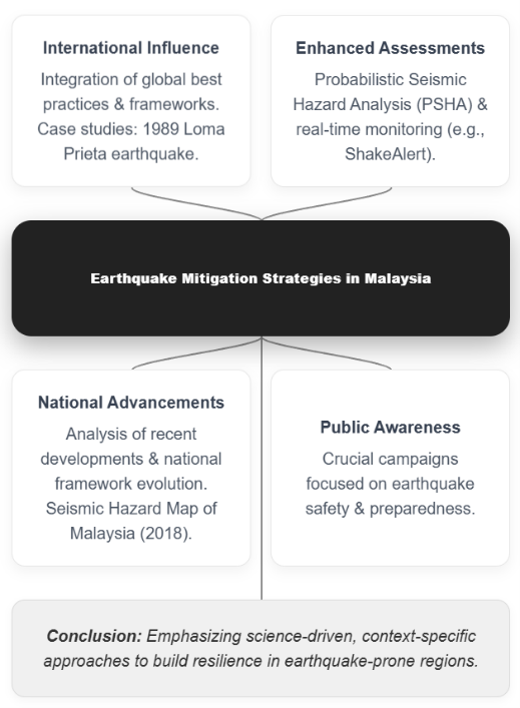
This paper provides a critical review of earthquake mitigation strategies in Malaysia. It aims to synthesize global best practices and evaluate their local application, feasibility, and the systemic challenges that hinder effective implementation. A narrative review of academic literature, government policy documents, and technical reports was conducted. The collected sources were analyzed using a thematic synthesis framework to structure the review around global advancements, Malaysia's specific seismic context, and the critical gaps between policy and on-the-ground practice. The review finds that while Malaysia has developed a progressive policy framework, its effectiveness is challenged by several key issues. A significant "knowing-doing gap" exists, where the adoption of advanced standards like Eurocode 8 is undermined by inconsistent enforcement and a shortage of specialized expertise. The practical feasibility of adopting global technologies is often limited by local factors, including high costs and infrastructural prerequisites. Furthermore, governance is characterized by a reactive "policy-disaster cycle," and community-based programs face challenges in achieving long-term sustainability. The novelty of this review lies in its critical synthesis that moves beyond a descriptive compilation of strategies. By identifying and analyzing the systemic barriers to resilience—from governance gaps to the vast, unaddressed risk of pre-code buildings—this paper provides actionable insights for policymakers, engineers, and disaster managers. It offers a clear-eyed assessment of the steps required to bridge the persistent gap between policy ambition and practical reality in Malaysia's journey towards seismic resilience.
References
[1] Dong, L., and Q. Luo. 2022. Investigations and New Insights on Earthquake Mechanics from Fault Slip Experiments. Earth-Science Reviews. 228: 104019. https://doi.org/10.1016/j.earscirev.2022.104019.
[2] Gastineau, R., et al. 2021. Active Subaquatic Fault Segments in Lake Iznik Along the Middle Strand of the North Anatolian Fault, NW Turkey. Tectonics. 40(1). https://doi.org/10.1029/2020TC006404.
[3] Chee Yin, H., M. M. Kassem, and F. Mohamed Nazri. 2022. Comprehensive Review of Community Seismic Resilience: Concept, Frameworks, and Case Studies. Advances in Civil Engineering. 2022(1). https://doi.org/10.1155/2022/7668214.
[4] Irsyam, M., et al. 2020. Development of the 2017 National Seismic Hazard Maps of Indonesia. Earthquake Spectra. 36(1 Suppl.): 112–136. https://doi.org/10.1177/8755293020951206.
[5] Mase, L. Z. 2020. Seismic Hazard Vulnerability of Bengkulu City, Indonesia, Based on Deterministic Seismic Hazard Analysis. Geotechnical and Geological Engineering. 38(5): 5433–5455. https://doi.org/10.1007/s10706-020-01375-6.
[6] Sreejaya, K. P., S. T. G. Raghukanth, I. D. Gupta, C. V. R. Murty, and D. Srinagesh. 2022. Seismic Hazard Map of India and Neighbouring Regions. Soil Dynamics and Earthquake Engineering. 163: 107505. https://doi.org/10.1016/j.soildyn.2022.107505.
[7] Scaini, C., A. Peresan, A. Tamaro, V. Poggi, and C. Barnaba. 2022. Can High-School Students Contribute to Seismic Risk Mitigation? Lessons Learned from the Development of a Crowd-Sourced Exposure Database. International Journal of Disaster Risk Reduction. 69:102755. https://doi.org/10.1016/j.ijdrr.2021.102755.
[8] Urlainis, A., and I. M. Shohet. 2022. Seismic Risk Mitigation and Management for Critical Infrastructures Using an RMIR Indicator." Buildings. 12(10): 1748. https://doi.org/10.3390/buildings12101748.
[9] Zhang, R., and H. Sun. 2022. Deep Learning and Data Analytics for Assessing Seismic Performance of Civil Infrastructures. In Sensor Technologies for Civil Infrastructures: Volume 1: Sensing Hardware and Data Collection Methods for Performance Assessment, 531–579. Elsevier. https://doi.org/10.1016/B978-0-08-102696-0.00001-4.
[10] Chen, W., and L. Zhang. 2022. An Automated Machine Learning Approach for Earthquake Casualty Rate and Economic Loss Prediction. Reliability Engineering & System Safety. 225: 108645. https://doi.org/10.1016/j.ress.2022.108645.
[11] Ferrario, M. F. 2022. "Landslides Triggered by the 2015 Mw 6.0 Sabah (Malaysia) Earthquake: Inventory and ESI-07 Intensity Assignment. Natural Hazards and Earth System Sciences. 22(10): 3527–3542. https://doi.org/10.5194/nhess-22-3527-2022.
[12] Golutin, B. 2020. Distribution of Ground Motion Seismic Surface Wave of the 2015 Shallow Strong Earthquake at Ranau Central Zone Seismically Active Region, Sabah, Malaysia. Bulletin of the Geological Society of Malaysia. 69: 67–77. https://doi.org/10.7186/bgsm69202006.
[13] Department of Mineral and Geoscience Malaysia. 2018. Malaysia Seismic Disaster Zone Map for Geodisaster Management. Kuala Lumpur.
[14] Sauti, N. S., M. E. Daud, M. Kaamin, and S. Sahat. 2022. Earthquake Risk Assessment of Sabah, Malaysia Based on Geospatial Approach. International Journal of Integrated Engineering. 14(5). https://doi.org/10.30880/ijie.2022.14.05.004.
[15] Sauti, N. S., M. E. Daud, M. Kaamin, and S. Sahat. 2021. GIS Spatial Modelling for Seismic Risk Assessment Based on Exposure, Resilience, and Capacity Indicators to Seismic Hazard: A Case Study of Pahang, Malaysia. Geomatics, Natural Hazards and Risk. 12(1): 1948–1972. https://doi.org/10.1080/19475705.2021.1947903.
[16] Babaei, S., and F. Karimi Ghaleh Jough. 2024. A Comprehensive Evaluation of Tuned Vertical Isolation System for Seismic Risk Mitigation. Journal of Applied Engineering Sciences. 14(1): 27–34. https://doi.org/10.2478/jaes-2024-0004.
[17] Anuar, A., F. C. Ros, and K. J. Ghalehteimouri. 2022. Water Quality Parameters as Early Warning Indicators in Earthquake Risk Management: A Case Study of Mount Kinabalu in the District of Ranau, Sabah, Malaysia. https://doi.org/10.21203/rs.3.rs-2349053/v1.
[18] Zhang, Y., J. F. Fung, K. J. Johnson, and S. Sattar. 2022. Review of Seismic Risk Mitigation Policies in Earthquake-Prone Countries: Lessons for Earthquake Resilience in the United States. Journal of Earthquake Engineering. 26(12): 6208–6235. https://doi.org/10.1080/13632469.2021.1911889.
[19] White, M. N., and P. Yanev. 2020. The Evolution of Managing Seismic Risk in American Urban Centers after the Loma Prieta Earthquake: Changes in California Authorities and Federal Statutes after 1989. Paper presented in Sendai, Japan.
[20] Baraschino, R., G. Baltzopoulos, and I. Iervolino. 2020. R2R-EU: Software for Fragility Fitting and Evaluation of Estimation Uncertainty in Seismic Risk Analysis. Soil Dynamics and Earthquake Engineering 132: 106093. https://doi.org/10.1016/j.soildyn.2020.106093.
[21] Cremen, G., F. Bozzoni, S. Pistorio, and C. Galasso. 2022. Developing a Risk-Informed Decision-Support System for Earthquake Early Warning at a Critical Seaport. Reliability Engineering & System Safety. 218: 108035. https://doi.org/10.1016/j.ress.2021.108035.
[22] Robat Mili, R., K. Amini Hosseini, and Y. O. Izadkhah. 2018. Developing a Holistic Model for Earthquake Risk Assessment and Disaster Management Interventions in Urban Fabrics. International Journal of Disaster Risk Reduction. 27: 355–365. https://doi.org/10.1016/j.ijdrr.2017.10.022.
[23] Cremen, G., and C. Galasso. 2021. A Decision-Making Methodology for Risk-Informed Earthquake Early Warning. Computer-Aided Civil and Infrastructure Engineering. 36(6): 747–761. https://doi.org/10.1111/mice.12670.
[24] Harith, N. S. H., and A. Adnan. 2023. Seismic Hazard Map of ASEAN Countries towards Risk Assessment and Sustainability of Structures and Infrastructures. The Eurasia Proceedings of Science, Technology, Engineering and Mathematics. 26: 121–134. https://doi.org/10.55549/epstem.1409412.
[25] Sauti, N. S., M. E. Daud, and M. Kaamin. 2020. Construction of an Integrated Social Vulnerability Index to Identify Spatial Variability of Exposure to Seismic Hazard in Pahang, Malaysia. International Journal of Design & Nature and Ecodynamics. 15(3): 365–372. https://doi.org/10.18280/ijdne.150310.
[26] Sauti, N. S., M. Effendi Daud, and M. Kaamin. 2020. Proposed Method and Framework for Evaluating and Calculating a Seismic Vulnerability Index of Malaysia. IOP Conference Series: Earth and Environmental Science. 616 (1): 012034. https://doi.org/10.1088/1755-1315/616/1/012034.
[27] Sauti, N. S., M. E. Daud, M. Kaamin, and S. Sahat. 2023. A Comprehensive Review of Holistic Indicators for Seismic Vulnerability Assessment of Malaysia. International Journal of Design & Nature and Ecodynamics. 18(3): 631–642. https://doi.org/10.18280/ijdne.180315.
[28] Rafie, M. T., D. P. Sahara, P. R. Cummins, W. Triyoso, and S. Widiyantoro. 2023. Stress Accumulation and Earthquake Activity on the Great Sumatran Fault, Indonesia. Natural Hazards 116 (3): 3401–3425. https://doi.org/10.1007/s11069-023-05816-2.
[29] Putra, A. D., N. Sulaiman, N. Roslan, H. Jamil, and K. Alias. 2022. Fault Zone Identification for Groundwater Flow Assessment Based on Seismic Reflection Survey Data at the Area of Felda Lepar Utara, Pahang, Malaysia. Journal of Physics: Conference Series. 2309(1): 012037. https://doi.org/10.1088/1742-6596/2309/1/012037.
[30] Martin, S. S., Y. Wang, M. Muzli, and S. Wei. 2020. The 1922 Peninsula Malaysia Earthquakes: Rare Intraplate Seismicity within the Sundaland Block in Southeast Asia. Seismological Research Letters. 91(5): 2531–2545. https://doi.org/10.1785/0220200052.
[31] McBride, S. K., et al. 2020. Developing Post-Alert Messaging for ShakeAlert, the Earthquake Early Warning System for the West Coast of the United States of America. International Journal of Disaster Risk Reduction. 50: 101713. https://doi.org/10.1016/j.ijdrr.2020.101713.
[32] Ramli, M. W. A., N. E. Alias, H. Mohd Yusof, Z. Yusop, and S. M. Taib. 2021. Development of a Local, Integrated Disaster Risk Assessment Framework for Malaysia. Sustainability. 13(19): 10792. https://doi.org/10.3390/su131910792.
[33] Amir, M. A., and N. H. Hamid. 2021. Hysteresis Loops of Base Isolation System—An Overview. Key Engineering Materials. 879: 189–201. https://doi.org/10.4028/www.scientific.net/KEM.879.189.
[34] Nurjaman, H., S. Suwito, D. Dinariana, G. Suprapto, B. Budiono, and M. Fau. 2022. Development of Numerical Model of a High Performance Precast Concrete System Equipped with Base Isolation. Evergreen. 9(2): 547–555. https://doi.org/10.5109/4794186.
[35] Raj, J. C. C., and M. Vinod Kumar. 2022. Performance Evaluation of Eco-Friendly Scrap Tyre Base Isolation Technology in Distinct Construction Quality RC Framed Buildings Located in Seismic Risk Zone. Sustainable Energy Technologies and Assessments. 53: 102511. https://doi.org/10.1016/j.seta.2022.102511.
[36] Kavvada, I., S. Moura, and A. Horvath. 2022. Aligning Sustainability and Regional Earthquake Hazard Mitigation Planning: Integrating Greenhouse Gas Emissions and Vertical Equity. Environmental Research: Infrastructure and Sustainability. 2(4): 045013. https://doi.org/10.1088/2634-4505/aca9f3.
[37] Freddi, F., J. Ghosh, N. Kotoky, and M. Raghunandan. 2021. Device Uncertainty Propagation in Low-Ductility RC Frames Retrofitted with BRBs for Seismic Risk Mitigation." Earthquake Engineering & Structural Dynamics. 50(9): 2488–2509. https://doi.org/10.1002/eqe.3456.
[38] Freddi, F., et al. 2021. Innovations in Earthquake Risk Reduction for Resilience: Recent Advances and Challenges. International Journal of Disaster Risk Reduction. 60: 102267. https://doi.org/10.1016/j.ijdrr.2021.102267.
[39] Aljwim, K., S. C. Alih, M. Vafaei, and S. Aisyah. 2020. Seismic Fragility Curves for Tall Concrete Wall Building in Malaysia Subjected to Near-Field Earthquakes. International Journal of Engineering Research and Technology. 13(9): 2205–2212. https://doi.org/10.37624/IJERT/13.9.2020.2205-2212.
[40] Jena, R., and B. Pradhan. 2020. Integrated ANN-Cross-Validation and AHP-TOPSIS Model to Improve Earthquake Risk Assessment. International Journal of Disaster Risk Reduction. 50: 101723. https://doi.org/10.1016/j.ijdrr.2020.101723.
[31] McBride, S. K., et al. 2020. Developing Post-Alert Messaging for ShakeAlert, the Earthquake Early Warning System for the West Coast of the United States of America. International Journal of Disaster Risk Reduction. 50: 101713. https://doi.org/10.1016/j.ijdrr.2020.101713.
[32] Ramli, M. W. A., N. E. Alias, H. Mohd Yusof, Z. Yusop, and S. M. Taib. 2021. Development of a Local, Integrated Disaster Risk Assessment Framework for Malaysia. Sustainability. 13(19): 10792. https://doi.org/10.3390/su131910792.
[33] Amir, M. A., and N. H. Hamid. 2021. Hysteresis Loops of Base Isolation System—An Overview. Key Engineering Materials. 879: 189–201. https://doi.org/10.4028/www.scientific.net/KEM.879.189.
[34] Nurjaman, H., S. Suwito, D. Dinariana, G. Suprapto, B. Budiono, and M. Fau. 2022. Development of Numerical Model of a High Performance Precast Concrete System Equipped with Base Isolation. Evergreen. 9(2): 547–555. https://doi.org/10.5109/4794186.
[35] Raj, J. C. J., and M. Vinod Kumar. 2022. Performance Evaluation of Eco-Friendly Scrap Tyre Base Isolation Technology in Distinct Construction Quality RC Framed Buildings Located in Seismic Risk Zone. Sustainable Energy Technologies and Assessments. 53: 102511. https://doi.org/10.1016/j.seta.2022.102511.
[36] Kavvada, I., S. Moura, and A. Horvath. 2022. Aligning Sustainability and Regional Earthquake Hazard Mitigation Planning: Integrating Greenhouse Gas Emissions and Vertical Equity. Environmental Research: Infrastructure and Sustainability. 2(4): 045013. https://doi.org/10.1088/2634-4505/aca9f3.
[37] Freddi, F., J. Ghosh, N. Kotoky, and M. Raghunandan. 2021. Device Uncertainty Propagation in Low-Ductility RC Frames Retrofitted with BRBs for Seismic Risk Mitigation. Earthquake Engineering & Structural Dynamics. 50(9): 2488–2509. https://doi.org/10.1002/eqe.3456.
[38] Freddi, F., et al. 2021. Innovations in Earthquake Risk Reduction for Resilience: Recent Advances and Challenges. International Journal of Disaster Risk Reduction. 60: 102267. https://doi.org/10.1016/j.ijdrr.2021.102267.
[39] Aljwim, K., S. C. Alih, M. Vafaei, and S. Aisyah. 2020. Seismic Fragility Curves for Tall Concrete Wall Building in Malaysia Subjected to Near-Field Earthquakes. International Journal of Engineering Research and Technology. 13(9): 2205–2212. https://doi.org/10.37624/ijert/13.9.2020.2205-2212.
[40] Jena, R., and B. Pradhan. 2020. Integrated ANN-Cross-Validation and AHP-TOPSIS Model to Improve Earthquake Risk Assessment. International Journal of Disaster Risk Reduction. 50: 101723. https://doi.org/10.1016/j.ijdrr.2020.101723.
[41] Mangalathu, S., and J.-S. Jeon. 2020. Regional Seismic Risk Assessment of Infrastructure Systems through Machine Learning: Active Learning Approach. Journal of Structural Engineering. 146(12). https://doi.org/10.1061/(ASCE)ST.1943-541X.0002831.
[42] Forcellini, D. 2021. Analytical Fragility Curves of Shallow-Founded Structures Subjected to Soil–Structure Interaction (SSI) Effects. Soil Dynamics and Earthquake Engineering. 141: 106487. https://doi.org/10.1016/j.soildyn.2020.106487.
[43] Qu, Z., F. Wang, X. Chen, X. Wang, and Z. Zhou. 2023. Rapid Report of Seismic Damage to Hospitals in the 2023 Turkey Earthquake Sequences. Earthquake Research Advances. 3(4): 100234. https://doi.org/10.1016/j.eqrea.2023.100234.
[44] Marhain, S., A. N. Ahmed, M. A. Murti, P. Kumar, and A. El-Shafie. 2021. Investigating the Application of Artificial Intelligence for Earthquake Prediction in Terengganu. Natural Hazards. 108(1): 977–999. https://doi.org/10.1007/s11069-021-04716-7.
[45] Chong, N. Omar, and K. Hisyam Kamarudin. 2018. Disaster Risk Management in Malaysia: Issues and Challenges from the Perspective of Agencies.
[46] Looi, D., N. Lam, and H.-H. Tsang. 2021. Developing Earthquake-Resistant Structural Design Standard for Malaysia Based on Eurocode 8: Challenges and Recommendations. Standards. 1(2): 134–153. https://doi.org/10.3390/standards1020012.
[47] Bikar, S. S., B. Rathakrishnan, M. R. Kamaluddin, N. Che Mohd Nasir, and M. A. Mohd Nasir. 2021. Social Sustainability of Post-Disaster: How Teachers Enable Primary School Students to Be Resilient in Times of Ranau Earthquake. Sustainability. 13(13): 7308. https://doi.org/10.3390/SU13137308.
[48] Kamarudin, M. A. Amzar, S. Wan Ahmad, H. A. Alsakkaf, S. I. Syed Mustopha, and O. Shafiq. 2025. The Assessment of Tall Building Structure Performance Due to Seismic Effect in Malaysia. Journal of Advanced Research Design. 129(1): 112–129. https://doi.org/10.37934/ARD.129.1.112129.
[49] Shaw, R., T. Izumi, R. Djalante, and F. Imamura. 2025. Introduction and Overview of Disaster Risk Landscape: Perspectives of Twenty Years from the Indian Ocean Tsunami of 2004. In Disaster Risk Reduction in Asia, 1–10. https://doi.org/10.1007/978-981-96-2669-4_1.
[50] Izumi, T., and E. Motoyama. 2025. Development and Progress of Community-Based Disaster Risk Reduction in Malaysia. In Disaster Risk Reduction in Asia, 285–304. https://doi.org/10.1007/978-981-96-2669-4_17.
[51] Abu Bakar, M. Z., and Z. F. Mohamad. 2023. Local Government Capacity for Earthquake Disaster Risk Reduction in Malaysia: Case Studies in Bentong and Selayang Areas. International Journal of Disaster Risk Reduction. 97: 103987. https://doi.org/10.1016/j.ijdrr.2023.103987.
[52] Ahmad, F., B. Golutin, and N. M. N. N. Rahimi. 2023. Are Dams in Malaysia Exposed to Earthquake Threat? In Recent Advances in Dam Engineering. 213–222. https://doi.org/10.1007/978-981-99-3708-0_15.
[53] Ganasan, R., C. G. Tan, Z. Ibrahim, F. M. Nazri, and Y. H. Wong. 2020. A Case Study on Structural Failure of Reinforced Concrete Beam–Column Joint After the First Significant Earthquake Impact in Malaysia. International Journal of Integrated Engineering. 12(8): 288–302. https://doi.org/10.30880/IJIE.2020.12.08.028.
[54] Abu Samah, A., H. A. Mohamed Shaffril, N. S. Ramli, J. L. D’Silva, D. Dahalan, and N. A. Mohamed. 2022. Readiness towards Earthquake Disasters among Community in Peninsular Malaysia.” Environmental Hazards. 21(3): 274–287. https://doi.org/10.1080/17477891.2021.1960472.
[55] Kassem, M. M., S. Beddu, J. H. Ooi, C. G. Tan, A. Mohamad El-Maissi, and F. Mohamed Nazri. 2021. Assessment of Seismic Building Vulnerability Using Rapid Visual Screening Method through Web-Based Application for Malaysia. Buildings. 11(10): 485. https://doi.org/10.3390/buildings11100485.
[56] Porter, K., R. Hamburger, and R. Kennedy. 2007. Practical Development and Application of Fragility Functions.
[57] Lallemant, D., A. Kiremidjian, and H. Burton. 2015. Statistical Procedures for Developing Earthquake Damage Fragility Curves. Earthquake Engineering & Structural Dynamics. 44(9): 1373–1389. https://doi.org/10.1002/eqe.2522.
Downloads
Published
Issue
Section
License
Copyright of articles that appear in Jurnal Teknologi belongs exclusively to Penerbit Universiti Teknologi Malaysia (Penerbit UTM Press). This copyright covers the rights to reproduce the article, including reprints, electronic reproductions, or any other reproductions of similar nature.