
NUMERICAL INVESTIGATION OF BIOFOULING ROUGHNESS IMPACT ON THE PERFORMANCE OF PROPELLER
DOI:
https://doi.org/10.11113/jurnalteknologi.v88.25357Keywords:
Biofouling, Surface Roughness, Propeller Performance, CFD Simulation, Hydrodynamic EfficiencyAbstract
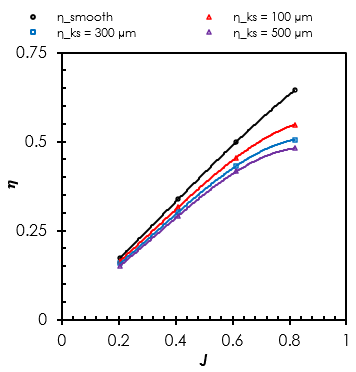
Biofouling-induced surface roughness is a critical issue affecting the hydrodynamic performance of marine propellers, leading to increased energy consumption and emissions. This study investigates the effects of varying roughness heights on the thrust, torque, and open water efficiency of a B-series B4-70 marine propeller using Computational Fluid Dynamics (CFD). A wall-function-based roughness model was implemented within the RANS-SST turbulence framework to simulate realistic fouling scenarios while maintaining computational efficiency. The results demonstrate that surface roughness significantly decreases thrust and efficiency while increasing torque. At a roughness height of 500 µm, thrust losses reached up to 18% and efficiency dropped by nearly 2.5% at high advance coefficients, while torque increased by over 10%. These performance degradations are attributed to elevated wall shear stress and altered pressure distribution across the blade surfaces. The findings highlight the importance of maintaining clean propeller surfaces to reduce hydrodynamic losses, fuel consumption, and operational emissions in maritime applications.
References
[1] Hakim ML, Tuswan, Firdaus A, Mursid O. Investigating the Comparison of Ship Resistance Components Between U and V-Shaped Hulls. Jurnal Teknologi 2023;85:153–64. https://doi.org/10.11113/jurnalteknologi.v85.19382.
[2] Choi HJ. Hull-form optimization of a container ship based on bell-shaped modification function. International Journal of Naval Architecture and Ocean Engineering 2015;7:478–89. https://doi.org/10.1515/ijnaoe-2015-0034.
[3] Haase M. Energy-efficient large medium-speed catamarans: Hull form design by full-scale CFD simulations. Ship Technology Research 2016;63:133–4. https://doi.org/10.1080/09377255.2016.1208974.
[4] Trimulyono A, Hakim ML, Ardhan C, Ahmad STP, Tuswan T, Santosa AWB. Analysis of the double steps position effect on planing hull performances. Brodogradnja 2023;74:41–72. https://doi.org/10.21278/brod74403.
[5] Radonja R, Pavić D, Glujić D. Methodological approach on optimizing the speed of navigation to reduce fuel consumption and increase energy efficiency of the cruising ship. Pomorstvo 2019;33:222–31. https://doi.org/10.31217/p.33.2.12.
[6] Farkas A, Degiuli N, Martić I, Vujanović M. Greenhouse gas emissions reduction potential by using antifouling coatings in a maritime transport industry. Journal of Cleaner Production 2021;295. https://doi.org/10.1016/j.jclepro.2021.126428.
[7] Adietya BA, Syahab H, Indiaryanto M, Aryawan WD, Utama IKAP. Influence Evaluation of Open Propellers with Boss Cap Fins: Case Studies on Types B4-70 and Ka4-70. CFD Letters 2024;16:143–77. https://doi.org/10.37934/cfdl.16.9.143177.
[8] Arifin MD, Felayati FM, Muhammad AH. Flow Separation Evaluation on Tubercle Ship Propeller. CFD Letters 2022;14:43–50. https://doi.org/10.37934/cfdl.14.4.4350.
[9] Berlian Arswendo Adietya, I Ketut Aria Pria Utama, Wasis Dwi Aryawan, Dwi Wahyudi, Anis Kurniati Arifah, Baharuddin Ali, et al. Characteristics Investigations of Ducted Ka4-70 Series Propeller with Boss Cap Fins Using Numerical and Experimental Method. CFD Letters 2023;16:24–41. https://doi.org/10.37934/cfdl.16.2.2441.
[10] Corbett JJ, Fischbeck PS, Pandis SN. Global nitrogen and sulfur inventories for oceangoing ships. Journal of Geophysical Research: Atmospheres 1999;104:3457–70. https://doi.org/10.1029/1998JD100040.
[11] Felayati FM, Semin, Cahyono B, Bakar RA, Birouk M. Performance and emissions of natural gas/diesel dual-fuel engine at low load conditions: Effect of natural gas split injection strategy. Fuel 2021;300:121012. https://doi.org/10.1016/j.fuel.2021.121012.
[12] Taskar B, Andersen P. Benefit of speed reduction for ships in different weather conditions. Transportation Research Part D: Transport and Environment 2020;85:102337. https://doi.org/10.1016/j.trd.2020.102337.
[13] Bigi N, Roncin K, Leroux J-B, Parlier Y. Ship Towed by Kite: Investigation of the Dynamic Coupling. Journal of Marine Science and Engineering 2020;8:486. https://doi.org/10.3390/jmse8070486.
[14] Podeur V, Merdrignac D, Behrel M, Roncin K, Fonti C, Jochum C, et al. Fuel economy assessment tool for auxiliary kite propulsion of merchant ship. La Houille Blanche 2018;104:5–7. https://doi.org/10.1051/lhb/2018001.
[15] Josten F, Isensee J. Design aspects of solar-powered ships. Ship Technology Research 1998.
[16] Nasirudin A, Hasanudin H, Utama D, Tahwoto LP. Determination of PV Power and Battery Capacity Size for a Leisure Solar Powered Boat at Kalimas River, Surabaya, Indonesia. Kapal: Jurnal Ilmu Pengetahuan Dan Teknologi Kelautan 2020;17:123–9. https://doi.org/10.14710/kapal.v17i3.31965.
[17] Schultz MP, Bendick JA, Holm ER, Hertel WM. Economic impact of biofouling on a naval surface ship. Biofouling 2011;27:87–98. https://doi.org/10.1080/08927014.2010.542809.
[18] Hakim ML, Nugroho B, Nurrohman MN, Suastika IK, Utama IKAP. Investigation of fuel consumption on an operating ship due to biofouling growth and quality of anti-fouling coating. IOP Conference Series: Earth and Environmental Science 2019;339:012037. https://doi.org/10.1088/1755-1315/339/1/012037.
[19] Hakim ML, Suastika IK, Utama IKAP, Purnamasari D, Muryadin M. Frictional Resistance Increase Due to Hull Roughness: An Analysis of the Hull Form Parameters Influence. Transactions on Maritime Science 2023;12. https://doi.org/10.7225/toms.v12.n02.002.
[20] Oliveira D, Granhag L. Matching Forces Applied in Underwater Hull Cleaning with Adhesion Strength of Marine Organisms. Journal of Marine Science and Engineering 2016;4:66. https://doi.org/10.3390/jmse4040066.
[21] Oliveira DR, Lagerström M, Granhag L, Werner S, Larsson AI, Ytreberg E. A novel tool for cost and emission reduction related to ship underwater hull maintenance. Journal of Cleaner Production 2022;356:131882. https://doi.org/10.1016/j.jclepro.2022.131882.
[22] Schultz MP. Effects of coating roughness and biofouling on ship resistance and powering. Biofouling 2007;23:331–41. https://doi.org/10.1080/08927010701461974.
[23] Demirel YK, Turan O, Incecik A. Predicting the effect of biofouling on ship resistance using CFD. Applied Ocean Research 2017;62:100–18. https://doi.org/10.1016/j.apor.2016.12.003.
[24] Hakim ML, Firdhaus A, Samuel S, Song S, Kim S, Utama IKAP. Investigating the impact of inhomogeneous roughness on the drag of a planing craft assisted by numerical simulation. Ocean Engineering 2025;325:120826. https://doi.org/10.1016/j.oceaneng.2025.120826.
[25] Amiruddin W, Hakim ML, Firdhaus A, Purnamasari D, Tuswan T, Samuel S, et al. Prediction of the impact of biofouling roughness on a full-scale planing boat performance using CFD. Ocean Engineering 2024;301:117457. https://doi.org/10.1016/j.oceaneng.2024.117457.
[26] Amiruddin W, Hakim ML, Fernanda R, Firdhaus A, Purnamasari D, Samuel S, et al. Assessing drag increase on fishing vessels due to biofouling-induced surface roughness using CFD. Ships and Offshore Structures 2025:1–17. https://doi.org/10.1080/17445302.2025.2472266.
[27] Schultz MP, Kavanagh CJ, Swain GW. Hydrodynamic forces on barnacles: Implications on detachment from fouling‐release surfaces. Biofouling 1999;13:323–35. https://doi.org/10.1080/08927019909378388.
[28] Vijayanandh R, Venkatesan K, Raj Kumar R, Senthil Kumar M, Raj Kumar G, Jagadeeshwaran P. Theoretical and Numerical Analyses on Propulsive Efficiency of Unmanned Aquatic Vehicle’s Propeller. Journal of Physics: Conference Series 2020;1504:012004. https://doi.org/10.1088/1742-6596/1504/1/012004.
[29] Fish FE. Advantages of Natural Propulsive Systems. Marine Technology Society Journal 2013;47:37–44. https://doi.org/10.4031/MTSJ.47.5.2.
[30] Song S, Demirel YK, Atlar M. An investigation into the effect of biofouling on full-scale propeller performance using CFD. Proceedings of the International Conference on Offshore Mechanics and Arctic Engineering - OMAE, vol. 2, American Society of Mechanical Engineers; 2019. https://doi.org/10.1115/OMAE2019-95315.
[31] Song S, Demirel YK, Atlar M. Penalty of hull and propeller fouling on ship self-propulsion performance. Applied Ocean Research 2020;94:102006. https://doi.org/10.1016/j.apor.2019.102006.
[32] Farkas A, Degiuli N, Martić I. The impact of biofouling on the propeller performance. Ocean Engineering 2021;219:108376. https://doi.org/10.1016/j.oceaneng.2020.108376.
[33] Owen D, Demirel YK, Oguz E, Tezdogan T, Incecik A. Investigating the effect of biofouling on propeller characteristics using CFD. Ocean Engineering 2018;159:505–16. https://doi.org/10.1016/j.oceaneng.2018.01.087.
[34] Seo K-C, Atlar M, Goo B. A Study on the Hydrodynamic Effect of Biofouling on Marine Propeller. Journal of the Korean Society of Marine Environment and Safety 2016;22:123–8. https://doi.org/10.7837/kosomes.2016.22.1.123.
[35] Zinati A, Ketabdari MJ, Zeraatgar H. Effects of Propeller Fouling on the Hydrodynamic Performance of a Marine Propeller. Polish Maritime Research 2023;30:61–73. https://doi.org/10.2478/pomr-2023-0059.
[36] Marcus EA, de Vries R, Raju Kulkarni A, Veldhuis LL. Aerodynamic Investigation of an Over-the-Wing Propeller for Distributed Propulsion. 2018 AIAA Aerospace Sciences Meeting, Reston, Virginia: American Institute of Aeronautics and Astronautics; 2018. https://doi.org/10.2514/6.2018-2053.
[37] Liu Y, Li L, Ning Z, Tian W, Hu H. Experimental Investigation on the Dynamic Icing Process over a Rotating Propeller Model. Journal of Propulsion and Power 2018;34:933–46. https://doi.org/10.2514/1.B36748.
[38] Zhang J, Wang J, Zhang B, Zeng Y, Duan J, Hou B. Fabrication of anodized superhydrophobic 5083 aluminum alloy surface for marine anti-corrosion and anti-biofouling. Journal of Oceanology and Limnology 2020;38:1246–55. https://doi.org/10.1007/s00343-020-0036-3.
[39] Salta M, Wharton JA, Stoodley P, Dennington SP, Goodes LR, Werwinski S, et al. Designing biomimetic antifouling surfaces. Philosophical Transactions of the Royal Society A: Mathematical, Physical and Engineering Sciences 2010;368:4729–54. https://doi.org/10.1098/rsta.2010.0195.
[40] Chrismianto D, Zakki AF, Arswendo B, Cendikia Abar IA. Comparison of Propeller Type B-Series And AU-Outline Gawn Series For Improving On Submarine Propulsion Performance Using Cfd. International Journal Of Advanced Research In Engineering & Technology 2019;10. https://doi.org/10.34218/IJARET.10.2.2019.061.
[41] Kelly J, Vogel C, Willden R. Impact and mitigation of blade surface roughness effects on wind turbine performance. Wind Energy 2022;25:660–77. https://doi.org/10.1002/we.2691.
[42] Vecchia P Della, Malgieri D, Nicolosi F, De Marco A. Numerical analysis of propeller effects on wing aerodynamic: tip mounted and distributed propulsion. Transportation Research Procedia 2018;29:106–15. https://doi.org/10.1016/j.trpro.2018.02.010.
[43] Adietya BA, Aryawan WD, Utama IKAP. A study into the effect of tip clearance on the performance of b-series and kaplan-series ducted propellers. IOP Conference Series: Earth and Environmental Science 2023;1166:012038. https://doi.org/10.1088/1755-1315/1166/1/012038.
[44] Berlian Arswendo Adietya, I Ketut Aria Pria Utama, Wasis Dwi Aryawan, Mochammad Nasir, Nurcholis, Mahendra Indiaryanto, et al. Numerical and Experimental Investigations into the Characteristics of Wageningen B4-70 Series of Propeller with Boss Cap Fins. CFD Letters 2023;15:152–69. https://doi.org/10.37934/cfdl.15.10.152169.
[45] Berlian Arswendo Adietya, Husein Syahab, Mochammad Nasir, Wasis Dwi Aryawan, I Ketut Aria Pria Utama. Numerical Analysis into the Improvement Performance of Ducted Propeller by using Fins: Case Studies on Types B4-70 and Ka4-70. CFD Letters 2024;16:12–42. https://doi.org/10.37934/cfdl.16.10.1242.
[46] Carlton J. Marine Propellers and Propulsion. Elsevier; 2012. https://doi.org/10.1016/C2010-0-68327-1.
[47] Molland AF, Turnock SR, Hudson DA. Ship Resistance and Propulsion. Cambridge: Cambridge University Press; 2017. https://doi.org/10.1017/9781316494196.
[48] Versteeg HK, Malalasekera W. An Introduction to Computational Fluid Dynamics. 2nd ed. Edinburgh: Pearson Education; 2007.
[49] Wilcox DC. Turbulence modeling for CFD 1994:15–9.
[50] Menter FR. Two-equation eddy-viscosity turbulence models for engineering applications. AIAA Journal 1994;32:1598–605. https://doi.org/10.2514/3.12149.
[51] Flack KA, Schultz MP. Review of hydraulic roughness scales in the fully rough regime. Journal of Fluids Engineering, Transactions of the ASME 2010;132:0412031–04120310. https://doi.org/10.1115/1.4001492.
[52] ANSYS. Introduction to ANSYS Fluent. Lecture 7: Turbulence Modeling. ANSYS User Manual 2014.
[53] Hama F. Boundary-layer characteristics for smooth and rough surfaces. Transactions - The Society of Naval Architects and Marine Engineers 1954;62:333–58.
[54] Cebeci T, Bradshaw P. Momentum transfer in boundary layers. New York: Hemisphere Publishing Corporation; 1977.
[55] ITTC. 9.1.0__Practical Guidelines for Ship CFD Applications. ITTC – Recommended Procedures and Guidelines ITTC 2011:1–8.
[56] Bernitsas M., Ray D, Kinley P. KT, KQ and Efficiency curvers for Wag b-series. University of Michigan 1981.
[57] Song S, Demirel YK, Atlar M. Propeller performance penalty of biofouling: Computational fluid dynamics prediction. Journal of Offshore Mechanics and Arctic Engineering 2020;142. https://doi.org/10.1115/1.4047201.
Downloads
Published
Issue
Section
License
Copyright of articles that appear in Jurnal Teknologi belongs exclusively to Penerbit Universiti Teknologi Malaysia (Penerbit UTM Press). This copyright covers the rights to reproduce the article, including reprints, electronic reproductions, or any other reproductions of similar nature.