
BIFURCATION ANALYSIS OF TEMPERATURE EFFECTS IN LAKE EUTROPHICATION
DOI:
https://doi.org/10.11113/jurnalteknologi.v88.25453Keywords:
Lake dynamics; temperature; regime shift; tropical lake; Bogdanov-Takens bifurcationAbstract
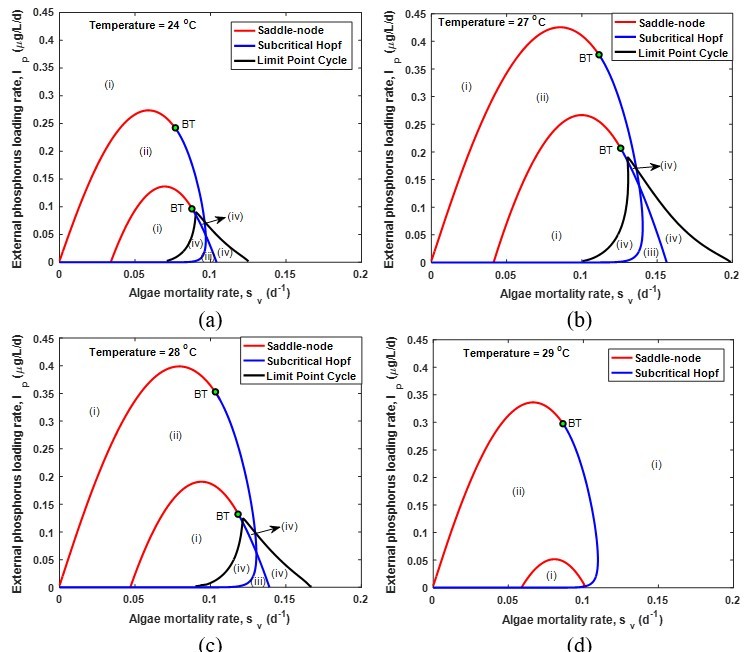
Over the past 20 years, rising global temperatures have accelerated the biological processes in lake systems and potentially intensify the lake eutrophication. This poses a challenge to establishing sustainable lake management strategies. To address this issue, this paper develops an algae-phosphorus model which incorporates the temperature effects to assess how warming influences lake eutrophication dynamics. We incorporate differential equations in formulating the model. A eutrophic lake, Tasik Harapan is chosen as the case study. Both XPPAUT and MatCont are used in conducting co-dimension one and co-dimension two bifurcation analyses. The bifurcation results revealed that rising temperatures would lead to an abrupt increase in algae concentration, shifting the lake to eutrophic state. Regime shift thresholds of external phosphorus loading are identified at various temperatures. A higher flushing rate is required to restore the lake when the temperature increases. Variation in algae mortality rate at different temperatures would lead to the occurrence of bistability and Hopf bifurcations. In two-parameter space of external phosphorus loading and algae mortality rates, variation in temperature causes various model dynamics, including saddle-node bifurcation, Bogdanov-Takens bifurcation and Hopf bifurcation. The complex dynamics and regime shift thresholds simulated from the model can guide early interventions to prevent irreversible degradation.
References
[1] Ayele, H. S. and Atlabachew, M. 2021. Review of characterization, factors, impacts, and solutions of Lake eutrophication: lesson for lake Tana, Ethiopia. Environmental Science and Pollution Research. 28: 14233-14252. DOI : https://doi.org/10.1007/s11356-020-12081-4
[2] Pásková, M., Štekerová, K., Zanker, M., Lasisi. T. T. and Zelenka, J. 2024. Water pollution generated by tourism: Review of system dynamics models. Heliyon. 10: e23824. DOI: https://doi.org/10.1016/j.heliyon.2023.e23824
[3] Igwaran, A., Kayode, A. J., Moloantoa, K. M., Khetsha, Z. P. and Unuofin, J. O. 2024. Cyanobacteria Harmful Algae Blooms: Causes, Impacts, and Risk Management. Water, Air and Soil Pollution. 235 DOI: https://doi.org/10.1007/s11270-023-06782-y.
[4] Wang, Y., Peng, Z., Liu, G., Zhang, H., Zhou, X. and Hu, W. 2023. A mathematical model for phosphorus interactions and transport at the sediment-water interface in a large shallow lake. Ecological Modelling. 476: 110254 DOI: https://doi.org/10.1016/j.ecolmodel.2022.110254.
[5] Akinnawo, S. O. 2023. Eutrophication: Causes, Consequences, Physical, Chemical and Biological Techniques for Mitigation Strategies. Environmental Challenges. 12: 100733 DOI: https://doi.org/10.1016/j.envc.2023.100733.
[6] Val, A. L., De Almeida‐Val, V. M. F., Randall, D. J. 2005. Tropical Environment. Fish Physiology. 21: 1-45 DOI: https://doi.org/10.1016/S1546-5098(05)21001-4.
[7] N., Neirynck. 2019. Advances in numerical bifurcation software: MatCont. PhD thesis, Ghent University.
[8] Huang, Q., Yu, H., Dai, C., Ma, Z., Wang, Q. and Zhao, M. 2022. Dynamic analysis of a new aquatic ecological model based on physical and ecological integrated control. Mathematical Biosciences and Engineering. 20: 930-954. DOI: https://doi.org/10.3934/mbe.2023043.
[9] Maurya, J., Misra, A. K. and Banerjee, S. 2025. Bifurcation analysis of fish-algae-nutrient interactions in aquatic ecosystems. Nonlinear Dynamics. 113: 1713-1743. DOI: https://doi.org/10.1007/s11071-024-10312-8.
[10] Sardany'es, J., Ivanˇci', F. and Vidiella, B. 2024. Identifying regime shifts, transients and late warning signals for proactive ecosystem management. Biological Conservation. 290: 110433. DOI: https://doi.org/10.1016/j.biocon.2023.110433.
[11] Tay, C. J., Mohd, M. H., Teh, S. Y. and Koh, H. L. 2022. Internal phosphorus recycling promotes rich and complex dynamics in an algae-phosphorus model: Implications for eutrophication management. Journal of Theoretical Biology. 532: 110913. DOI: https://doi.org/10.1016/j.jtbi.2021.110913.
[12] Tay, C. J., Koh, H. L., Mohd, M. H. and Teh, S. Y. 2022. Assessing the role of internal phosphorus recycling on eutrophication in four lakes in China and Malaysia. Ecological Informatics. 72: 101830. DOI: https://doi.org/10.1016/j.ecoinf.2022.101830.
[13] Xiao, Q., Duan, H., Qin, B., Hu, Z., Zhang, M., Qi, T. and Lee, X. 2022. Eutrophication and temperature drive large variability in carbon dioxide from China's Lake Taihu. Limnology and Oceanography. 67: 379-391. DOI: https://doi.org/10.1002/lno.11998.
[14] Meerhoff, M., Audet, J., Davidson, T. A., De Meester, L., Hilt, S., Kosten, S. et al. 2022. Feedback between climate change and eutrophication: revisiting the allied attack concept and how to strike back. Inland Waters. 12: 187-204. DOI: https://doi.org/10.1080/20442041.2022.2029317.
[15] Zhao, F., Zhan, X., Xu, H., Zhu, G., Zou, W., Zhu, M. et al. 2022. New insights into eutrophication management: Importance of temperature and water residence time. Journal of Environmental Sciences. 111: 229-239. DOI: https://doi.org/10.1016/j.jes.2021.02.033.
[16] Salk, K. R., Venkiteswaran, J. J., Couture, R. M., Higgins, S. N., Paterson, M. J. and Schiff, S. L. 2022. Warming combined with experimental eutrophication intensifies lake phytoplankton blooms. Limnology and Oceanography. 67: 147-158. DOI: https://doi.org/10.1002/lno.11982.
[17] Jiménez-Navarro, I. C., Mesman, J. P., Pierson, D., Trolle, D., Nielsen, A. and Senent-Aparicio, J. 2023. Application of an integrated catchment-lake model approach for simulating effects of climate change on lake inputs and biogeochemistry. Science of the Total Environment. 885: 163946. DOI: https://doi.org/10.1016/j.scitotenv.2023.163946.
[18] Kong, X., Determann, M., Andersen, T. K., Barbosa, C. C., Dadi, T., Janssen, A. B. G., Paule-Mercado, M. C., Pujoni, D. G. F., Schultze, M. and Rinke, K. 2023. Synergistic Effects of Warming and Internal Nutrient Loading Interfere with the Long-Term Stability of Lake Restoration and Induce Sudden Re-eutrophication. Environmental Science and Technology. 57: 4003-4013 DOI: https://doi.org/10.1021/acs.est.2c07181.
[19] Lehman, J. T., Botkin, D. B. and Likens, G. E. 1975. The assumptions and rationales of a computer model of phytoplankton population dynamics. Limnology and Oceanography. 20(3): 343-364. DOI: https://doi.org/10.4319/lo.1975.20.3.0343.
[20] O'Brien, W. J. The Dynamics of nutrient limitation of phytoplankton algae: A model reconsidered. 1974. Ecology. 55: 135-141. DOI: https://doi.org/10.2307/1934626
[21] Carpenter, S. R. Eutrophication of aquatic ecosystems: Bistability and soil phosphorus. 2005. Proceedings of the National Academy of Sciences. 102: 10002-10005. DOI: https://doi.org/10.1073/pnas.0503959102.
[22] Carpenter, S. R., Ludwig, D. and Brock, W. A. 1999. Management of eutrophication for lakes subject to potentially irreversible change. Ecological Applications. 9: 751-771. DOI: https://doi.org/10.1890/1051-0761(1999)009[0751:MOEFLS]2.0.CO;2
[23] Genkai-Kato, M. and Carpenter, S. R. 2005. Eutrophication due to phosphorus recycling in relation to lake morphometry, temperature, and macrophytes. Ecology. 86: 210-219. DOI: https://doi.org/10.1890/03-0545
[24] Tasnim, B., Fang, X., Hayworth, J. S., and Tian, D. 2021. Simulating Nutrients and Phytoplankton Dynamics in Lakes: Model Development and Applications. Water. 13: 2088 DOI: https://doi.org/10.3390/w13152088
[25] Alcaraz, M., Almeda, R., Saiz, E., Calbet, A., Duarte, C. M., Agusti, A., Santiago, R. and Alonso, A. 2013. Effects of temperature on the metabolic stoichiometry of Arctic zooplankton. Biogeosciences. 10: 689-697. DOI: https://doi.org/10.5194/bg-10-689-2013.
[26] Murrell, M. C. 2003. Bacterioplankton dynamics in a subtropical estuary: Evidence for substrate limitation. Aquatic Microbial Ecology. 32: 239-250. DOI: https://doi.org/10.3354/ame032239
[27] Richardson, D. C., Carey, C. C., Bruesewitz, D. A. and Weathers, K. C. 2017. Intra- and inter-annual variability in metabolism in an oligotrophic lake. Aquatic Sciences. 79: 319-333. DOI:
https://doi.org/10.1007/s00027-016-0499-7.
[28] Vasseur, D. A. and McCann, K. S. 2005. A mechanistic approach for modeling temperature-dependent consumer-resource dynamics. The American Naturalist. 166(2): 184-198. DOI: https://doi.org/10.1086/431285.
[29] Dhooge, A., Govaerts, W., Kuznetsov, Y. A., Meijerd, H. G. E. and Sautois, B. 2008. New features of the software MatCont for bifurcation analysis of dynamical systems. Mathematical and Computer Modelling of Dynamical System. 14: 147-175. DOI: https://doi.org/10.1080/13873950701742754
[30] Ermentrout, B. 2002. Simulating, analyzing, and animating dynamical systems: a guide to XPPAUT for researchers and
students. SIAM, Philadelphia. DOI: https://doi.org/10.1137/1.9780898718195
[31] Kiani, M., Tammeorg, P., Niemistö, J., Simojoki, A. and Tammeorg, O. 2020. Internal phosphorus loading in a small shallow Lake: Response after sediment removal. Science of the Total Environment. 725: 138279. DOI: https://doi.org/10.1016/j.scitotenv.2020.138279
[32] Tay, C. J., Teh, S. Y. and Koh, H. L. Eutrophication bifurcation analysis for Tasik Harapan restoration. 2020. International Journal of Environmental Science and Development. 11(8): 407-413 DOI: https://doi.org/10.18178/ijesd.2020.11.8.1282
Downloads
Published
Issue
Section
License
Copyright of articles that appear in Jurnal Teknologi belongs exclusively to Penerbit Universiti Teknologi Malaysia (Penerbit UTM Press). This copyright covers the rights to reproduce the article, including reprints, electronic reproductions, or any other reproductions of similar nature.