IMPACT OF PHYSICAL CHARACTERISTICS AND MINERALOGY OF CLAY ON SWELLING BEHAVIOR
DOI:
https://doi.org/10.11113/jurnalteknologi.v88.25465Keywords:
Expansive soil, swelling, shrinking, geotechnical properties, mineralogical and morphological characteristicsAbstract
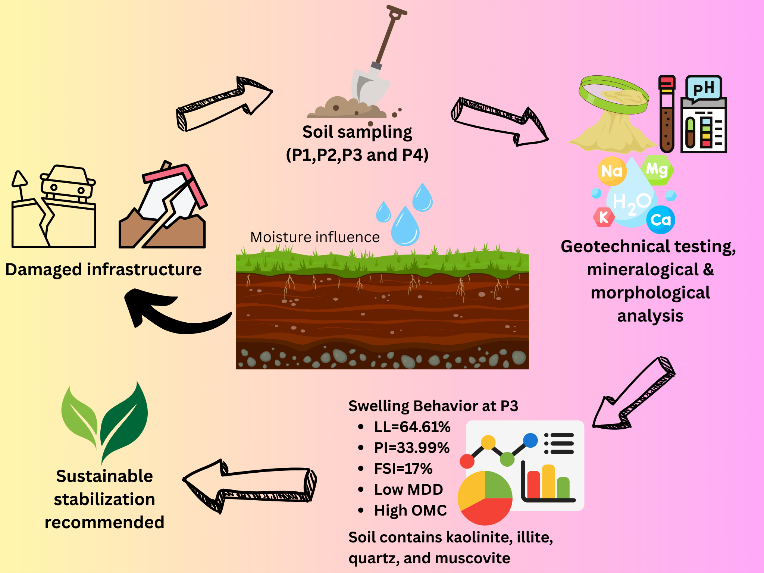
Expansive soils, known for their considerable changes in volume resulting from moisture variations, present major challenges to geotechnical engineering, particularly in semi-arid environments. This study presents a detailed investigation into the geotechnical behavior, mineralogical composition, and morphological features of expansive soils sampled from a paddy field. Four subsurface samples (P1–P4) were extracted at a uniform depth of 1.3 meters. Post-collection, the samples were oven-dried and passed through a 0.425 mm sieve to standardize the material for testing. XRD analysis identified kaolinite, illite, quartz, and muscovite as dominant mineral constituents. XRF showed major components were silicon dioxide (51.93%), iron oxide (20.87%) and aluminum oxide (18.03%), indicating clay presence. SEM analysis revealed a porous microstructure with irregular, platy clay particles forming interconnected networks, affecting water absorption. Sample P3 exhibited the highest expansive potential, with a liquid limit of 64.61%, a plasticity index of 33.99%, and a free swell index of 17%. A low maximum dry density (1.175 g/cm³) and specific gravity (2.26) in P3 suggest a fine-grained matrix with a high proportion of clay minerals. P4 had high optimum moisture content (29%) due to silt-clay and coarse particles. Soils shrinkage 10.49-11.42% upon drying. Swelling potential varied from 10% (P2) to 17% (P3), likely due to differences in clay minerals. The findings underscore the role of mineralogy and moisture sensitivity in the swelling behavior of expansive soils and highlight the need for sustainable stabilization strategies employing environmentally benign additives.
References
[1] Kalantari, B. (2012). Foundations on expansive soil: a review. Research Journal of Applied Sciences, Engineering and Technology, 4(18), 3231-3237.
[2] Bell, F. G., & Culshaw, M. G. (2001). Problems soils: a review from a British perspective. In Problematic Soils: Proceedings of the Symposium Held at Nottingham Trent University on 8 November 2001 (pp. 1-35). Thomas Telford Publishing.
[3] Holtz, W. G., & Gibbs, H. J. (1956). Engineering properties of expansive clays. Transactions of the American Society of Civil Engineers, 121(1), 641-663. https://doi.org/10.1061/TACEAT.0007324
[4] Kumar, S. P., Prasad, L. D., Sivanarayana, C., & Prasad, D. S. V. (2019). A study on stabilization of expansive soil by using agricultural by-products. International Journal of Civil Engineering (IJCE).
[5] Zamin, B., Nasir, H., Mehmood, K., Iqbal, Q., Farooq, A., & Tufail, M. (2021). An experimental study on the geotechnical, mineralogical, and swelling behavior of KPK expansive soils. Advances in civil engineering, 2021(1), 8493091. https://doi.org/10.1155/2021/8493091
[6] Asuri, S., & Keshavamurthy, P. (2016). Expansive soil characterisation: an appraisal. Indian National Academy of Engineering, 1, 29-33. https://doi.org/10.1007/s41403-016-0001-9
[7] Reddy, P. S., Mohanty, B., & Rao, B. H. (2020). Influence of clay content and montmorillonite content on swelling behavior of expansive soils. International Journal of Geosynthetics and Ground Engineering, 6, 1-12. https://doi.org/10.1007/s40891-020-0186-6
[8] Der Merwe, V. (1964). The prediction of heave from the plasticity index and the percentage clay fraction. The Civil Engineer in South Africa, 6(6), 103.
[9] Ikeagwuani, C. C., & Nwonu, D. C. (2019). Emerging trends in expansive soil stabilisation: A review. Journal of Rock Mechanics and Geotechnical Engineering, 11(2), 423-440. https://doi.org/10.1016/j.jrmge.2018.08.013
[10] Jefferson, I., & Jones, L. D. (2012). Expansive soils. ICE Manual of Geotechnical Engineering Vol 1: Geotechnical Engineering Principles, Problematic Soils and Site Investigation (ICE Manuals), 413-441.
[11] Aqeel, A. (2016). Investigation of expansive soils in Obhor Sabkha, Jeddah-Saudi Arabia. Arabian Journal of Geosciences, 9, 1-14. https://doi.org/10.1007/s12517-016-2341-x
[12] Hakami, B. A., & Seif, E. S. S. A. (2019). Expansive potentiality of sabkha soils of Rabigh Lagoon, Saudi Arabia: a case study. Arabian Journal of Geosciences, 12, 1-14. https://doi.org/10.1007/s12517-019-4271-x
[13] Sarkar, B., Rusmin, R., Ugochukwu, U. C., Mukhopadhyay, R., & Manjaiah, K. M. (2019). Modified clay minerals for environmental applications. In Modified clay and zeolite nanocomposite materials (pp. 113-127). Elsevier. https://doi.org/10.1016/B978-0-12-814617-0.00003-7
[14] Biswas, B., Juhasz, A. L., Mahmudur Rahman, M., & Naidu, R. (2020). Modified clays alter diversity and respiration profile of microorganisms in long‐term hydrocarbon and metal co‐contaminated soil. Microbial Biotechnology, 13(2), 522-534. https://doi.org/10.1111/1751-7915.13510
[15] Ombaka, O. (2016). Characterization and classification of clay minerals for potential applications in Rugi Ward, Kenya. African Journal of Environmental Science and Technology, 10(11), 415-431. https://doi.org/10.5897/AJEST2016.2184
[16] Gaudin, A., Ansan, V., Lorand, J. P., & Pont, S. (2020). Genesis of a florencite-bearing kaolin deposit on ordovician schists at Saint-Aubin-des-Châteaux, Armorican Massif, France. Ore Geology Reviews, 120, 103445. https://doi.org/10.1016/j.oregeorev.2020.103445
[17] Karakaya, M. C., Karakaya, N., Temel, A., & Yavuz, F. (2021). Mineralogical and geochemical properties and genesis of kaolin and alunite deposits SE of Aksaray (Central Turkey). Applied Geochemistry, 124, 104830. https://doi.org/10.1016/j.apgeochem.2020.104830
[18] Hernández, A. C., Sánchez-Espejo, R., Meléndez, W., González, G., López-Galindo, A., & Viseras, C. (2019). Characterization of Venezuelan kaolins as health care ingredients. Applied Clay Science, 175, 30-39.
https://doi.org/10.1016/j.clay.2019.01.003
[19] Akisanmi, P. (2022). Classification of clay minerals. Mineralogy, 3-9. https://doi.org/10.5772/intechopen.103841
[20] Kahr, G., & Madsen, F. T. (1995). Determination of the cation exchange capacity and the surface area of bentonite, illite and kaolinite by methylene blue adsorption. Applied clay science, 9(5), 327-336. https://doi.org/10.1016/0169-1317(94)00028-O
[21] Bergaya, F., Lagaly, G., & Vayer, M. (2013). Cation and anion exchange. In Developments in Clay Science (Vol. 5, pp. 333-359). Elsevier. https://doi.org/10.1016/B978-0-08-098259-5.00013-5
[22] Götze, J., Pan, Y., & Müller, A. (2021). Mineralogy and Mineral Chemistry of quartz: A review. Mineralogical Magazine, 85(5), 639-664. https://doi.org/10.1180/mgm.2021.72
[23] Rezaee, L., Moosavi, A. A., Davatgar, N., & Sepaskhah, A. R. (2020). Shrinkage-swelling characteristics and plasticity indices of paddy soils: spatial variability and their influential parameters. Archives of Agronomy and Soil Science, 66(14), 2005-2025. https://doi.org/10.1080/03650340.2019.1706169
[24] Selvakumar, S., Soundara, B., Raj, N., & Kulanthaivel, P. (2024). Microstructural investigation on the expansive soils for sustainable stabilization purposes. Discover Soil, 1(1), 8. https://doi.org/10.1007/s44378-024-00009-0
[25] Lew, B. (2010). Structure damage due to expansive soils: A case study. Electronic Journal of Geotechnical Engineering, 15, 1317-1324.
[26] Zhang, X. W., Kong, L. W., Cui, X. L., & Yin, S. (2016). Occurrence characteristics of free iron oxides in soil microstructure: evidence from XRD, SEM and EDS. Bulletin of Engineering Geology and the Environment, 75(4), 1493-1503.
[27] Ng, C. W. W., Owusu, S. T., Zhou, C., & Chiu, A. C. F. (2020). Effects of sesquioxide content on stress-dependent water retention behaviour of weathered soils. Engineering geology, 266, 105455.
[28] Burnett, A. D. (1995). A quantitative X-ray diffraction technique for analyzing sedimentary rocks and soils. Journal of testing and evaluation, 23(2), 111-118. https://doi.org/10.1520/JTE10902J
[29] Sridharan, A., & Prakash, K. (2000). Classification procedures for expansive soils. Proceedings of the Institution of Civil Engineers-Geotechnical Engineering, 143(4), 235-240. https://doi.org/10.1680/geng.2000.143.4.235
[30] Lin, B., Cerato, A. B., Madden, A. S., & Elwood Madden, M. E. (2013). Effect of fly ash on the behavior of expansive soils: microscopic analysis. Environmental & Engineering Geoscience, 19(1), 85-94. https://doi.org/10.2113/gseegeosci.19.1.85
[31] Tahasildar, J., Rao, B. H., & Shukla, S. K. (2017). Mineralogical compositions of some Indian expansive soils and their influence on swelling properties. International Journal of Geosynthetics and Ground Engineering, 3, 1-10. https://doi.org/10.1007/s40891-016-0081-3
[32] Adetola, S., Oyejide, A., Emmanuel, E., Adejinle, S., & Aiyegbabe, J. (2024). Microstructural Analysis of blended Guinea-Corn Stalk and Saw-Dust Ash for Cement Mixture of Interlocking Concrete Block. In 2024 International Conference on Science, Engineering and Business for Driving Sustainable Development Goals (SEB4SDG) (pp. 1-6). IEEE. https://doi.org/10.1109/SEB4SDG60871.2024.10629948
[33] Adajar, M. A., & Valbuena, K. (2021). Optimization of the strength properties of expansive soil stabilized with agricultural wastes. GEOMATE Journal, 21(88), 35-41. https://doi.org/10.21660/2021.88.gxi253
[34] Ogunribido, T. H. T. (2012). Geotechnical properties of saw dust ash stabilized southwestern Nigeria lateritic soils. Environmental Research, Engineering and Management, 60(2), 29-33. https://doi.org/10.5755/j01.erem.60.2.986
[35] Mehta, B., & Sachan, A. (2017). Effect of mineralogical properties of expansive soil on its mechanical behavior. Geotechnical and Geological Engineering, 35, 2923-2934. https://doi.org/10.1007/s10706-017-0289-6
[36] Butt, W. A., Gupta, K., & Jha, J. N. (2016). Strength behavior of clayey soil stabilized with saw dust ash. International Journal of Geo-Engineering, 7, 1-9. https://doi.org/10.1186/s40703-016-0032-9
[37] Adetoro, A. E., & Faluyi, O. S. (2015). Potentials of Non-Cementitious Additives for Stabilization of Oye Local Government Area Soils, Ekiti State, Nigeria. International Journal of Scientific Research in Knowledge, 3(11), 288-296. https://doi.org/10.12983/ijsrk-2015-p0288-0296
[38] Ito, M., & Azam, S. (2009). Engineering characteristics of a glacio-lacustrine clay deposit in a semi-arid climate. Bulletin of Engineering Geology and The Environment, 68, 551-557. https://doi.org/10.1007/s10064-009-0229-7
[39] Jha, A. K., & Sivapullaiah, P. V. (2018). Potential of fly ash to suppress the susceptible behavior of lime-treated gypseous soil. Soils and Foundations, 58(3), 654-665. https://doi.org/10.1016/j.sandf.2018.02.024
[40] Oguche, J. O., Adeyeri, J. B., Amu, O. O., & Joseph, O. F. (2022). Stabilization of Expansive Clay Soils Using Saw Dust Ash. Journal of Innovation Science and Technology, 2(1).
Downloads
Published
Issue
Section
License
Copyright of articles that appear in Jurnal Teknologi belongs exclusively to Penerbit Universiti Teknologi Malaysia (Penerbit UTM Press). This copyright covers the rights to reproduce the article, including reprints, electronic reproductions, or any other reproductions of similar nature.