
MECHANICAL CHARACTERIZATION OF POLYLACTIC ACID WITH DIFFERENT INFILL PATTERNS AND ARRANGEMENTS USING FUSED DEPOSITION MODELING
DOI:
https://doi.org/10.11113/jurnalteknologi.v88.25503Keywords:
Multiple Infill Patterns, Infill Arrangement, Strength-to-Weight Ratio, 3D PrintingAbstract
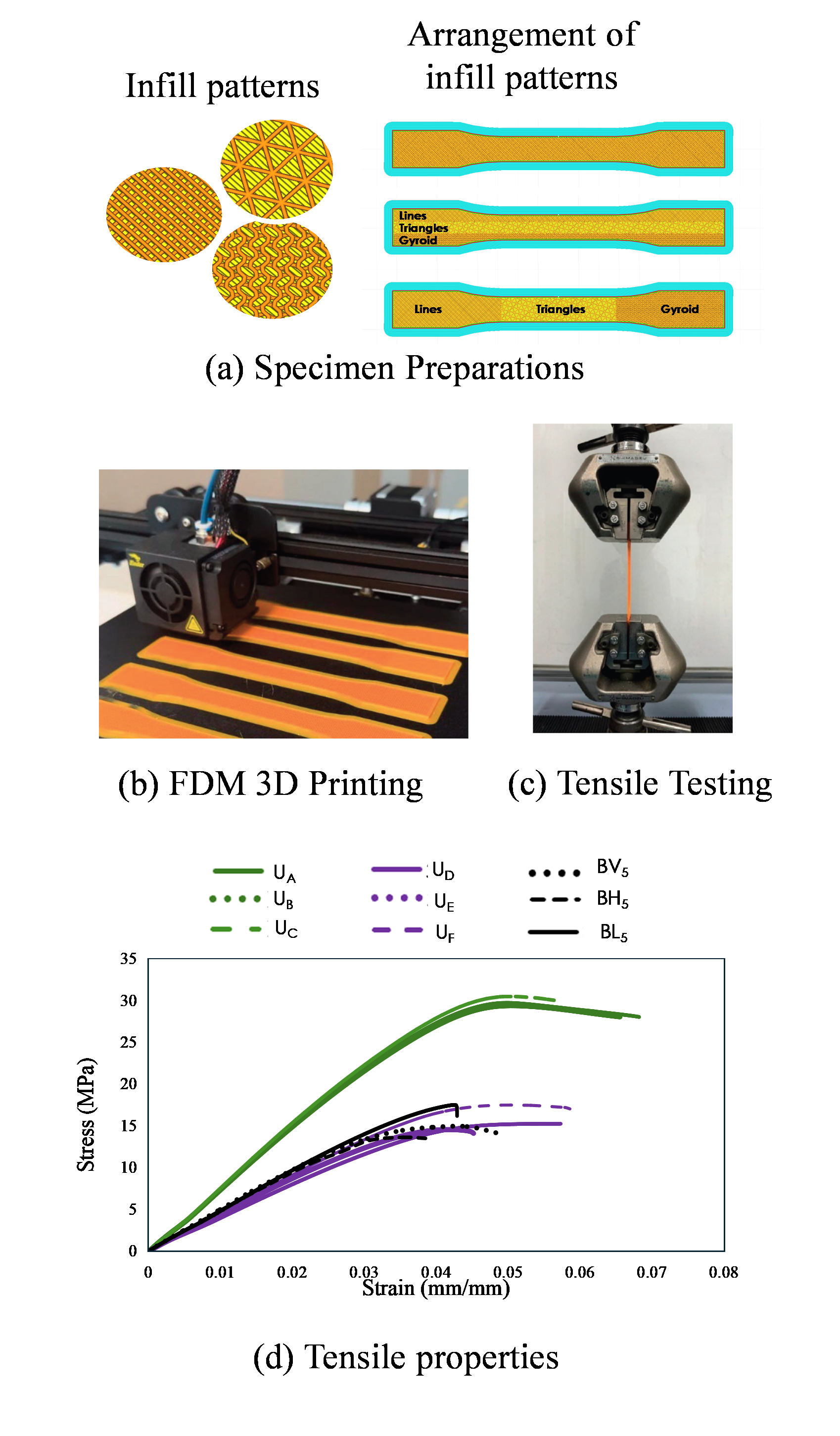
Infill patterns significantly affect the mechanical properties, printing time and material consumption of 3-Dimensional (3D) printed Polylactic Acid (PLA) parts. Despite the wide variety of available infill patterns, the effect of combining and arranging multiple infill patterns on strength-to-weight ratio within a single print remains underexplored. This study investigates the effect of infill pattern arrangements on enhancing the strength-to-weight performance for applications requiring strong yet lightweight components. Three infill patterns (Lines, Triangles and Gyroid) were selected and arranged in three different configurations: by-layer, by-horizontal area and by-vertical area. By-layer arrangement exhibited improved tensile strength, Young’s Modulus and strength-to-weight ratio. BL5 with 50% infill density and arranged by-layer, demonstrated the best performance, with a tensile strength of 17.77 MPa and strength-to-weight ratios of 2.85 MPa/g. The infill patterns in this arrangement, delays crack propagation, as the non-continuous geometry created by the varied patterns disrupts the crack path. In contrast, the lowest tensile strength was observed for by-vertical area arrangement, where the tension load was applied perpendicular to the interface between different infill patterns, increasing the likelihood for crack initiation and propagation. Although the by-layer arrangement required a longer printing time, it produced part with a superior strength-to-weight ratio compared to the other arrangements, making it an effective strategy for balancing mechanical strength and material efficiency.
References
[1] Zhou, L., J. Miller, J. Vezza, M. Mayster, M. Raffay, Q. Justice, Z. Al Tamimi, G. Hansotte, L. D. Sunkara, and J. Bernat. 2024. Additive Manufacturing: A Comprehensive Review. Sensors. 24(9): 2668. https://doi.org/10.3390/s24092668.
[2] Segovia-Guerrero, L., N. Baladés, J. J. Gallardo-Galán, A. J. Gil-Mena, and D. L. Sales. 2025. Additive vs. Subtractive Manufacturing: A Comparative Life Cycle and Cost Analyses of Steel Mill Spare Parts. Journal of Manufacturing and Materials Processing. 9(4): 138. https://doi.org/10.3390/jmmp9040138.
[3] Jung, S., L. B. Kara, Z. Nie, T. W. Simpson, and K. S. Whitefoot. 2023. Is Additive Manufacturing an Environmentally and Economically Preferred Alternative for Mass Production? Environmental Science & Technology. 57(16): 6373–6386. https://doi.org/10.1021/acs.est.2c04927.
[4] Raja, S., and A. John Rajan. 2023. Challenges and Opportunities in Additive Manufacturing Polymer Technology: A Review Based on Optimization Perspective. Advances in Polymer Technology. 2023: 8639185. https://doi.org/10.1155/2023/8639185.
[5] Tümer, E. H., and H. Y. Erbil. 2021. Extrusion-Based 3D Printing Applications of PLA Composites: A Review. Coatings. 11(4): 390. https://doi.org/10.3390/coatings11040390.
[6] Altıparmak, S. C., V. A. Yardley, Z. Shi, and J. Lin. 2022. Extrusion-Based Additive Manufacturing Technologies: State of the Art and Future Perspectives. Journal of Manufacturing Processes. 83: 607–636. https://doi.org/10.1016/j.jmapro.2022.09.032.
[7] Foorginejad, A., K. Kalili, V. Abdollahi, and H. Afshari. 2026. “Multi-Objective Optimization of Biomedical Scaffold Geometries for Mechanical and Porous Performance Enhancement. International Journal of Engineering, Transactions A: Basics. 39(1): 176–191. https://doi.org/10.5829/ije.2026.39.01a.14.
[8] Sri, H. A., and K. C. Vikram. 2021. Fused Deposition Modeling of an Aircraft Wing Using Industrial Robot with Non-Linear Tool Path Generation. International Journal of Engineering, Transactions A: Basics. 34(1): 272–282. https://doi.org/10.5829/ije.2021.34.01a.30.
[9] Sotov, A., A. Abdrakhmanova, A. Zaytsev, and A. Popovich. 2026. Bio-Inspired Continuously Reinforced Polymer Composites: Synthesis of Nature and Additive Manufacturing. International Journal of Engineering. 39(3): 770–788. https://doi.org/10.5829/ije.2026.39.03c.16.
[10] Lazzeri, S., E. Talanti, S. Basciano, R. Barbato, F. Fontanelli, F. Uccheddu, M. Servi, Y. Volpe, L. Vagnoli, E. Amore, et al. 2022. 3D-Printed Patient-Specific Casts for the Distal Radius in Children: Outcome and Pre-Market Survey. Materials. 15(8): 2863. https://doi.org/10.3390/ma15082863.
[11] Calderone, D., G. Cesarelli, C. Ricciardi, F. Amato, and F. Clemente. 2024. 3D Printing Application for Orthopedic Pediatric Surgery—A Systematic Review. Rapid Prototyping Journal. 30(11): 276–288. https://doi.org/10.1108/RPJ-05-2024-0222.
[12] Ekanayake, C., J. C. P. H. Gamage, P. Mendis, and P. Weerasinghe. 2023. Revolution in Orthopedic Immobilization Materials: A Comprehensive Review. Heliyon. 9(3): e13640. https://doi.org/10.1016/j.heliyon.2023.e13640.
[13] Patel, P., and P. Gohil. 2022. Custom Orthotics Development Process Based on Additive Manufacturing. Materials Today: Proceedings. 59(3): A52–A63. https://doi.org/10.1016/j.matpr.2022.04.858.
[14] Yang, J., B. Li, J. Liu, Z. Tu, and X. Wu. 2024. Application of Additive Manufacturing in the Automobile Industry: A Mini Review. Processes. 12(6): 1101. https://doi.org/10.3390/pr12061101.
[15] Böckin, D., and A. M. Tillman. 2019. Environmental Assessment of Additive Manufacturing in the Automotive Industry. Journal of Cleaner Production. 226: 977–987. https://doi.org/10.1016/j.jclepro.2019.04.086.
[16] Mohseni, Y., M. Mohseni, S. Suresh, M. Riotto, A. Jaggessar, J. P. Little, M. L. Wille, and P. K. Yarlagadda. 2023. Investigating Impacts of FDM Printing Parameters and Geometrical Features on Void Formation in 3D Printed Automotive Components. Materials Today: Proceedings.. In Press. https://doi.org/10.1016/j.matpr.2023.06.078.
[17] Mohanavel, V., K. A. Ali, K. Ranganathan, J. A. Jeffrey, M. M. Ravikumar, and S. J. Rajkumar. 2021. The Roles and Applications of Additive Manufacturing in the Aerospace and Automobile Sector. Materials Today: Proceedings. 47: 405–409. https://doi.org/10.1016/j.matpr.2021.04.596.
[18] Tanveer, M. Q., G. Mishra, S. Mishra, and R. Sharma. 2022. Effect of Infill Pattern and Infill Density on Mechanical Behaviour of FDM 3D Printed Parts—A Current Review. Materials Today: Proceedings. 62: 100–108. https://doi.org/10.1016/j.matpr.2022.02.310.
[19] Khan, I., M. Tariq, M. Abas, M. Shakeel, F. Hira, A. Al Rashid, and M. Koç. 2023. Parametric Investigation and Optimisation of Mechanical Properties of Thick Tri-Material Based Composite of PLA-PETG-ABS 3D-Printed Using Fused Filament Fabrication. Composites Part C: Open Access. 12: 100392. https://doi.org/10.1016/j.jcomc.2023.100392.
[20] Kumaresan, R., K. Kadirgama, M. Samykano, W. S. Harun, A. Thirugnanasambandam, and K. Kanny. 2025. In-Depth Study and Optimization of Process Parameters to Enhance Tensile and Compressive Strengths of PETG in FDM Technology. Journal of Materials Research and Technology. 37: 397–416. https://doi.org/10.1016/j.jmrt.2025.06.013.
[21] Haque, M. M., S. R. Dhrubo, A. F. Pranto, A. Ahmed, M. M. Arefin, M. Arifuzzaman, and M. S. Islam. 2025. Impact of Process Parameters and Material Selection on the Mechanical Performance of FDM 3D-Printed Components. Hybrid Advances. 100502. https://doi.org/10.1016/j.hybadv.2025.100502.
[22] Kumaresan, R., A. Kottasamy, J. Mogan, L. Sandanamsamy, M. Samykano, K. Kadirgama, and W. S. Harun. 2024. Preliminary Investigation on the Tensile Properties of FDM Printed PLA/Copper Composite. Materials Today: Proceedings. 109: 87–92. https://doi.org/10.1016/j.matpr.2023.10.054.
[23] Tanveer, M. Q., A. Haleem, and M. Suhaib. 2019. Effect of Variable Infill Density on Mechanical Behaviour of 3-D Printed PLA Specimen: An Experimental Investigation. SN Applied Sciences. 1(12): 1701. https://doi.org/10.1007/s42452-019-1744-1.
[24] Ambati, S. S., and R. Ambatipudi. 2022. Effect of Infill Density and Infill Pattern on the Mechanical Properties of 3D Printed PLA Parts. Materials Today: Proceedings. 64: 804–807. https://doi.org/10.1016/j.matpr.2022.05.312.
[25] Al Rashid, A., and M. Koç. 2025. 3D-Printed Recycled Polyethylene Terephthalate (PET) Sandwich Structures—Influence of Infill Design and Density on Tensile, Dynamic Mechanical, and Creep Response. International Journal of Lightweight Materials and Manufacture. In Press. https://doi.org/10.1016/j.ijlmm.2025.03.001.
[26] Khaliq, J., D. R. Gurrapu, and F. Elfakhri. 2023. Effects of Infill Line Multiplier and Patterns on Mechanical Properties of Lightweight and Resilient Hollow Section Products Manufactured Using Fused Filament Fabrication. Polymers 15: 2585. https://doi.org/10.3390/polym15122585.
Downloads
Published
Issue
Section
License
Copyright of articles that appear in Jurnal Teknologi belongs exclusively to Penerbit Universiti Teknologi Malaysia (Penerbit UTM Press). This copyright covers the rights to reproduce the article, including reprints, electronic reproductions, or any other reproductions of similar nature.