
SURFACE MORPHOLOGY AND FUNCTIONAL PROPERTIES OF BAMBOO CHARCOAL COATED POLYESTER-COTTON FABRIC
DOI:
https://doi.org/10.11113/jurnalteknologi.v88.25508Keywords:
Bamboo charcoal, blended fabric, moisture management, durability, thermo-physiological propertiesAbstract
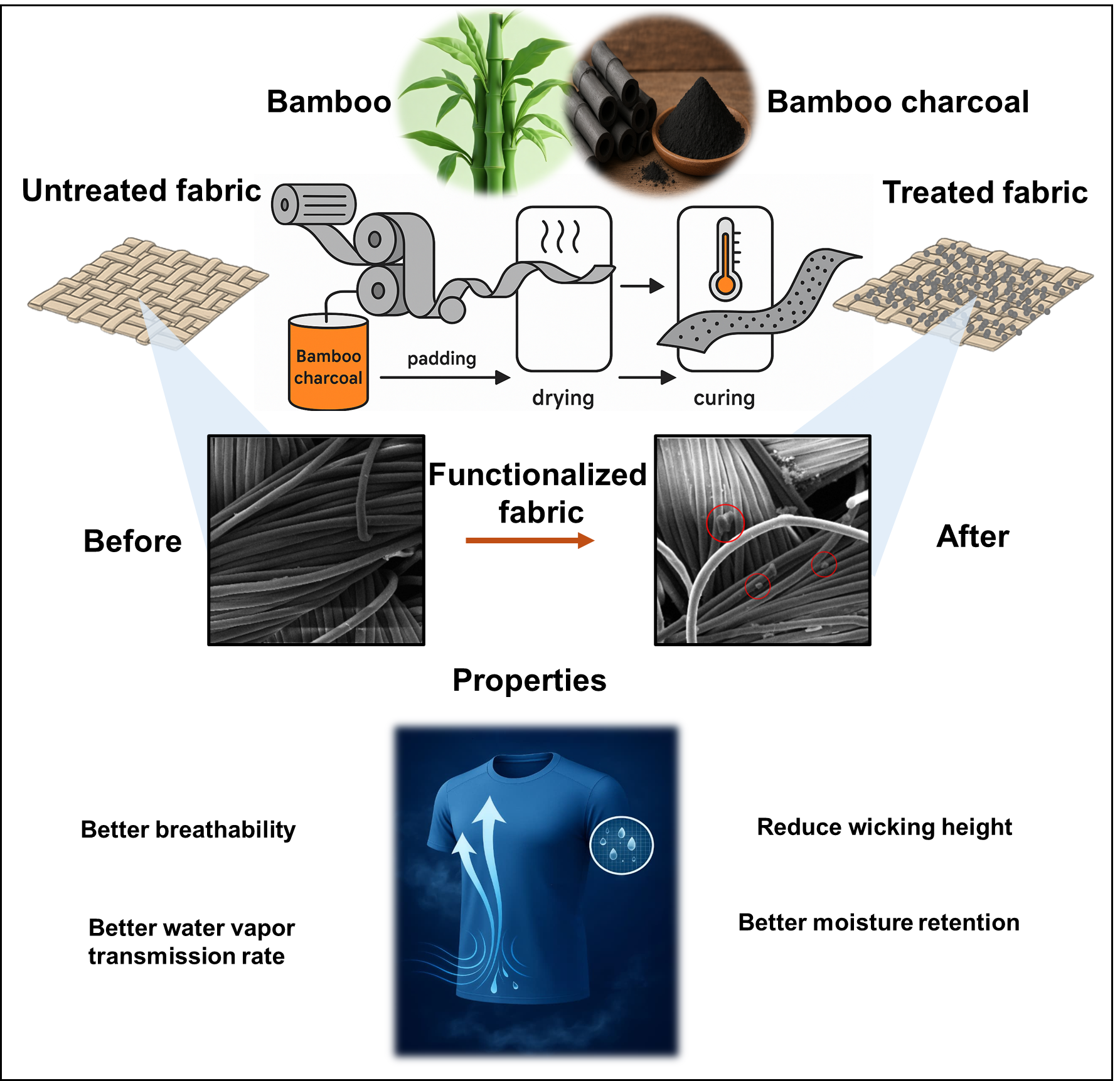
The demand for multifunctional and sustainable textiles is growing in response to global concerns about comfort, durability, and environmental responsibility. Although bamboo charcoal is widely acknowledged for its adsorption capacity, antimicrobial activity, and eco-friendly nature, its properties after being coated onto fabric, especially the breathability, moisture regulation, and long-term durability, remain insufficiently explored. This study addresses this gap by coating bamboo charcoal microparticles onto polyester–cotton blended fabrics using the pad-dry-cure method and evaluating their structural, chemical, and functional performance. Scanning Electron Microscopy (SEM) showed strong particle adhesion on fiber surfaces, while Fourier Transform Infrared Spectroscopy (FTIR) confirmed the persistence of key functional groups after multiple washing and abrasion cycles. Functionality tests demonstrated an improved Water Vapour Transmission Rate (WVTR) of 2.2%, indicating enhanced breathability. Durability analysis revealed that the bamboo charcoal coating retained approximately 62.5% of its coating after washing and 5,000 of abrasion cycles. These findings revealed the potential of bamboo charcoal as a sustainable, low-cost, and effective coating for imparting multifunctional properties to fabrics. The work contributes to advancing functional textile engineering, offering applications in sportswear, healthcare, protective clothing, and eco-friendly apparel aligned with circular innovation goals.
References
[1] Rathour, R., H. Kumar, K. Prasad, P. Anerao, M. Kumar, A. Kapley, A. Pandey, M. Kumar Awasthi, and L. Singh. 2022. Multifunctional Applications of Bamboo Crop beyond Environmental Management: An Indian Prospective. Bioengineered, 13(4): 8893–8914.
[2] Smole, M. S., S. Hribernik, K. S. Kleinschek, and T. Kreže. 2013. Plant Fibres for Textile and Technical Applications. Advances in Agrophysical Research, 369–98.
[3] Hawanis, H. S. N., R. A. Ilyas, R. Jalil, R. Ibrahim, R. A. Majid, and N. H. Ab Hamid. 2024. Extraction and Characterization of Morphological, Physical, Physiochemical, Thermal, and Chemical Composition of Five Malaysian Bamboo Species. Cellulose. 31(13): 7941–52. https://doi.org/10.1007/s10570-024-06090-6.
[4] Kamarudin, M. H., M. S. Saringat, and N. H. Sulaiman. 2016. The Study of Mechanical Properties of Laminated Bamboo Strip (LBS) from Gigantochloa levis Type Mixed with Epoxy. Jurnal Teknologi (Sciences & Engineering). 78(5–10): 59–64.
[5] Borowski, P. F., I. Patuk, and E. R. Bandala. 2022. Innovative Industrial Use of Bamboo as a Key ‘Green’ Material. Sustainability. 14(4): 1955.
[6] United Nations. 2015. Transforming Our World: The 2030 Agenda for Sustainable Development. https://sdgs.un.org/2030agenda.
[7] Afrin, T., T. Tsuzuki, R. K. Kanwar, and X. Wang. 2012. The Origin of the Antibacterial Property of Bamboo. Journal of the Textile Institute. 103(8): 844–49.
[8] Afrin, T., R. K. Kanwar, X. Wang, and T. Tsuzuki. 2014. Properties of Bamboo Fibres Produced Using an Environmentally Benign Method. Journal of the Textile Institute. 105(12): 1293–99.
[9] Emamverdian, A., Y. Ding, F. Ranaei, and Z. Ahmad. 2020. Application of Bamboo Plants in Nine Aspects. Scientific World Journal. 2020: 7284203.
[10] Hu, W., Z. Feng, J. Yang, Q. Gao, and L. Ni. 2021. Combustion Behaviors of Molded Bamboo Charcoal: Influence of Pyrolysis Temperatures. Energy. 226: 120253.
[11] Ofondu, A., and C. Iroegbu. 2021. Bamboos: From Bioresource to Sustainable Materials and Chemicals. Sustainability. 13: 12200.
[12] Vuthiganond, N., M. Nakpathom, B. Somboon, and R. Mongkholrattanasit. 2023. Improving the Deodorizing Ability of Cotton Fabric by Printing with Bamboo Charcoal. Journal of Natural Fibers. 20(1).
[13] Gunasekaran, G., C. Prakash, and S. Periyasamy. 2021. Effect of Charcoal Particles on Thermophysiological Comfort Properties of Woven Fabrics. Journal of Natural Fibers. 18(3): 355–68.
[14] Foo, M. B., and S. H. Nasir. 2024. The Effect of Bamboo Charcoal Microparticles Application on the Comfort Properties of Woven Fabric. Progress in Engineering Application and Technology. 5(1): 402–8.
[15] Chen, Q., R. Zhang, Y. Wang, X. Wen, and D. Qin. 2016. The Effect of Bamboo Charcoal on Water Absorption, Contact Angle, and the Physical-Mechanical Properties of Bamboo/Low-Density Polyethylene Composites. BioResources. 11(4): 9986–10001.
[16] Isukuru, E. J., A. O. Ogunkeyede, A. A. Adebayo, and M. F. Uruejoma. 2023. Potentials of Bamboo and Its Ecological Benefits in Nigeria. Advances in Bamboo Science. 4: 100032.
[17] Chaturvedi, K., et al. 2024. Bamboo for Producing Charcoal and Biochar for Versatile Applications. Biomass Conversion and Biorefinery. 14(14): 15159–85.
[18] Mahesh, G. 2014. Development and Utilisation of Bamboo Charcoal Polyester Fiber in Technical Textiles. Thesis, College of Home Science, Acharya N. G. Ranga Agricultural University.
[19] Liu, S. J., and S. C. Liao. 2021. Surface Modification of Bamboo Charcoal by O₂ Plasma Treatment and UV-Grafted Thermosensitive AgNPs Hydrogel to Improve Antibacterial Properties in Biomedical Application. Nanomaterials. 11(10).
[20] Chen, X., P. Ji, G. Jin, and H. Wang. 2022. Preparation, Structure, and Properties of Bamboo Charcoal and Its Modified Polyester Fiber. Journal of the Textile Institute. 1–11.
[21] Asfand, Norina, and Sikander Abbas Basra. 2020. Analysis of Textile Capillarity Evaluation Methods: Literature Review. In International Young Researchers Conference Industrial Engineering 2020: Conference Proceedings. 141–46. Kaunas, Lithuania: Kaunas University of Technology, Faculty of Mechanical Engineering and Design. https://doi.org/10.5755/e01.2538-6727.2020.
[22] Isa, S. S. M., M. M. Ramli, N. A. M. A. Hambali, M. M. A. B. Abdullah, and S. A. Z. Murad. 2017. The Production of Malaysian Bamboo Charcoal (Gigantochloa albociliata) as the Potential Absorbent. AIP Conference Proceedings. 1885.
[23] Ilyas, R. A., S. M. Sapuan, M. R. Ishak, and E. S. Zainudin. 2017. Effect of Delignification on the Physical, Thermal, Chemical, and Structural Properties of Sugar Palm Fibre. BioResources. 12(4): 8734–54.
[24] Khandaker, S., T. Kuba, Y. Toyohara, S. Kamida, and Y. Uchikawa. 2017. Development of Ion-Exchange Properties of Bamboo Charcoal Modified with Concentrated Nitric Acid. IOP Conference Series: Earth and Environmental Science. 82 (1).
[25] Xu, G., L. Wang, J. Liu, and J. Wu. 2013. FTIR and XPS Analysis of the Changes in Bamboo Chemical Structure Decayed by White-Rot and Brown-Rot Fungi. Applied Surface Science. 280: 799–805.
[26] Yu, H., et al. 2022. Changes in Chemical and Thermal Properties of Bamboo after Delignification Treatment. Polymers. 14: 2573.
[27] Kim, H. 2021. Moisture Vapor Permeability and Thermal Wear Comfort of Ecofriendly Fiber-Embedded Woven Fabrics for High-Performance Clothing. Materials. 14: 6205.
[28] Mallick, Palash, and Susanta Sekhar De. 2022. Absorbency and Wicking Behaviour of Natural Fibre-Based Yarn and Fabric. In Natural Fiber, edited by Han Yong Jeon. London: IntechOpen. https://doi.org/10.5772/intechopen.102584.
[29] Aruchamy, K., S. P. Subramani, S. K. Palaniappan, S. K. Pal, B. Mylsamy, and V. Chinnasamy. 2022. Effect of Blend Ratio on the Thermal Comfort Characteristics of Cotton/Bamboo Blended Fabrics. Journal of Natural Fibers. 19(1): 105–14.
[30] Gunasekaran, G., C. Prakash, and S. Periyasamy. 2019. Preparation and Characterisation of Bamboo Charcoal Particles and the Effect of Their Application on the Thermophysiological Comfort Properties of Woven Fabrics. Journal of the Textile Institute. 1–8.
[31] Kumar, R., J. Gunjal, and S. Chauhan. 2021. Effect of Carbonization Temperature on Properties of Natural Fiber and Charcoal-Filled Hybrid Polymer Composite. Composites Part B: Engineering. 217: 108846.
[32] Liu, C., S. Zhang, S. Yan, and M. Pan. 2024. Mechanical and Antibacterial Properties of Bamboo Charcoal/ZnO-Modified Bamboo Fiber/Polylactic Acid Composites. Forests. 15: 371.
Downloads
Published
Issue
Section
License
Copyright of articles that appear in Jurnal Teknologi belongs exclusively to Penerbit Universiti Teknologi Malaysia (Penerbit UTM Press). This copyright covers the rights to reproduce the article, including reprints, electronic reproductions, or any other reproductions of similar nature.