
MODELING AND SIMULATION STUDY OF THE VEHICLE AUTOMATIC TRANSMISSION CONTROLLER SYSTEM
DOI:
https://doi.org/10.11113/jurnalteknologi.v89.25547Keywords:
State flow, Simulink MATLAB, Automatic transmission, and Aerodynamic drag coefficientsAbstract
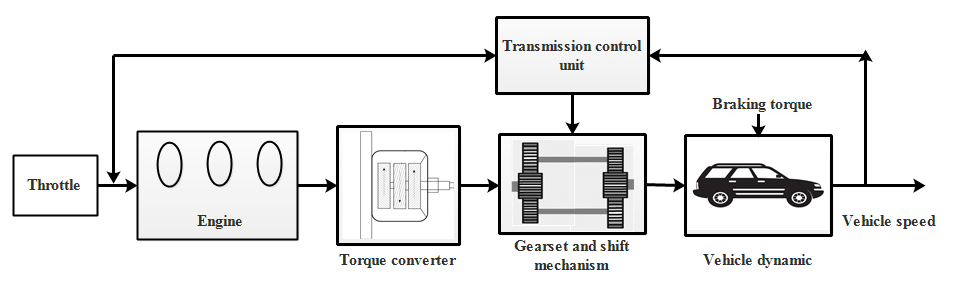
Road conditions vary from one country to another within the same country or between different countries. Therefore, drivers need to adjust their vehicles' speed to suit the road conditions, making the transmission system a crucial component of any vehicle. This system transfers engine power to the wheels and controls vehicle speed. In this paper, an automatic transmission model has been constructed by using MATLAB's Simulink environment. As the results were validated by comparing them with previous results. The system's performance was analyzed at various throttle ratios, specifically 20%, 40%, and 60%. Logic control (state flow) has been used to change the vehicle speed according to the vehicle speed and throttle ratio. For each throttle setting ratio, vehicle speed, engine speed, and torque were examined under two conditions: with the brakes applied for 25 seconds and without braking. The results showed that as the throttle ratio increases, both the vehicle's speed and torque increase. But the torque doesn't increase as much as the speed does. The innovation of this effort lies in merging Stateflow-based logic control with automatic transmission modeling for enhanced gear-shift reply analysis, offering a useful plan for upcoming intellectual transmission system designs.
References
[1] G.-Q. Wu, J. Chen, and W.-J. Zhu, “Performance analysis and improvement of flat torque converters using DOE method,” Chinese J. Mech. Eng., Vol. 31, pp. 1–9, 2018.
[2] A. Al Faysal and S. M. Haris, “Development of magnetic gears: A review,” J. Kejuruter., Vol. 1, No. 7, pp. 49–56, 2018.
[3] C. Liu, C. Liu, and W. Ma, “Mathematical model for elliptic torus of automotive torque converter and fundamental
analysis of its effect on performance,” Math. Probl. Eng., Vol. 2015, No. 1, p. 851816, 2015.
[4] W. Yang and H. Ding, “Automatic detection of degenerate planetary gear trains with different degree of freedoms,” Appl. Math. Model., Vol. 64, pp. 320–332, 2018.
[5] W. Yang and H. Ding, “The complete set of one-degree-of-freedom planetary gear trains with up to nine links,” J. Mech. Des., Vol. 141, No. 4, p. 43301, 2019.
[6] W. Yang, Y. Li, and H. Ding, “Configuration design of planetary gear mechanisms of automatic transmissions based on the tree graph and structure constraints,” Mech. Mach. Theory, Vol. 197, p. 105644, 2024.
[7] W. Zhuang, X. Zhang, H. Peng, and L. Wang, “Rapid configuration design of multiple-planetary-gear power-split hybrid powertrain via mode combination,” IEEE/ASME Trans. Mechatronics, Vol. 21, No. 6, pp. 2924–2934, 2016.
[8] Y. Qin et al., “Noise and vibration suppression in hybrid electric vehicles: State of the art and challenges,” Renew. Sustain. Energy Rev., Vol. 124, p. 109782, 2020.
[9] J. Hong, B. Gao, H. Yue, and H. Chen, “Dry clutch control of two-speed electric vehicles by using an optimal control scheme with persistent time-varying disturbance rejection,” IEEE Trans. Transp. Electrif., Vol. 7, No. 3, pp. 2034–2046, 2020.
[10] J. Hong et al., “Gear downshift control of inverse-automatic mechanical transmission of electric vehicle,” Green Energy Intell. Transp., Vol. 1, No. 1, p. 100005, 2022.
[11] R. Isermann, “Engine modeling and control,” Berlin Springers Berlin Heidelb., Vol. 1017, 2014.
[12] M. Diachuk and S. M. Easa, “Modeling combined operation of engine and torque converter for improved vehicle Powertrain’s complex control,” Vehicles, Vol. 4, No. 2, pp. 501–528, 2022.
[13] G. I. Y. Mustafa, H. P. Wang, and Y. Tian, “Vibration control of an active vehicle suspension systems using optimized model-free fuzzy logic controller based on time delay estimation,” Adv. Eng. Softw., Vol. 127, pp. 141–149, 2019.
[14] V. Perelmuter, Electrotechnical Systems: Simulation with Simulink® and SimPowerSystemsTM. CRC Press, 2020.
[15] V. G. Mikhailov, “Data transmission with Simulink on 6-DoF platform on CAN BUS,” Системный анализ и прикладная информатика, No. 1, pp. 29–37, 2021.
[16] A. Boll, F. Brokhausen, T. Amorim, T. Kehrer, and A. Vogelsang, “Characteristics, potentials, and limitations of open-source Simulink projects for empirical research,” Softw. Syst. Model., Vol. 20, No. 6, pp. 2111–2130, 2021.
[17] P. Bera, “A design method of selecting gear ratios in manual transmissions of modern passenger cars,” Mech. Mach. Theory, Vol. 132, pp. 133–153, 2019.
[18] P. Hashchuk, “Optimal gear shift algorithm in the car transmission during its deceleration,” 2018.
[19] J. Yang, Z. Chen, W. Shi, R. Yuan, J. Liu, and Y. Zhao, “Vibration control of commercial vehicle drive axles based on modification of helical gears,” Mech. Syst. Signal Process., Vol. 193, p. 110252, 2023.
[20] O. Desouky, “Integration of Engine and TWC Models through Developing an Exhaust Manifold Model for Predicting Motor Vehicle Emissions during Drive Cycles.” 2022.
[21] R. Elumalai, K. Ravi, P. V Elumalai, M. Sreenivasa Reddy, E. Prakash, and P. Sekar, “Development of an ammonia-biodiesel dual fuel combustion engine’s injection strategy map using response surface optimization and artificial neural network prediction,” Sci. Rep., Vol. 14, No. 1, p. 543, 2024.
[22] D. Sarojini, E. Harrison, and D. N. Mavris, “Dynamic environment for loads prediction and handling investigation (delphi),” in AIAA Scitech 2021 Forum, 2021, p. 326.
[23] P. Shi, X. Qian, C. Chadia, Y. Sun, T. Liang, and A. Yang, “A Review of Research on Longitudinal Control of Intelligent Vehicles Based on Drive/Brake by Wire,” World Electr. Veh. J., Vol. 15, No. 12, p. 557, 2024.
[24] T. Gillespie, Fundamentals of vehicle dynamics. SAE international, 2021. [25] F. H. F. Zum Hagen et al., “Study of brake wear particle emissions: impact of braking and cruising conditions,” Environ. Sci. Technol., Vol. 53, No. 9, pp. 5143–5150, 2019.
[26] S. Azadi, R. Kazemi, and H. R. Nedamani, Vehicle dynamics and control: Advanced methodologies. Elsevier, 2021.
[27] M. Belrzaeg, A. A. Ahmed, A. Q. Almabrouk, M. M. Khaleel, A. A. Ahmed, and M. Almukhtar, “Vehicle dynamics and tire models: An overview,” World J. Adv. Res. Rev, Vol. 12, No. 1, pp. 331–348, 2021.
[28] J. Guerrero-Ibáñez, S. Zeadally, and J. Contreras-Castillo, “Sensor technologies for intelligent transportation systems,” Sensors, Vol. 18, No. 4, p. 1212, 2018.
[29] L. Zhu, F. R. Yu, Y. Wang, B. Ning, and T. Tang, “Big data analytics in intelligent transportation systems: A survey,” IEEE Trans. Intell. Transp. Syst., Vol. 20, No. 1, pp. 383–398, 2018.
[30] Y. Yang, Y. He, Z. Yang, C. Fu, and Z. Cong, “Torque coordination control of an electro-hydraulic composite brake system during mode switching based on braking intention,” Energies, Vol. 13, No. 8, p. 2031, 2020.
[31] L. Zhang, L. Yu, N. Pan, Y. Zhang, and J. Song, “Cooperative control of regenerative braking and friction braking in the transient process of anti-lock braking activation in electric vehicles,” Proc. Inst. Mech. Eng. Part D J. Automob. Eng., Vol. 230, No. 11, pp. 1459–1476, 2016.
[32] C. Yang, T. Sun, W. Wang, Y. Li, Y. Zhang, and M. Zha, “Regenerative braking system development and perspectives for electric vehicles: An overview,” Renew. Sustain. Energy Rev., Vol. 198, p. 114389, 2024.
[33] O. Atabay, M. Ötkür, and İ. M. Ereke, “Model based predictive engine torque control for improved drivability,” Proc. Inst. Mech. Eng. Part D J. Automob. Eng., Vol. 232, No. 12, pp. 1654–1666, 2018
[34] Z. Ju, H. Zhang, X. Li, X. Chen, J. Han, and M. Yang, “A survey on attack detection and resilience for connected and automated vehicles: From vehicle dynamics and control perspective,” IEEE Trans. Intell. Veh., Vol. 7, No. 4, pp. 815–837, 2022.
[35] K. Rajamani, N. A. Jan, A. K. Subramani, and A. N. Raj, “Access to finance: challenges faced by micro, small, and medium enterprises in India,” Eng. Econ., Vol. 33, No. 1, pp. 73–85, 2022.
[36] J. B. Cannata-Andía et al., “A single-oral bolus of 100,000 IU of cholecalciferol at hospital admission did not improve outcomes in the COVID-19 disease: the COVID-VIT-D—a randomised multicentre international clinical trial,” BMC Med., Vol. 20, No. 1, p. 83, 2022.
[37] O. Atabay, M. Ötkür, and İ. M. Ereke, “Model based predictive engine torque control for improved drivability,” Proc. Inst. Mech. Eng. Part D J. Automob. Eng., Vol. 232, No. 12, pp. 1654–1666, 2018.
[38] Z. Ju, H. Zhang, X. Li, X. Chen, J. Han, and M. Yang, “A survey on attack detection and resilience for connected and automated vehicles: From vehicle dynamics and control perspective,” IEEE Trans. Intell. Veh., Vol. 7, No. 4, pp. 815–837, 2022.
[39] A. Alam, M. Mittal, and V. Lakshminarasimhan, “Analysis of in-cylinder flow and cycle-to-cycle flow variations in a small spark-ignition engine at different throttle openings,” SAE Technical Paper, 2020.
[40] W. Han, L. Xiong, Z. Yu, G. Zhuo, B. Leng, and S. Xu, “Integrated pressure estimation and control for electro-hydraulic brake systems of electric vehicles considering actuator characteristics and vehicle longitudinal dynamics,” IEEE/ASME Trans. Mechatronics, Vol. 28, No. 1, pp. 197–209, 2022.
[41] Z. Yue and H. Liu, “Advanced research on internal combustion engines and engine fuels,” Energies, Vol. 16, No. 16. MDPI, p. 5940, 2023.
[42] F. Ma et al., “A review of current advances in ammonia combustion from the fundamentals to applications in internal combustion engines,” Energies, Vol. 16, No. 17, p. 6304, 2023.
[43] A. Hassantabar, A. Najjaran, and M. Farzaneh-Gord, “Investigating the effect of engine speed and flight altitude on the performance of throttle body injection (TBI) system of a two-stroke air-powered engine,” Aerosp. Sci. Technol., Vol. 86, pp. 375–386, 2019.
Downloads
Published
Issue
Section
License
Copyright of articles that appear in Jurnal Teknologi belongs exclusively to Penerbit Universiti Teknologi Malaysia (Penerbit UTM Press). This copyright covers the rights to reproduce the article, including reprints, electronic reproductions, or any other reproductions of similar nature.