
HYDROGEN-RICH SYNGAS (HRS) PRODUCTION FROM RICE HUSKS WITH MIGRATORY PYROLYTIC FRONT METHOD IN TOP-LIT UPDRAFT GASIFIER (TLUD)
DOI:
https://doi.org/10.11113/jurnalteknologi.v88.25566Keywords:
Hydrogen, top-lit updraft, gasification, syngas, rice husk.Abstract
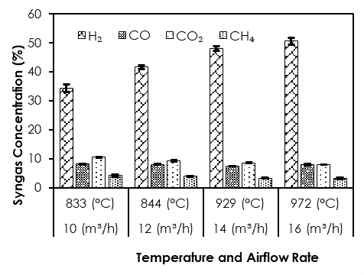
Biomass gasification is an emerging method for hydrogen-rich syngas (HRS) production, though the systematic effects of gasification parameters on HRS composition remain unclear. Prior studies on top-lit-updraft gasifier (TLUD) focused on the effects of chamber configuration on syngas and char composition, with unclear insight into hydrogen enhancement processes in gasification. The present study examines the effects of airflow on HRS production in a TLUD reactor using rice husk pyrolysis. Flare flame that is formed at 10–16 m³/h air flow rate confirms the reactor reliability within specific conditions. Interestingly, H₂ concentration in the HRS rose linearly with air flow rate, reaching a maximum of 51% H₂ as the average reactor temperature increased above 900℃. CO₂ emission dropped by 25.7% at a high air flow rate due to high-temperature consumption by hot char in the reduction zone. Methane oxidation supplies water vapor in the oxidation zone, supporting the water-gas shift reaction to boost H₂ production. CO2 emission of 0.15 kg/ kg H2 shows that the present setup has a lower carbon footprint compared to that of the Steam Methane Reforming, though the energy requirement of 1325 MJ/kg shows that the gasification requires further optimization for field implementation.
References
[1] Hoang, A. T., et al. 2023. Hydrogen Production by Water Splitting with Support of Metal- and Carbon-Based Photocatalysts. ACS Sustainable Chemistry & Engineering. 11(4): 1221–52. https://doi.org/10.1021/acssuschemeng.2c05226.
[2] Nguyen-Thi, T. X., and T. M. T. Bui. 2023. Effects of Injection Strategies on Mixture Formation and Combustion in a Spark-Ignition Engine Fueled with Syngas–Biogas–Hydrogen. International Journal of Renewable Energy Development. 12(1): 118–28.
[3] Vidian, F., A. Situmeang, H. Fitriani, T. Arief, and M. Saleh. 2024. Experimental Biomass Gasification in Updraft Gasifier with Gas Outlet at Reduction Zone and Air Supply Using Suction Blower. Journal of Advanced Research in Fluid Mechanics and Thermal Sciences. 118(1): 155–62. https://doi.org/10.37934/arfmts.118.1.155162.
[4] Le Tan, N. T., N. P. Thien Le, T. P. Vo, T. P. Mai, and D. Q. Nguyen. 2022. Experiment and Simulation of Rice Husk Gasification Process with a Downdraft Gasifier. Chemical Engineering Transactions. 97: 79–84. https://doi.org/10.3303/CET2297014.
[5] Simanjuntak, J. P., K. A. Al-Attab, E. Daryanto, B. H. Tambunan, and Eswanto. 2022. Bioenergy as an Alternative Energy Source: Progress and Development to Meet the Energy Mix in Indonesia. Journal of Advanced Research in Fluid Mechanics and Thermal Sciences. 97(1): 85–104. https://doi.org/10.37934/arfmts.97.1.85104.
[6] Ali, A. M., et al. 2022. Process Optimization and Economic Evaluation of Air Gasification of Saudi Arabian Date Palm Fronds for H₂-Rich Syngas Using Response Surface Methodology. Fuel. 316: 123359. https://doi.org/10.1016/j.fuel.2022.123359.
[7] Younus, T., A. Anwer, Z. Asim, and M. S. Surahio. 2018. Production of Hydrogen by Steam Methane Reformation Process. E3S Web of Conferences. 51: 03003. https://doi.org/10.1051/e3sconf/20185103003.
[8] Yousef, S., J. Eimontas, K. Zakarauskas, and N. Striūgas. 2025. Oxygen Updraft Gasification of Euro Cotton Banknotes Waste for Hydrogen-Rich Syngas Production. Journal of the Energy Institute. 118: 101906. https://doi.org/10.1016/j.joei.2024.101906.
[9] James R., A. M., W. Yuan, M. D. Boyette, and D. Wang. 2018. Airflow and Insulation Effects on Simultaneous Syngas and Biochar Production in a Top-Lit Updraft Biomass Gasifier. Renewable Energy. 117: 116–24. https://doi.org/10.1016/j.renene.2017.10.034.
[10] Quintero-Coronel, D. A., Y. A. Lenis-Rodas, L. A. Corredor, P. Perreault, and A. Gonzalez-Quiroga. 2021. Thermochemical Conversion of Coal and Biomass Blends in a Top-Lit Updraft Fixed-Bed Reactor: Experimental Assessment of the Ignition Front Propagation Velocity. Energy. 220: 119702. https://doi.org/10.1016/j.energy.2020.119702.
[11] Kumar, A., D. S. Pandey, and T. Mondal. 2025. Experimental Investigation of Process Parameters for Hydrogen-Rich Syngas Production from Rice Husk Gasification. Sustainable Chemistry for Climate Action. 6: 100061. https://doi.org/10.1016/j.scca.2025.100061.
[12] James R., A. M., C. Castorena, and W. Yuan. 2021. Modeling Product Distribution of Top-Lit Updraft Gasification. BioResources. 16(4): 6629–42. https://doi.org/10.15376/biores.16.4.6629-6642.
[13] Anderson, P. S., and S. J. S. Anderson. 2016. Origins, History, and Future of TLUD Micro-Gasification and Cookstove Advancement. TLUD Technology.
[14] Sánchez-Pólito, J., et al. 2024. Development and Evaluation Performance of Top-Lit Updraft Biomass Micro-Gasifiers for Energy-Intensive Household Cooking Tasks in Mexico. Sustainable Energy Technologies and Assessments. 103813. https://doi.org/10.1016/j.seta.2024.103813.
[15] Scharler, R., et al. 2021. Emission Minimization of a Top-Lit Updraft Gasifier Cookstove Based on Experiments and Detailed CFD Analyses. Energy Conversion and Management. 247: 114755. https://doi.org/10.1016/j.enconman.2021.114755.
[16] Minh Loy, A. C., et al. 2020. Optimization Study of Syngas Production from Catalytic Air Gasification of Rice Husk. International Journal on Advanced Science, Engineering and Information Technology. 10(5): 1784–91. https://doi.org/10.18517/ijaseit.10.5.9906.
[17] Shukla, S. S., R. Chava, S. Appari, B. A., and B. V. R. Kuncharam. 2022. Sustainable Use of Rice Husk for the Cleaner Production of Value-Added Products. Journal of Environmental Chemical Engineering. 10(1): 106899. https://doi.org/10.1016/j.jece.2021.106899.
[18] Corrêa, P. S. P., J. Zhang, E. E. S. Lora, R. V. Andrade, L. R. de Mello e Pinto, and A. Ratner. 2019. Experimental Study on Applying Biomass-Derived Syngas in a Microturbine. Applied Thermal Engineering. 146: 328–37. https://doi.org/10.1016/j.applthermaleng.2018.09.123.
[19] Ma, Y., W. Zheng, X. Guo, M. Tigabu, and F. Guo. 2021. Effect of Forest Floor Fuel Moisture Content on Chemical Components of PM₂.₅ Emitted during Combustion. Chemosphere. 279: 130547. https://doi.org/10.1016/j.chemosphere.2021.130547.
[20] Romes, N. B., R. A. Wahab, and M. A. Hamid. 2019. Proximate Analysis and Bioactivity Study on Acoustically Isolated Elaeis guineensis Leaves Extract. AIP Conference Proceedings. American Institute of Physics. https://doi.org/10.1063/1.5125505.
[21] Maliki, M., E. U. Ikhuoria, and P. Aluyor. 2023. Proximate Analysis of Selected Agricultural Waste for Their Nutritional Potential. North African Journal of Food and Nutrition Research. 7(15): 117–25. https://doi.org/10.51745/najfnr.7.15.117-125.
[22] Nguyen, N. M., F. Alobaid, P. Dieringer, and B. Epple. 2021. Biomass-Based Chemical Looping Gasification: Overview and Recent Developments. Applied Sciences. 11(15): 7069. https://doi.org/10.3390/app11157069.
[23] Steven, S., et al. 2022. Thermodynamics Simulation Performance of Rice Husk Combustion with a Realistic Decomposition Approach on the Devolatilization Stage. Waste and Biomass Valorization. 13(5): 2735–47. https://doi.org/10.1007/s12649-021-01657-x.
[24] Ahmad, R. K., S. A. Sulaiman, S. Yusup, S. S. Dol, M. Inayat, and H. A. Umar. 2022. Exploring the Potential of Coconut Shell Biomass for Charcoal Production. Ain Shams Engineering Journal. 13(1). https://doi.org/10.1016/j.asej.2021.05.013.
[25] Ríos-Badrán, I. M., I. Luzardo-Ocampo, J. F. García-Trejo, J. Santos-Cruz, and C. Gutiérrez-Antonio. 2020. Production and Characterization of Fuel Pellets from Rice Husk and Wheat Straw. Renewable Energy. 145: 500–507. https://doi.org/10.1016/j.renene.2019.06.048.
[26] Mehta, Y. 2018. Gasification and Combustion Studies in Top-Lit Updraft Gasifier Cookstove.
[27] Murad, E., and F. Dragomir. 2012. Heat Generators with TLUD Gasifier for Generating Energy from Biomass with a Negative Balance of CO₂.
[28] Hamad, M. A. F., A. M. Radwan, and A. Amin. 2017. Review of Biomass Thermal Gasification. Biomass Volume Estimation and Valorization for Energy. 488. https://doi.org/10.5772/66362
[29] James Rivas, Arthur M. 2015. Simultaneous Biochar and Syngas Production in a Top-Lit Updraft Biomass Gasifier. Accessed March 25, 2025. https://ridda2.utp.ac.pa/handle/123456789/5100.
[30] Quintero-Coronel, D. A., et al. 2023. Assessment of the Interchangeability of Coal–Biomass Syngas with Natural Gas for Atmospheric Burners and High-Pressure Combustion Applications. Energy. 276: 127551. https://doi.org/10.1016/j.energy.2023.127551.
[31] Shen, W., S. Wang, and X. Hou. 2023. Coupling Mechanism of Pressure and Temperature in a Co-Rotating Cavity with Radial Flow. Thermal Science and Engineering Progress. 43: 101940. https://doi.org/10.1016/j.tsep.2023.101940.
[32] Li, J., J. Liu, S. Liao, and R. Yan. 2010. Hydrogen-Rich Gas Production by Air–Steam Gasification of Rice Husk Using Supported Nano-NiO/γ-Al₂O₃ Catalyst. International Journal of Hydrogen Energy. 35(14): 7399–7404. https://doi.org/10.1016/j.ijhydene.2010.04.108.
[33] Saravanakumar, A., T. M. Haridasan, T. B. Reed, and R. K. Bai. 2007. Experimental Investigation and Modelling Study of Long Stick Wood Gasification in a Top-Lit Updraft Fixed-Bed Gasifier. Fuel. 86(17–18): 2846–56. https://doi.org/10.1016/j.fuel.2007.03.028.
[34] Patra, T. K., and P. N. Sheth. 2015. Biomass Gasification Models for Downdraft Gasifier: A State-of-the-Art Review. Renewable and Sustainable Energy Reviews. 50: 583–93. https://doi.org/10.1016/j.rser.2015.05.012.
[35] Dmitrenko, Y. M., and P. A. Klevan. 2011. Hydrogen Production in a Reversible Flow Filtration Combustion Reactor. Journal of Engineering Physics and Thermophysics. 84(6): 1296–1303. https://doi.org/10.1007/s10891-011-0597-2.
[36] Piyathissa, S. D. S., P. D. Kahandage, Namgay, H. Zhang, R. Noguchi, and T. Ahamed. 2023. Introducing a Novel Rice Husk Combustion Technology for Maximizing Energy and Amorphous Silica Production Using a Prototype Hybrid Rice Husk Burner to Minimize Environmental Impacts and Health Risk. Energies. 16(3): 1120. https://doi.org/10.3390/en16031120.
[37] Onthong, K., and J. Charoensuk. 2019. A New Method for Zone Development Observation for Updraft Rice Husk Gasification.
[38] Hendriyana, H. 2020. Effect of Equivalence Ratio on the Rice Husk Gasification Performance Using Updraft Gasifier with Air Suction Mode. Jurnal Bahan Alam Terbarukan. 9(1): 30–35. https://doi.org/10.15294/jbat.v9i1.23527.
[39] Serhan, M., et al. 2019. Total Iron Measurement in Human Serum with a Smartphone. Paper presented at the AIChE Annual Meeting. American Institute of Chemical Engineers.
[40] Eom, H., B. Jeon, and D. Shin. 2025. An Experimental Study on the Carbon Adsorption Performance of Biochar for Producing Carbon-Negative Turquoise Hydrogen. International Journal of Hydrogen Energy. 106: 1322–31. https://doi.org/10.1016/j.ijhydene.2025.01.093.
Downloads
Published
Issue
Section
License
Copyright of articles that appear in Jurnal Teknologi belongs exclusively to Penerbit Universiti Teknologi Malaysia (Penerbit UTM Press). This copyright covers the rights to reproduce the article, including reprints, electronic reproductions, or any other reproductions of similar nature.