
HUMAN ANNOYANCE FROM RAILWAY TRAFFIC-INDUCED GROUND VIBRATIONS IN URBAN: A REVIEW
DOI:
https://doi.org/10.11113/jurnalteknologi.v88.25823Keywords:
Vibration, Annoyance, Railway Traffic, Psychological BehaviourAbstract
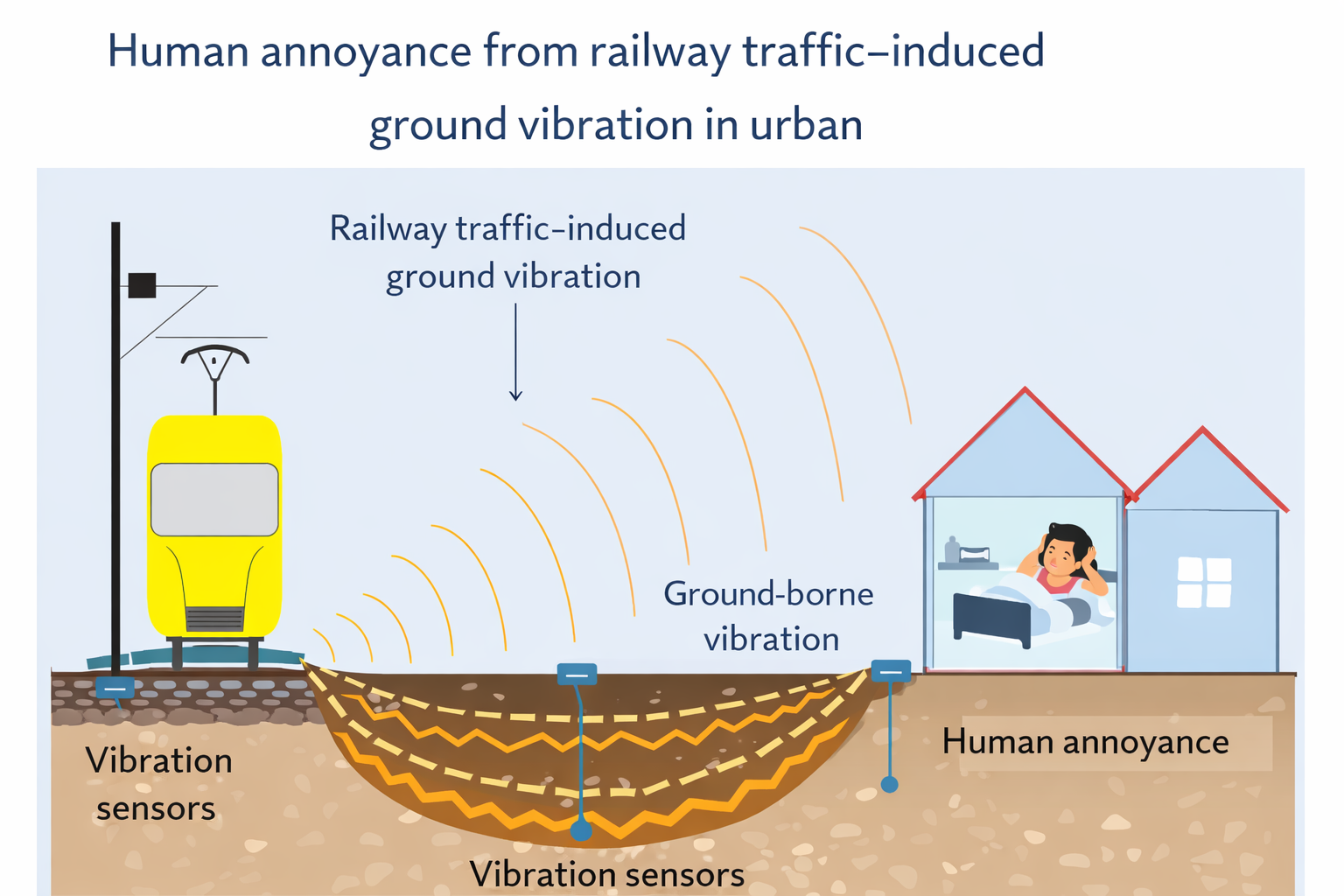
The increasing focus on urbanization and transportation networks has raised concerns about the impact of ground-borne vibrations from railway traffic on human well-being. These vibrations, transmitted through the ground into nearby buildings, can cause annoyance, discomfort, and potential health issues. While past research explored vibration fundamentals and progress, this review addresses gaps in understanding their psychological and social impacts on urban populations. The review examines the correlation between factors influencing ground-borne vibration (GBV) including vibration intensity, frequency, exposure duration, soil conditions, and buildings characteristics and human annoyance, as well as the associated psychological and social impacts on urban communities. Findings highlight that low-frequency vibrations are strongly associated with higher annoyance levels. Proximity to railway lines and older building infrastructure intensified effects. Individual sensitivity varied, with some reporting discomfort even at lower vibration levels. The review also emphasizes the importance of considering residents' subjective experiences when assessing impact. Ultimately, this review concludes that railway-induced vibrations significantly affect quality of life in urban areas, underscoring the need for effective mitigation strategies and stricter regulatory frameworks.
References
[1] Whittle N, Peris E, Condie J, Woodcock J, Brown P, Moorhouse AT, et al. Development of a social survey for the study of vibration annoyance in residential environments: Good practice guidance. Appl Acoust 2015;87:83–93. https://doi.org/10.1016/j.apacoust.2014.06.015.
[2] Connolly DP, Kouroussis G, Woodward PK, Alves Costa P, Verlinden O, Forde MC. Field testing and analysis of high speed rail vibrations. Soil Dyn Earthq Eng 2014;67:102–18. https://doi.org/10.1016/j.soildyn.2014.08.013.
[3] Auersch L. Train-induced ground vibration due to the irregularities of the soil. Soil Dyn Earthq Eng 2021;140. https://doi.org/10.1016/j.soildyn.2020.106438.
[4] Hakimi Ibrahim AN, Borhan MN, Mat Yazid MR, Rahmat RA, Yukawa S. Factors influencing passengers’ satisfaction with the light rail transit service in alpha cities: Evidence from Kuala Lumpur, Malaysia using structural equation modelling. Mathematics 2021;9. https://doi.org/10.3390/math9161954.
[5] Ali SSS, Razman MR, Awang A. The estimation and relationship of domestic electricity consumption and appliances ownership in Malaysia’s intermediate city. Int J Energy Econ Policy 2020;10:116–22. https://doi.org/10.32479/ijeep.8358.
[6] Wen L, Kenworthy J, Guo X, Marinova D. Solving Traffic Congestion through Street Renaissance: A Perspective from Dense Asian Cities. Urban Sci 2019;3. https://doi.org/10.3390/urbansci3010018.
[7] Ali SSS, Razman MR, Awang A, Asyraf MRM, Ishak MR, Ilyas RA, et al. Critical Determinants of Household Electricity Consumption in a Rapidly Growing City. Sustain (Switzerland)I 2021;13:4441. https://doi.org/10.3390/su1308444.
[8] Prasarana Malaysia Berhad. Klang Valley Integrated Transit Map. Prasarana Malaysia Berhad 2019:1–3.
[9] Lazi MKAM, Adnan MA, Sulaiman N, Kamarudin SNN, Hassan SA, Warid MNM, et al. Allowable Limit of Human Annoyance Towards Ground-Borne Vibration Velocity Induced by Rail Traffic: A Review. IOP Conf Ser Earth Environ Sci 2023;1238. https://doi.org/10.1088/1755-1315/1238/1/012007.
[10] Morihara T, Yokoshima S, Matsumoto Y. Effects of noise and vibration due to the hokuriku shinkansen railway on the living environment: A socio-acoustic survey one year after the opening. Int J Environ Res Public Health 2021;18. https://doi.org/10.3390/ijerph18157794. [11] Peris E, Woodcock J, Sica G, Sharp C, Moorhouse AT, Waddington DC. Guidance for new policy developments on railway noise and vibration. Transp Res Part A Policy Pract 2016;85:76–88. https://doi.org/10.1016/j.tra.2016.01.004.
[12] Vasheghani M, Sadeghi J, Khajehdezfuly A. Legal consequences of train-induced structure borne noise and vibration in residential buildings. Noise Mapp 2022;9:170–88. https://doi.org/10.1515/noise-2022-0156.
[13] Induced R. RAILWAY INDUCED State of the art report 2017:2–82.
[14] Tao Z, Hu Z, Wu G, Huang C, Zou C, Ying Z. Train-Induced Vibration Predictions Based on Data-Driven Cascaded State-Space Model. Buildings 2022;12. https://doi.org/10.3390/buildings12020114.
[15] Auersch L. The excitation of ground vibration by rail traffic: Theory of vehicle-track-soil interaction and measurements on high-speed lines. J Sound Vib 2005;284:103–32. https://doi.org/10.1016/j.jsv.2004.06.017.
[16] Zhao Y, Ling X, Wang Z, Gong W, Li G. Acceleration frequency characteristics of the freight-train-induced vibration of the Beijing-Harbin Railway subgrade. Shock Vib 2020;2020. https://doi.org/10.1155/2020/6651713.
[17] Coquel G, Fillol C. Analysis of ground-borne noise and vibration levels generated by buses. Procedia Eng 2017;199:2699–704. https://doi.org/10.1016/j.proeng.2017.09.564.
[18] Barneich JA. “Vehicle induced ground motion,” in Vibration Problems in Geotechnical Engineering. (Detroit, MI ASCE), 1985:187–202.
[19] Singh J, Singh SP, Joneson E. Measurement and analysis of US truck vibration for leaf spring and air ride suspensions, and development of tests to simulate these conditions. Packag Technol Sci 2006;19:309–23. https://doi.org/10.1002/pts.732.
[20] Figlus T, Szafraniec P, Skrúcaný T. Methods of measuring and processing signals during tests of the exposure of a motorcycle driver to vibration and noise. Int J Environ Res Public Health 2019;16. https://doi.org/10.3390/ijerph16173145.
[21] Singh SP, Sandhu APS, Singh J, Joneson E. Measurement and analysis of truck and rail shipping environment in India. Packag Technol Sci 2007;20:381–92. https://doi.org/10.1002/pts.764.
[22] Burdzik R, Konieczny Ł. Research on structure, propagation and exposure to general vibration in passenger car for different damping parameters. J Vibroengineering 2013;15:1680–8.
[23] Burdzik R. Research on the influence of engine rotational speed to the vibration penetration into the driver via feet - multidimensional analysis. J Vibroengineering 2013;15:2114–23.
[24] Lu Y, Chen L, Wu SF, Hu J, Li H. Analyzing motorcycle low-frequency noise. J Theor Comput Acoust 2022;30. https://doi.org/10.1142/S2591728522500050.
[25] Connolly DP, Marecki GP, Kouroussis G, Thalassinakis I, Woodward PK. The growth of railway ground vibration problems—A review. Sci Total Environ 2016;568:1276–82.
[26] Ntotsios E, Thompson D, Hussein M. The effect of track load correlation on ground-borne vibration from railways. J Sound Vib 2017;402:142–63.
[27] Thompson DJ, Kouroussis G, Ntotsios E. Modelling, simulation and evaluation of ground vibration caused by rail vehicles. Veh Syst Dyn 2019;57:936–83.
[28] Kouroussis G, Connolly DP, Olivier B, Laghrouche O, Costa PA. Railway cuttings and embankments: Experimental and numerical studies of ground vibration. Sci Total Environ 2016;557:110–22.
[29] Tao Z, Wang Y, Sanayei M, Moore JA, Zou C. Experimental study of train-induced vibration in over-track buildings in a
metro depot. Eng Struct 2019;198:109473.
[30] Khan MR, Dasaka SM. Temporal variation of ground-borne vibrations in ballasted high-speed railway embankments. Transp Infrastruct Geotechnol 2020;7:224–42.
[31] Jing L, Wang K, Zhai W. Impact vibration behavior of railway vehicles: a state-of-the-art overview. Acta Mech Sin Xuebao 2021;37:1193–221. https://doi.org/10.1007/s10409-021-01140-9.
[32] Huang S, Chen Y, Zou C, Jian S. Train-induced environmental vibrations by considering different building foundations along curved track. Transp Geotech 2022;35. https://doi.org/10.1016/j.trgeo.2022.100785.
[33] Brenguier F, Boué P, Ben-Zion Y, Vernon F, Johnson CW, Mordret A, et al. Train traffic as a powerful noise source for monitoring active faults with seismic interferometry. Geophys Res Lett 2019;46:9529–36.
[34] Lazi MKAM, Adnan MA. Human Response and Annoyance Towards Ground-Borne Vibration Induced by Railway Traffic. Int J Integr Eng 2022;14:296–312.
[35] Ouakka S, Verlinden O, Kouroussis G. Railway ground vibration and mitigation measures: benchmarking of best practices. Railw Eng Sci 2022;30. https://doi.org/10.1007/s40534-021-00264-9.
[36] Xu L, Ma M, Cao R, Tan X, Liang R. Effect of longitudinally varying characteristics of soil on metro train-induced ground vibrations based on wave propagation analysis. Soil Dyn Earthq Eng 2022;152. https://doi.org/10.1016/j.soildyn.2021.107020.
[37] Lazi MKAM, Adnan MA, Sulaiman N. Empirical model of ground-borne vibration induced by freight railway traffic. Pertanika J Sci Technol 2021;29:1763–85. https://doi.org/10.47836/pjst.29.3.21.
[38] Longinow A, Mohammadi J. Effects of Vibrations on Structures: Overview and Case Studies. Pract Period Struct Des Constr 2022;27. https://doi.org/10.1061/(asce)sc.1943-5576.0000730.
[39] Zou C, Wang Y, Tao Z. Train-induced building vibration and radiated noise by considering soil properties. Sustain 2020;12. https://doi.org/10.3390/su12030937.
[40] Yao J, Chen Y, Dong L. Influence of Water Level Change on Vibration Response and Isolation of Saturated Soil Under Moving Loads. Appl Sci 2025;15:10461. https://doi.org/10.3390/app151910461.
[41] Qi Y, Indraratna B. Influence of Rubber Inclusion on the Dynamic Response of Rail Track. J Mater Civ Eng 2022;34. https://doi.org/10.1061/(asce)mt.1943-5533.0004069.
[42] Han K, Wang J, Xiao T, Li S, Zhang D, Dong H. Effects of train vibration load on the structure and hydraulic properties of soils. Sci Rep 2024;14. https://doi.org/10.1038/s41598-024-57956-5.
[43] Rafidah M, Lazi MKAM, Hassan SA, Padil KH, Sulaiman N, Razman MR. Influence of types of railway traffic on ground borne vibration towards vibration threshold limit. Sci Rep 2025;15. https://doi.org/10.1038/s41598-025-20912-y.
[44] Wang X, Liu X, Lei G, Zhang H. Study of the Isolation Effect of a New Damping Material for Environmental Vibrations Due to High-Speed Train Operation. Adv Civ Eng 2025;2025. https://doi.org/10.1155/adce/2978409.
[45] Li X, Chen Y, Zou C, Chen Y. Train-induced vibration mitigation based on foundation improvement. J Build Eng 2023;76. https://doi.org/10.1016/j.jobe.2023.107106.
[46] Connolly DP, Kouroussis G, Laghrouche O, Ho CL, Forde MC. Benchmarking railway vibrations – Track, vehicle, ground and building effects. Constr Build Mater 2015;92:64–81. https://doi.org/10.1016/j.conbuildmat.2014.07.042.
[47] Coulier P, Lombaert G, Degrande G. The influence of source--receiver interaction on the numerical prediction of railway induced vibrations. J Sound Vib 2014;333:2520–38.
[48] Maclachlan L, Ögren M, van Kempen E, Hussain-Alkhateeb L, Waye KP. Annoyance in response to vibrations from railways. Int J Environ Res Public Health 2018;15. https://doi.org/10.3390/ijerph15091887.
[49] Zhang X, Feng N, Wang Y, Shen Y. An analysis of the simulated acoustic emission sources with different propagation distances, types and depths for rail defect detection. Appl Acoust 2014;86:80–8. [50] Faizan AA, Kırtel O, Çelebi E, Zülfikar AC, Göktepe F. Experimental validation of a simplified numerical model to predict train-induced ground vibrations. Comput Geotech 2022;141. https://doi.org/10.1016/j.compgeo.2021.104547.
[51] Carneiro D, Alexiou T, Reumers P, Degrande G. Ground vibration due to a train running at different speed on a test track. Soil Dyn Earthq Eng 2026;200. https://doi.org/10.1016/j.soildyn.2025.109768.
[52] Arham AF, Razman MR, Amin L, Mahadi Z, Ern LK, Zakaria SZS, et al. Integrated research framework approaches to the control of dengue diseases for achieving sustainable development goals in Malaysia. Indian J Public Heal Res Dev 2018;9:1231. https://doi.org/10.5958/0976-5506.2018.01626.1.
[53] Razman MR, Hadi AH, Jahi JM, Idrus S, Mohamed AF, Harman Shah AH. Transformation for better living environment in urban region: application of the principle of transboundary liability and the montreal protocol experiences. Akademika 2011;81.
[54] Campbell I. Measurement Uncertainty Associated with Sound and Vibration Instrumentation. Uncertain Acoust 2020:53–103. https://doi.org/10.1201/9780429470622-3.
[55] Matsumoto Y, Kunimatsu S. A review of standards for evaluation of vibration in living environment and studies of human perception of whole-body vibration. Environ Vib Predict Monit Mitig Eval (ISEV 2005) 2021:599–606. https://doi.org/10.1201/9781003209379-88.
[56] British Standards Institution. BS 6472-1:2008 Guide to evaluation of human exposure to vibration in buildings Part 1: Vibration sources other than blasting 2008:28.
[57] Kuczyński J, Wach P. Effect of Train Vibration on Buildings-Comparison of the Fft and 1/3 Octave Methods n.d.
[58] Norén-Cosgriff K, Dahl BM, Park J, Kaynia AM. FE Modelling as a Design Tool for Mitigation Measures for Railway Vibrations. Notes Numer Fluid Mech Multidiscip Des 2021;150:429–36. https://doi.org/10.1007/978-3-030-70289-2_45.
[59] Department of Environment. Guidelines for Environmental Vibration Limits and Control. 2021.
[60] Gatersleben B, Griffin I. Environmental stress. Handb Environ Psychol Qual Life Res 2017:469–85.
[61] Seidler A, Schubert M, Mehrjerdian Y, Krapf K, Popp C, van Kamp I, et al. Health effects of railway-induced vibration combined with railway noise – A systematic review with exposure-effect curves. Environ Res 2023;233. https://doi.org/10.1016/j.envres.2023.116480.
[62] Maljaee SS, Khadem Sameni M, Ahmadi M. Effects of railway noise and vibrations on dissatisfaction of residents: case study of Iran. Environ Dev Sustain 2022. https://doi.org/10.1007/s10668-022-02718-4.
[63] He Y, Zhang Y, Yao Y, He Y, Sheng X. Review on the Prediction and Control of Structural Vibration and Noise in Buildings Caused by Rail Transit. Buildings 2023;13. https://doi.org/10.3390/buildings13092310.
[64] Eriksson C, Pershagen G, Nilsson M. Biological mechanisms related to cardiovascular and metabolic effects by environmental noise. Eur Comm Jt Res Cent 2018:19.
[65] Khan D, Burdzik R. Measurement and analysis of transport noise and vibration: A review of techniques, case studies, and future directions. Meas J Int Meas Confed 2023;220. https://doi.org/10.1016/j.measurement.2023.113354.
[66] Qu S, Yang J, Zhu S, Zhai W, Kouroussis G, Zhang Q. Experimental study on ground vibration induced by double-line subway trains and road traffic. Transp Geotech 2021;29. https://doi.org/10.1016/j.trgeo.2021.100564.
[67] Kou L, Kwan MP, Chai Y. Living with urban sounds: Understanding the effects of human mobilities on individual sound exposure and psychological health. Geoforum 2021;126:13–25. https://doi.org/10.1016/j.geoforum.2021.07.011.
[68] Bai Y, He Z, Qu S, Wang X, Li P, Zhang X, et al. Rail pad damping characteristics in track vibration reduction evaluated through hammer tests and theoretical analysis. Meas J Int Meas Confed 2025;239. https://doi.org/10.1016/j.measurement.2024.115467.
[69] Nering K, Kowalska-Koczwara A, Stypuła K. Annoyance based vibro-acoustic comfort evaluation of as summation of stimuli annoyance in the context of human exposure to noise and vibration in buildings. Sustain 2020;12:1–18. https://doi.org/10.3390/su12239876.
[70] Lazi MKAM, Adnan MA, Sulaiman N. The Impact of Train Operation Time with Ground Borne Vibration Induced by Railway Traffic. IOP Conf Ser Earth Environ Sci 2022;971. https://doi.org/10.1088/1755-1315/971/1/012004.
[71] Mohd Lazi MKA, Adnan MA, Sulaiman N, Shahrir MD. Comparison of Ground-Borne Vibration Induced by Railway Within Peak and Non-peak Hours. Adv Sci Technol Innov 2021:549–55. https://doi.org/10.1007/978-3-030-65181-7_44.
[72] Ali SSS, Razman MR, Awang A. The nexus of population, GDP growth, electricity generation, electricity consumption and carbon emissions output in Malaysia. Int J Energy Econ Policy 2020;10:84–9. https://doi.org/10.32479/ijeep.8987.
[73] Roslan ZB, Ramli Z, Razman MR, Asyraf MRM, Ishak MR, Ilyas RA, et al. Reflections on Local Community Identity by Evaluating Heritage Sustainability Protection in Jugra, Selangor, Malaysia. Sustainability 2021;13:8705. https://doi.org/10.3390/su13168705.
[74] Wang L, Gao X, Zhao C, Wang P, Li Z. Vibration transfer from underground train to multi-story building: Modelling and validation with in-situ test data. Undergr Sp 2024;19:301–16. https://doi.org/10.1016/j.undsp.2024.04.004.
[75] Kuo KA, Papadopoulos M, Lombaert G, Degrande G. The coupling loss of a building subject to railway induced vibrations: Numerical modelling and experimental measurements. J Sound Vib 2019;442:459–81. https://doi.org/10.1016/j.jsv.2018.10.048.
[76] Barros dos Santos J, Lima JP. Health Determinants, Applications, and Methods: A Systematic Literature Review on the Relationships Between the Urban Transport of People and Health. Transp Res Rec 2024;2678:245–71. https://doi.org/10.1177/03611981231170625.
[77] Hanson C, Towers D, Meister L. High-Speed Ground Transportation Noise and Vibration Impact Assessment. HMMH Rep 293630-4 2005;6:141–9.
[78] Licitra G, Fredianelli L, Petri D, Vigotti MA. Annoyance evaluation due to overall railway noise and vibration in Pisa urban areas. Sci Total Environ 2016;568:1315–25. https://doi.org/10.1016/j.scitotenv.2015.11.071.
[79] Beben D, Maleska T, Bobra P, Duda J, Anigacz W. Influence of Traffic-Induced Vibrations on Humans and Residential Building—A Case Study. Int J Environ Res Public Health 2022;19. https://doi.org/10.3390/ijerph19095441.
[80] Xia H; Cao YM. Problem of railway traffic induced vibrations of environments. J Railw Sci Eng 2004;1(1):44–51.
[81] Zhu P, Ho SN, Jiang Y, Tan X. Built environment, commuting behaviour and job accessibility in a rail-based dense urban context. Transp Res Part D Transp Environ 2020;87. https://doi.org/10.1016/j.trd.2020.102438.
[82] Hao Y, Qi H, Liu S, Nian V, Zhang Z. Study of Noise and Vibration Impacts to Buildings Due to Urban Rail Transit and Mitigation Measures. Sustain 2022;14. ttps://doi.org/10.3390/su14053119.
Downloads
Published
Issue
Section
License
Copyright of articles that appear in Jurnal Teknologi belongs exclusively to Penerbit Universiti Teknologi Malaysia (Penerbit UTM Press). This copyright covers the rights to reproduce the article, including reprints, electronic reproductions, or any other reproductions of similar nature.