STRUCTURAL PERFORMANCE OF MODIFIED WARM MIX ASPHALT BLOCK PAVEMENTS USING A HIGHWAY ACCELERATED LOADING INSTRUMENT
DOI:
https://doi.org/10.11113/jurnalteknologi.v88.25954Keywords:
Warm mix asphalt, rut depth, coal bottom ash, waste cooking oil, zycotherm-sp2Abstract
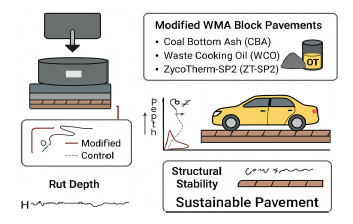
Rutting and deflection significantly deteriorate pavement durability and safety, requiring innovative strategies to boost structural performance and sustainability. This study investigates the structural stability of modified Warm Mix Asphalt (WMA) block pavements by subjecting them to controlled, accelerated loading using a Highway Accelerated Loading Instrument (HALI). This research also investigates the combined use of Waste Cooking Oil (WCO), Coal Bottom Ash (CBA), and ZycoTherm-SP2 (ZT-SP2) as binder modifiers in WMA for block pavement applications. The modifiers were blended with 60/70 penetration-grade bitumen to improve binder qualities. The modified mixtures were then used to produce WMA blocks with thicknesses of 70 mm, 80 mm, and 90 mm, laid in a stretcher bond pattern with joint widths of 0 mm and 2 mm. Advanced testing methodologies, such as material characterization, rut depth and deflection behavior, surface deformation monitoring, and HALI, provide insights into pavement deterioration mechanisms. The results show that the optimal modifier combination of 0.1% ZT-SP2, 4% WCO, and 5% CBA achieved the best performance, improving rutting resistance and structural stability. The minimum mean rut depths for 90 mm blocks were 5.55 mm (modified) and 5.49 mm (control). The findings demonstrate that the rutting resistance and structural stability are greatly improved in WMA block pavements incorporating binder modifiers. This makes them a sustainable choice for long-lasting pavement construction in practical applications.
References
[1] A. Behnood, “A review of the warm mix asphalt (WMA) technologies: Effects on thermo-mechanical and rheological properties,” Journal of Cleaner Production, 2020, doi: https://10.1016/j.jclepro.2020.120817.
[2] V. Kumar and E. Coleri, “Effects of finer gradation, temperature, warm mix additives, and compaction methods on density and performance of asphalt mixtures,” Construction and Building Materials, Vol. 394, No. September 2022, p. 132226, 2023, doi: https://10.1016/j.conbuildmat.2023.132226.
[3] W. Mix and A. Concrete, “A comprehensive review of the use of neutral carbon and bio-oil wastes on Warm Mix Asphal” Malaysian Journal of Civil Engineering, Vol. 1, pp. 41–61, 2024.
[4] H. H. Joni and H. H. Mohammed, “Effect of Warm Asphalt Additive on Pavement Performance,” Journal of Engineering and Sustainable Development, Vol. 23, No. 5, pp. 137–146, 2019, doi: https://10.31272/jeasd.23.5.10.
[5] C. Hettiarachchi, X. Hou, J. Wang, and F. Xiao, “A comprehensive review on the utilization of reclaimed asphalt material with warm mix asphalt technology,” Construction and Building Materials, Vol. 227, p. 117096, 2019, doi: https://10.1016/j.conbuildmat.2019.117096.
[6] P. Caputo et al., “The role of additives in warm mix asphalt technology: An insight into their mechanisms of improving an emerging technology,” Nanomaterials, Vol. 10, No. 6, pp. 1–17, 2020, doi: https://10.3390/nano10061202.
[7] P. Caputo, D. Miriello, A. Bloise, N. Baldino, O. Mileti, and G. Antonio, “International Journal of Adhesion and Adhesives A comparison and correlation between bitumen adhesion evaluation test methods, boiling and contact angle tests,” International Journal of Adhesion and Adhesives, Vol. 102, p. 102680, 2020, doi: https://10.1016/j.ijadhadh.2020.102680.
[8] A. Yousefi, A. Behnood, A. Nowruzi, and H. Haghshenas, “Performance evaluation of asphalt mixtures containing warm mix asphalt (WMA) additives and reclaimed asphalt pavement (RAP),” Construction and Building Materials, Vol. 268, p. 121200, 2021, doi: https://10.1016/j.conbuildmat.2020.121200.
[9] S. Maidin, T. K. Rajendran, S. Ismail, and L. M. Ali, “Systematic Literature Review on the Application of Additive Manufacturing in Repair and Restoration,” Jurnal Teknologi, Vol. 85, No. 6, pp. 85–94, 2023, doi: https://10.11113/jurnalteknologi.v85.20019.
[10] M. Azman, H. M. Nor, M. Rosli Hainin, H. Yaacob, C. Ros Ismail, and A. K. Nur Hafizah, “The effect of groove-underside shaped concrete block on pavement permanent deformation,” Jurnal Teknologi, Vol. 61, No. 3, pp. 7–14, 2013, doi: https://10.11113/jt.v61.1763.
[11] S. Zhou, H. Zhang, J. Jia, M. Zhao, Q. Ai, and L. Tong, “Experimental Study on Pavement Performance of Warm High Modulus Mixture Whmm-13,” Baltic Journal of Road and Bridge Engineering, Vol. 19, No. 3, pp. 1–16, 2024, doi: https://10.7250/bjrbe.2024-19.640.
[12] M. Sukhija and N. Saboo, “A comprehensive review of warm mix asphalt mixtures-laboratory to field,” Construction and Building Materials, Vol. 274, p. 121781, 2021, doi: https://10.1016/j.conbuildmat.2020.121781.
[13] Y. Babangida, A. Mohamed, and A. H. Norhidayah, “Effect of incorporating ram-fat and oil,” Malaysian Journal of Civil Engineering, Vol. 3, pp. 25–32, 2024.
[14] U. O. F. M. Powder, F. O. R. Buildings, and I. N. Seaside, “Modified with graphite carbon particles on concrete construction” Jurnal Teknologi, Vol. 6, pp. 37–45, 2023.
[15] B. Singh, D. Prasad, A. Kumar, and B. Yadav, “Use of nano-materials to enhance the properties of asphalt mixes,” Material Today Proceedings, Vol. 65, pp. 1861–1866, 2022, doi: https://10.1016/j.matpr.2022.05.043.
[16] L. V. P. M. Prasadraju and V. S. P. K. Kvs, “Effect of various combinations of aperture diameter and pattern on concrete paver block,” Material Today Proceedings, Vol. 45, pp. 5494–5499, 2021, doi: https://10.1016/j.matpr.2021.02.201.
[17] D. Hoha et al., “Accelerated testing of a recycled road structure made with reclaimed asphalt pavement material” Vol. 262, 2020, doi: https://10.1016/j.conbuildmat.2020.120658.
[18] W. Xue, G. W. Flintsch, and B. K. Diefenderfer, “Measuring Pavement Permanent Deformation in Accelerated Pavement Testing,” No. April, 2020, doi: https://10.1177/0361198120915471.
[19] S. Bhattacharjee, “Use of Accelerated Loading Equipment for Fatigue Characterization of Hot Mix Asphalt in the Laboratory,” No. January, 2005.
[20] A. Yousefi, A. Behnood, A. Nowruzi, and H. Haghshenas, “Performance evaluation of asphalt mixtures containing warm mix asphalt (WMA) additives and reclaimed asphalt pavement (RAP),” Construction and Building Materials, No. xxxx, p. 121200, 2020, doi: https://10.1016/j.conbuildmat.2020.121200.
[21] R. Mamat et al., “Using bio-binder as an alternative binder” Jurnal Teknologi, Vol. 23, pp. 17–20, 2015.
[22] B. Hill, B. Behnia, S. Hakimzadeh, W. Buttlar, and H. Reis, “Evaluation of low-temperature cracking performance of warm-mix asphalt mixtures,” Transportation Research Record, No. 2294, pp. 81–88, 2012, doi: https://10.3141/2294-09.
[23] Y. B. Attahiru et al., “A review on green economy and development of green roads and highways using carbon neutral materials,” Renewable and Sustainable Energy Review, Vol. 101, No. June 2018, pp. 600–613, 2019, doi: https://10.1016/j.rser.2018.11.036.
[24] G. Piccone, G. Loprencipe, A. Almeida, and N. Fiore, “Evaluation of the performance of a warm mix asphalt (WMA) considering aged and unaged specimens,” Coatings, Vol. 10, No. 12, pp. 1–17, 2020, doi: https://10.3390/coatings10121241.
[25] A. S. Eltwai, “Structural performance of asphalt block pavement as related to thickness, binder types, and joint width,” PhD Thesis, 2015.
[26] M. N. Soutsos, K. Tang, H. A. Khalid, and S. G. Millard, “The effect of construction pattern and unit interlock on the structural behaviour of block pavements,” Construction and Building Materials, Vol. 25, No. 10, pp. 3832–3840, 2011, doi: https://10.1016/j.conbuildmat.2011.04.002.
[27] M. Sukhija, N. Saboo, and A. Pani, “Effect of warm mix asphalt (WMA) technologies on the moisture resistance of asphalt mixtures,” Construction and Building Materials, Vol. 369, No. November 2022, p. 130589, 2023, doi: https://10.1016/j.conbuildmat.2023.130589.
[28] X. Li, Z. Zhou, X. Lv, K. Xiong, X. Wang, and Z. You, “Temperature segregation of warm mix asphalt pavement: Laboratory and field evaluations,” Construction and Building Materials, Vol. 136, pp. 436–445, 2017, doi: https://10.1016/j.conbuildmat.2016.12.195.
[29] L. Gupta and A. Bellary, “Comparative study on the Behavior of Bituminous Concrete Mix and Warm Mix Asphalt Prepared Using Lime and Zycotherm as Additive,” Material Today Proceedings, Vol. 5, No. 1, pp. 2074–2081, 2018, doi: https://10.1016/j.matpr.2017.09.203.
[30] M. M. Salleh, R. M. Noor, A. Yahya, S. Abd-Aziz, and H. Hussin, “Potential Applications of Lignin and Its Derivatives From Lignocellulosic Biomass – a Review,” Jurnal Teknologi, Vol. 85, No. 3, pp. 43–59, 2023, doi: https://10.11113/jurnalteknologi.v85.15032.
[31] K. Yan, Y. Li, Z. Long, L. You, M. Wang, and M. Zhang, “Mechanical behaviors of asphalt mixtures modified with European rock bitumen and waste cooking oil,” Construction and Building Materials, Vol. 319, No. December 2021, p. 125909, 2022, doi: https://10.1016/j.conbuildmat.2021.125909.
[32] A. Abdelgalil and H. Nor, “The influence of block thickness on the performance of asphalt paving blocks,” Research Journal of Applied. Sciences and Engineering Technology, Vol. 7, No. 10, pp. 2129–2134, 2014, doi: https://10.19026/rjaset.7.507.
[33] A. Abdelgalil and H. Nor, “The Effect of Joint Width on Structural Performance of Asphalt Block Pavements,” Research Journal of Applied Sciences and Engineering Technology, Vol. 7, No. 8, pp. 1612–1617, 2014, doi: https://10.19026/rjaset.7.439.
[34] A. Eltwati, “The Influence of Block Thickness on the Performance of Asphalt Paving Blocks The Influence of Block Thickness on the Performance of Asphalt Paving Blocks,” Jurnal Teknologi, No. March, 2015, doi: https://10.19026/rjaset.7.507.
[35] A. Eltwati, “The Effect of Joint Width on Structural Performance of Asphalt Block Pavements,” Jurnal Teknologi, No. March, 2015, doi: https://10.19026/rjaset.7.439.
[36] A. Eltwati, R. P. Jaya, A. Mohamed, E. Jusli, and Z. Al-saffar, “Effect of Warm Mix Asphalt (WMA) Antistripping Agent on Performance of Waste Engine Oil-Rejuvenated Asphalt Binders and Mixtures,” Sustainability (Switzerland), 2023.
[37] Z. Ahmed et al., “Mechanical and Performance Characteristics of Warm Mix Asphalt Modified with Phase Change Materials and Recycled Cigarette Filters,” pp. 1–22, 2025.
[38] P. Yang and J. Liu, “Rheological properties of Deurex–modified WMA binder containing SBS,” Vol. 6466, 2018, doi: https://10.1080/10916466.2018.1437633.
[39] W. Zhang et al., “Evaluation method of storage stability of SBS modified bitumen based on dynamic rheological properties,” Construction and Building Materials, Vol. 323, No. January, p. 126615, 2022, doi: https://10.1016/j.conbuildmat.2022.126615.
[40] R. Zhang, A. Ranjbar, F. Zhou, and D. Deb, “Effect of chemical warm-mix additives on asphalt binder rheological and chemical properties in the context of aging,” Construction and Building Materials, Vol. 393, No. October 2022, p. 132061, 2023, doi: https://10.1016/j.conbuildmat.2023.132061.
[41] X. Yu, Z. Leng, and T. Wei, “Investigation of the Rheological Modification Mechanism of Warm-Mix Additives on Crumb-Rubber-Modified Asphalt,” Journal of Materials in Civil Engineering, Vol. 26, No. 2, pp. 312–319, 2014, doi: https://10.1061/(asce)mt.1943-5533.0000808.
[42] M. M. Hilal and M. Y. Fattah, “Applied Sciences Evaluation of Resilient Modulus and Rutting for Warm Asphalt Mixtures : A Local Study in Iraq,” 2022.
[43] S. A. Mohammed et al., “A Review of the Utilization of Coal Bottom Ash (CBA) in the Construction Industry,” pp. 1–16, 2021.
[44] E. Concrete et al., “Enhancing concrete performance by utilizing crushed glass and waste bottle plastic fibers for improved strength and” Jurnal Teknologi, Vol. 6, pp. 47–57, 2023.
[45] “Engineering Properties and Structural Performance of,” No. July, 2008.
[46] M. Q. Ismael, M. Y. Fattah, and A. F. Jasim, “Improving the rutting resistance of asphalt pavement modified with the carbon nanotubes additive,” Ain Shams Engineering Journal, Vol. 12, No. 4, pp. 3619–3627, 2021, doi: https://10.1016/j.asej.2021.02.038.
Downloads
Published
Issue
Section
License
Copyright of articles that appear in Jurnal Teknologi belongs exclusively to Penerbit Universiti Teknologi Malaysia (Penerbit UTM Press). This copyright covers the rights to reproduce the article, including reprints, electronic reproductions, or any other reproductions of similar nature.