
SEISMIC FRAGILITY OF INFILLED STEEL BUILDINGS WITH CHEVRON AND X-BRACED CONFIGURATIONS
DOI:
https://doi.org/10.11113/jurnalteknologi.v88.26026Keywords:
Chevron braced frames, X-braced frames, Infill wall, Incremental Dynamic - Push-over Analysis, Fragility curves, Peak ground acceleration.Abstract
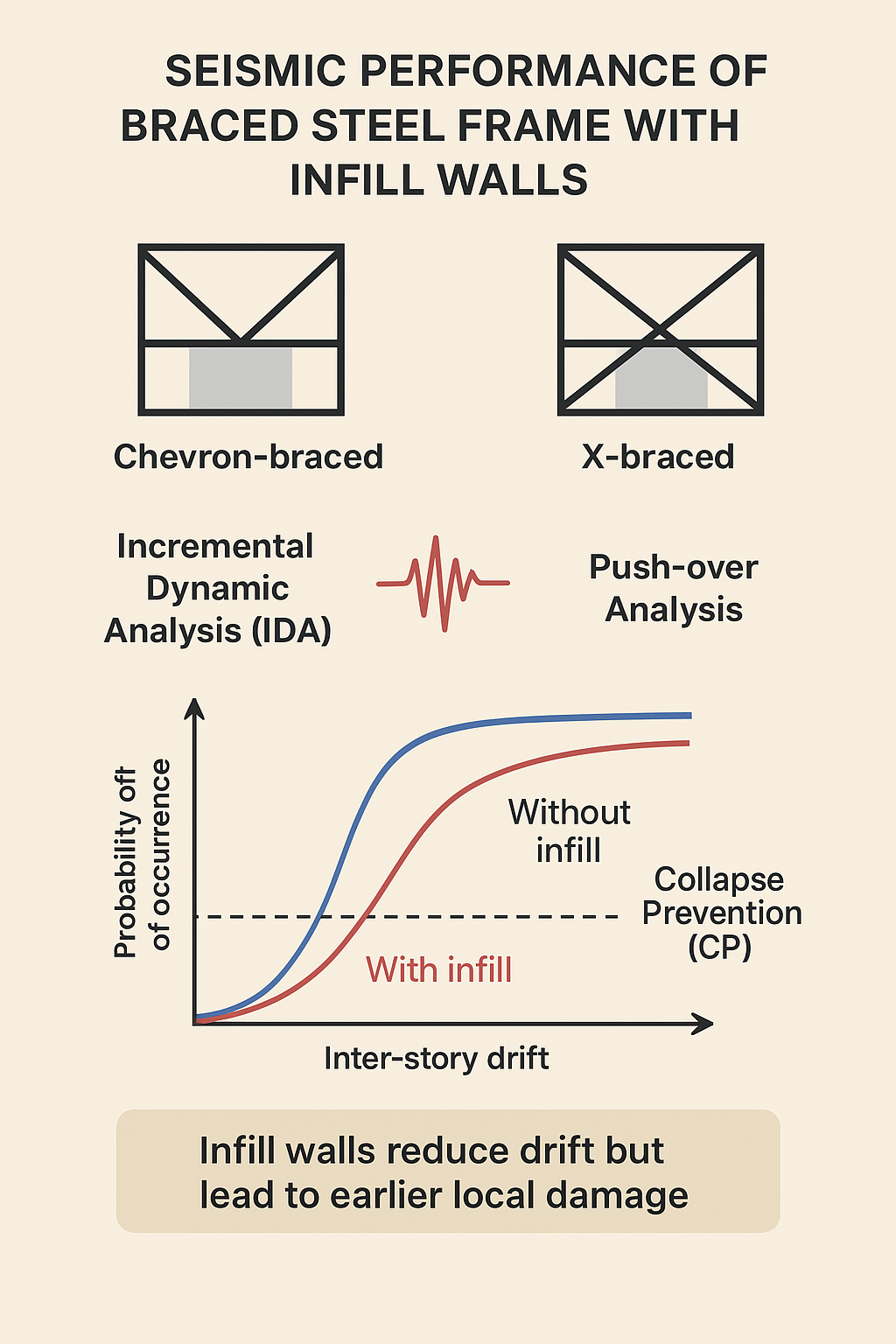
The use of bracing frames to resist lateral forces in high seismic regions is essential, as earthquakes can cause severe structural damage and loss of life. This study investigates the interaction between chevron and X-braced steel frames and infill walls, focusing on their seismic fragility. The main objective is to develop and assess fragility curves for twelve two-dimensional structural models subjected to seismic loading. Incremental Dynamic Analysis (IDA) and Push-over Analysis were employed using fifteen ground motion records in SAP2000 to evaluate failure modes, inter-story drift demands, and fragility behavior for models with and without infill walls. Results from the pushover analysis indicate that in concentric braced frames, the initial damage state appears earlier in models with infill walls, while frames without infill experience this state at higher drift levels. Conversely, IDA results reveal that frames without infill walls exhibit greater inter-story drift demands and higher overall capacity than those with infill walls. This suggests that while infill walls contribute to stiffness and reduce drift, they also lead to earlier onset of local damage. Fragility curves developed through statistical analysis demonstrate that two- and three-story frames without infill have a higher probability of reaching the Collapse Prevention (CP) performance level compared to those with infill. However, for taller frames (four to seven stories), the opposite trend is observed. These findings emphasize the complex influence of infill walls on the seismic performance of braced steel structures and provide valuable insights for safer structural design in earthquake-prone regions.
References
[1] R. A. Jazany, I. Hajirasouliha, and H. Farshchi, “Influence of masonry infill on the seismic performance of concentrically braced frames,” J Constr Steel Res, Vol. 88, pp. 150–163, 2013, doi: 10.1016/j.jcsr.2013.05.009.
[2] D. G. Lignos and E. Karamanci, “Drift-based and dual-parameter fragility curves for concentrically braced frames in seismic regions,” J Constr Steel Res, Vol. 90, pp. 209–220, 2013, doi: 10.1016/j.jcsr.2013.07.034.
[3] M. Hassan, N. Sipcic, and G. Vasdravellis, “Seismic performance evaluation of high-post-yield stiffness concentrically braced steel frames under mainshock-consistent-aftershock sequences,” Earthq Eng Struct Dyn, Vol. 52, No. 7, pp. 2222–2250, Jun. 2023, doi: 10.1002/EQE.3880.
[4] Ali Mohammadgholipour and AHM Muntasir Billah, “Performance-based plastic design and seismic fragility assessment for chevron braced steel frames considering aftershock effects,” Soil Dynamics and Earthquake Engineering, Vol. 178, Mar. 2024.
[5] Adil Emre Özel and Esra Mete Güneyisi, “Effects of eccentric steel bracing systems on seismic fragility curves of mid-rise R/C buildings: A case study,” Structural Safety, Vol. 33, No. 1, pp. 82–95, Jan. 2011.
[6] Cheng Fang, Boyan Ping, Yue Zheng, Yiwei Ping, and Hao Ling, “Seismic fragility and loss estimation of self-centering steel braced frames under mainshock-aftershock sequences,” Journal of Building Engineering, Vol. 73, Aug. 2023.
[7] Muhammad Shoaib Khan, Abdul Basit, Muhammad Rizwan, and Naveed Ahmad, “Seismic fragility functions for RC As-built and eccentric steel brace frames,” Structures, Vol. 50, pp. 1338–1352, Apr. 2023.
[8] Mojtaba Gorji Azandariani, Ali Gorji Azandariani, Ali Mohammad Rousta, and Hamid Malek Nia, “Seismic fragility assessment of reinforced concrete moment frames retrofitted with strongback braced system,” Results in Engineering, Vol. 20, Dec. 2023.
[9] Maryam Behrangfar, Mohsen Gerami, and Mehrsa Mirzahosseini, “The effect of the ground motion frequency content on seismic performance and fragility curve of special concentric braced frames,” Structures, Vol. 57, Nov. 2023.
[10] Mahmoud Faytarouni, Onur Seker, Bulent Akbas, and Jay Shen, “Seismic assessment of ductile concentrically braced frames with HSS bracings,” Eng Struct, Vol. 191, pp. 401–416, Jul. 2019.
[11] Dimitrios G. Lignos and Emre Karamanci, “Drift-based and dual-parameter fragility curves for concentrically braced frames in seismic regions,” J Constr Steel Res, Vol. 90, pp. 209–220, Nov. 2013.
[12] M.R. Banihashemi, A.R. Mirzagoltabar, and H.R. Tavakoli, “Reliability and fragility curve assessment of steel concentrically braced frames,” European Journal of Environmental and Civil Engineering, Vol. 20, No. 7, pp. 748–770, Jul. 2016.
[13] Charles W. Roeder, Eric J. Lumpkin, and Dawn E. Lehman, “Seismic Performance Assessment of Concentrically Braced Steel Frames,” Earthquake Spectra, Vol. 28, No. 2, May 2012.
[14] Pramesta Praba Sumedi, Senot Sangadji, and Halwan Alfisa Saifullah, “The fragility curve of low-to-mid-rise steel frame buildings retrofitted with inverted V-bracing ,” AIP Conf Proc, Vol. 2696, No. 1, Aug. 2023.
[15] R. Yahyapour and S. M. Seyedpoor, “Comparing the Seismic Behavior of Various Knee Braced Steel Frames Based on Incremental Dynamic Analysis and Development of Fragility Curves,” International Journal of Steel Structures, Vol. 21, pp. 1228–1241, Jun. 2021.
[16] F. Mazza, “In-plane and out-of-plane nonlinear seismic response of masonry infills for hospitals retrofitted with hysteretic damped braces,” Soil Dynamics and Earthquake Engineering, Vol. 148, Sep. 2021, doi: 10.1016/j.soildyn.2021.106803.
[17] A. Jalaeefar and A. Zargar, “Effect of infill walls on behavior of reinforced concrete special moment frames under seismic sequences,” Structures, Vol. 28, pp. 766–773, Dec. 2020, doi: 10.1016/j.istruc.2020.09.029.
[18] Jinkoo Kim and Hyunhoon Choi, “Response modification factors of chevron-braced frames,” Eng Struct, Vol. 27, Dec. 2004.
[19] Nicola Caterino, Iunio Iervolino, Gaetano Manfredi, and Edoardo Cosenza, “Multi-Criteria Decision Making for Seismic Retrofitting of RC Structures,” Journal of Earthquake Engineering, Vol. 12, No. 4, May 2008.
[20] W. K. Tso, T. J. Zhu, and A. C. Heidebrecht, “Engineering implication of ground motion A/V ratio,” 1992.
[21] Seismic Evaluation and Retrofit of Existing Buildings. Reston, VA: American Society of Civil Engineers, 2017. DOI:10.1061/9780784414859.
[22] M. E. and B. R. E. M. E. Y. K. Wen, “The Role of Fragility Assessment in Consequence-Based Engineering,” Saga Journal, Vol. 21, No. 3, Aug. 2005.
Downloads
Published
Issue
Section
License
Copyright of articles that appear in Jurnal Teknologi belongs exclusively to Penerbit Universiti Teknologi Malaysia (Penerbit UTM Press). This copyright covers the rights to reproduce the article, including reprints, electronic reproductions, or any other reproductions of similar nature.